Imagine this…
There’s a child. No screen time limits, no “my battery is at 5%” panic… yet they’re having the time of their life. Why? Because they possess a magical power: imagination.
And what we call a toy is simply the physical expression of that power.
But this story didn’t start with “let’s invent toys.”
This is the history of humanity refusing to tolerate boredom 😄
🏺 The Birth of Toys: The First Human Who Said “I’m Bored”
Toys don’t belong to a single inventor. This is a collective “boredom revolution.”
Archaeological findings tell us this:
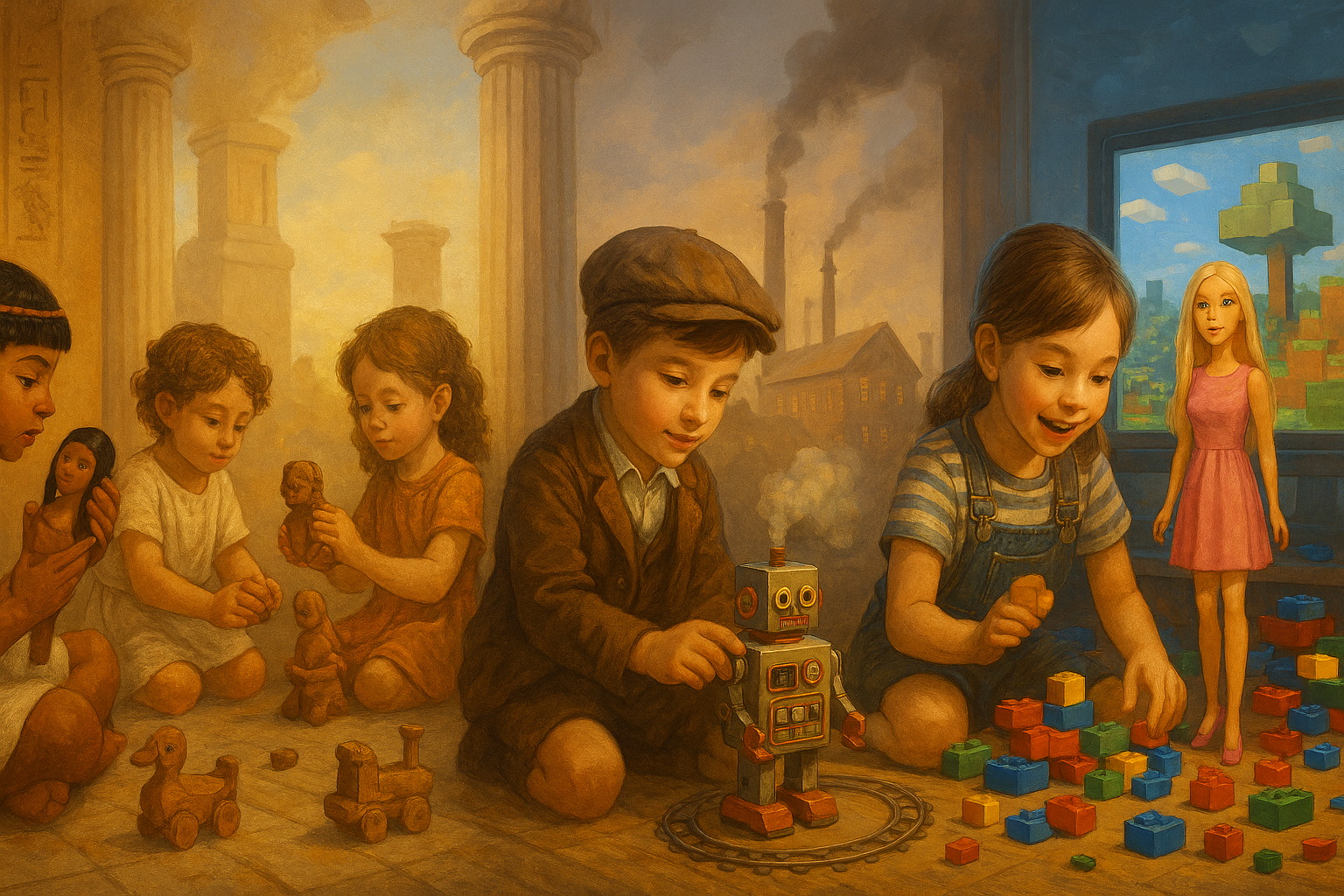
In Ancient Egypt, children played with small wooden dolls.
Some of these dolls even had movable limbs — basically the ancestors of today’s action figures!
Children in Ancient Greece:
Played with clay balls
Built small carts
Created “farming simulations” with animal figures 😄
👉 Fun fact: Back then, toys weren’t just for fun — they were tools for teaching social roles.
Dolls for girls → learning motherhood
Carts/weapons for boys → learning to be warriors
So toys = the first “life simulation”
⚙️ How Toys Evolved: From Stone to Technology
The earliest toys came straight from nature:
Stone = ball
Stick = sword
Bone = figure
Then humans said:
“I can upgrade this.”
And with the Industrial Revolution, things got serious.
🏭 The Change Brought by the Industrial Revolution
Mass production began
Toys became cheaper
More children had access to them
Now toys were no longer just for the wealthy —
👉 they became accessible to everyone.
🧠 What Do Toys Actually Do? (Scientific but Fun)
Let’s be honest…
Toys are not just distractions. They’re basically a mini education system.
🎓 Hidden Superpowers of Toys:
1. Brain Development
Puzzles and building toys improve problem-solving skills
2. Social Intelligence
Dolls → empathy
Role-playing games → understanding social roles
3. Motor Skills
Small pieces → better hand-eye coordination
4. Emotional Development
Toys = a child’s therapy room
Sadness, fear, happiness → expressed through play
👉 In short: A toy is a child’s first teacher + psychologist + best friend
👤 The People Who Transformed the Toy World
Even though toys weren’t invented by one person, some individuals took them to the next level.
🧱 Ole Kirk Christiansen – “From Wood to an Empire”
A Danish carpenter
Started with wooden toys
Revolutionized the industry with plastic bricks
The meaning of LEGO:
👉 “Play well”
But in reality:
👉 “Build your own world”
👗 Ruth Handler – The Fashion Designer of Imagination
She noticed her daughter playing with paper dolls
But her daughter imagined being an adult
And Barbie was born.
👉 Barbie isn’t just a toy,
it’s the physical form of the question:
“What will I be when I grow up?”
🧸 Modern Toys: Children of the Digital Age
Today, toys are no longer just physical.
LEGO → still on top
Barbie → a cultural icon
Minecraft → unlimited imagination
👉 Minecraft is basically a digital toy:
“Do whatever you want. No one interferes.”
💡 Benefits of Toys
✔ Boost creativity
→ A box of LEGO = infinite possibilities
✔ Teach problem-solving
→ “Why doesn’t this piece fit?”
✔ Build patience
→ A 1000-piece puzzle = patience test 😄
✔ Encourage independent thinking
→ Children create their own worlds
✔ Reduce stress
→ Yes, even for adults
(There are more adult LEGO fans than you think 👀)
🧠 Practical Tips (Golden Advice)
👉 When choosing toys for a child:
Choose fewer but more creative toys
Too many toys = less imagination
👉 The best toys:
Open-ended (LEGO, blocks, sand)
Not forcing a single “correct” way
👉 Screen vs toys:
Digital games aren’t bad
But physical toys = real-world experience
👉 For adults:
Feeling stressed? Go buy some LEGO 😄
It actually works.
🌍 The Importance of Toys: Small Thing, Big Impact
Toys:
Carry culture
Teach
Inspire imagination
By looking at a child’s toy, you can understand the era they live in:
Stone toys → nature
Plastic toys → industry
Digital games → technology age
🎈 Conclusion: Toys = The Miniature Story of Humanity
Toys are not small things.
They are humanity in its purest form.
In a child’s hands:
A box of LEGO becomes a city
A doll becomes a life
A game becomes a world
And the most beautiful truth is:
👉 As we grow up, toys change…
But our need to play never does.
Maybe that’s why:
When adults play, we call it a “hobby” 😄