Imagine a world where doctors do not just treat diseases after they appear, but can actually repair the genetic mistakes that cause them. A world where a baby born with a serious inherited disease has a chance for a healthy life because scientists can edit the instructions inside their cells. A world where medicine is designed specifically for you — based on your unique DNA.
This is no longer just a science fiction idea. Thanks to revolutionary technologies like CRISPR gene editing, modern genetics is entering one of the most exciting eras in human history. 🧬✨
Genetic engineering is changing the way we understand life, disease, and the future of healthcare. But with these incredible possibilities come important questions: How far should humans go in changing our own biology? Should we edit human genes? And what will the future of evolution look like?
Let’s explore the fascinating world of DNA science.
🧬 DNA: The Instruction Manual of Life
Every cell in your body contains DNA — a biological instruction system that tells your body how to grow, function, and repair itself.
Think of DNA as a huge computer program. 💻🧬
Genes are like individual lines of code.
DNA mutations are like errors in that code.
Genetic diseases happen when important instructions are damaged.
Scientists have discovered that many diseases are connected to genetic changes, including:
🩸 Sickle cell disease
🧬 Cystic fibrosis
👁️ Certain inherited eye disorders
🧠 Some neurological conditions
🎗️ Increased risk of certain cancers
For decades, doctors could only manage many of these conditions. Today, scientists are working toward something much more powerful:
Fixing the genetic cause itself.
✂️ CRISPR: The Revolutionary Gene Editing Tool
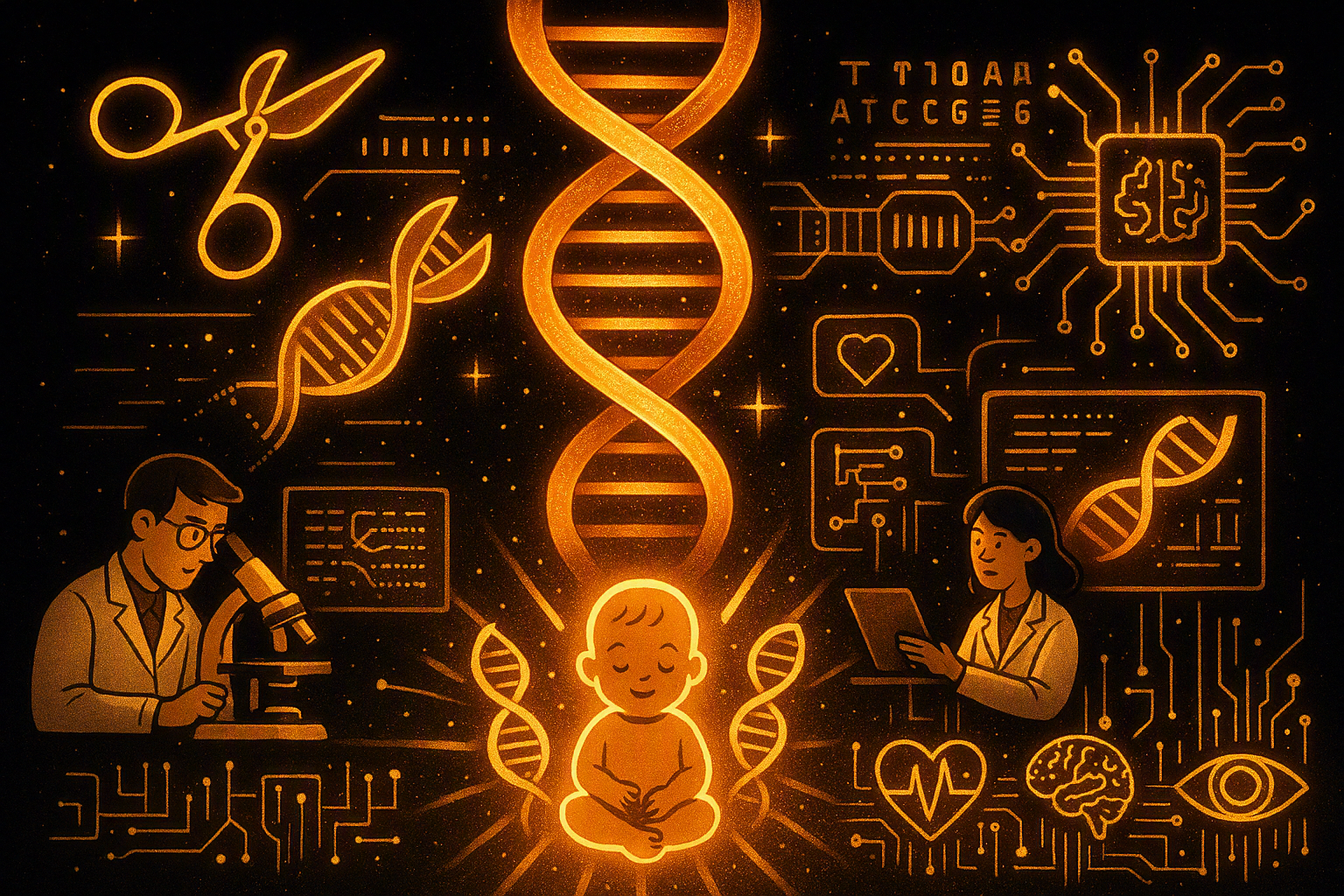
One of the biggest scientific breakthroughs of the 21st century is CRISPR-Cas9, often described as a “genetic scissors.”
But how does it work?
Imagine your DNA is a massive book containing billions of letters. If one sentence contains a mistake, CRISPR allows scientists to:
Find the incorrect DNA sequence 🔍
Cut the problematic section ✂️
Replace or repair the genetic information 🧬
This technology gives researchers the ability to edit DNA with incredible precision.
CRISPR was inspired by a natural defense system found in bacteria. Scientists discovered that bacteria use CRISPR-like mechanisms to remember and fight viral infections.
Today, researchers are adapting this natural system to solve human health problems.
🩺 Genetic Diseases: From Treatment to Possible Cures
For many years, genetic diseases were considered extremely difficult to treat because the problem existed inside a person’s DNA.
Now, gene therapy and gene editing are opening new doors.
🩸 Sickle Cell Disease
Sickle cell disease is caused by a mutation affecting hemoglobin, a protein responsible for carrying oxygen in blood.
Scientists have developed gene-based treatments that can modify a patient’s own blood cells and help them produce healthier hemoglobin.
This represents a major shift:
Old approach: Treat symptoms
New approach: Target the genetic cause
👁️ Genetic Vision Disorders
Some inherited eye diseases happen because specific genes do not work correctly.
Researchers are exploring gene therapies that deliver corrected genetic instructions directly to eye cells.
The goal?
Helping patients regain or preserve vision.
🎗️ Cancer and Genetic Medicine
Cancer is also connected to genetic changes.
Scientists are developing personalized cancer treatments that analyze the DNA of tumors and create therapies designed specifically for each patient.
Instead of asking:
“Which medicine works for most people?”
Future medicine may ask:
“Which medicine works best for this person’s biology?”
🧪 Personalized Medicine: Healthcare Designed for You
Imagine visiting a doctor and receiving a treatment plan based on your DNA, lifestyle, and personal health risks.
This is the promise of personalized medicine.
Traditional medicine often follows a general approach:
➡️ Same medication
➡️ Same dosage
➡️ Similar treatment plan
But humans are genetically different.
Two people can take the same medicine and have completely different results because their bodies process drugs differently.
Personalized medicine uses:
🧬 Genetic information
📊 Health data
🤖 Artificial intelligence analysis
🔬 Advanced laboratory testing
to create more accurate treatments.
🤖 AI and Genetics: A Powerful Scientific Partnership
The future of genetic medicine is not only about biology. Artificial intelligence is becoming a major partner in DNA research.
AI can help scientists:
🔍 Analyze enormous genetic databases
🧬 Predict how DNA mutations affect health
💊 Discover new medicines faster
🧠 Understand complex biological systems
Human DNA contains approximately 3 billion DNA base pairs, creating an enormous amount of information.
AI helps researchers find patterns that would take humans decades to discover.
The combination of:
🧬 Genetics + 🤖 Artificial Intelligence + 🔬 Biotechnology
could become one of the most powerful scientific collaborations in history.
⚖️ The Ethical Questions Behind DNA Modification
With great scientific power comes great responsibility.
Genetic engineering creates important ethical debates.
Should Humans Edit Future Generations?
There is a major difference between:
Somatic Gene Editing
Changes made to a person’s own cells.
Example:
Treating an adult with a genetic disease
These changes usually do not pass to children.
Germline Editing
Changes made to embryos or reproductive cells.
These changes could be inherited by future generations.
This creates difficult questions:
❓ Should parents be allowed to choose certain genetic traits?
❓ Could gene editing increase inequality?
❓ Who decides what is considered a “better” human?
Science can provide the tools, but society must decide how those tools should be used.
👶 Designer Babies: Science Fiction or Future Reality?
The idea of “designer babies” often appears in movies and books.
It refers to selecting or modifying genes for certain characteristics, such as:
Physical appearance
Intelligence
Athletic ability
Disease resistance
However, human traits are extremely complex.
Intelligence, personality, and abilities are influenced by thousands of genes combined with environment and experiences.
Creating a “perfect human” is far more complicated than changing a single DNA sequence.
🌍 The Future of Human Evolution
For millions of years, human evolution happened naturally through mutation and environmental adaptation.
Now, humans may gain the ability to influence their own biological future.
Future possibilities may include:
🚀 Humans better adapted for space travel
🧬 Resistance against certain diseases
🧠 Improved understanding of brain-related conditions
🩺 Longer and healthier lives
Some scientists believe genetic engineering could eventually become a new chapter in human evolution.
But the biggest challenge will not only be scientific.
It will be deciding:
What kind of future do we want to create?
🌱 Practical Things You Can Do Today: Understanding Your Own Genetics
You do not need to be a scientist to benefit from genetic knowledge.
Here are simple ways to become more aware of your genetic health:
✅ Learn your family health history
Knowing diseases that run in your family can help you make better health decisions.
✅ Follow advances in medical science
Genetic medicine is developing rapidly, and new treatments are constantly emerging.
✅ Support healthy DNA through lifestyle choices
While you cannot change your genes completely, your lifestyle influences how your genes function.
Important habits include:
🥗 Balanced nutrition
🏃 Regular exercise
😴 Quality sleep
🚭 Avoiding harmful substances
🧘 Managing chronic stress
Your genes are your starting point, but your lifestyle plays an important role.
🔮 Final Thoughts: Are We Entering a New Genetic Age?
Human DNA is no longer a mysterious code that scientists can only observe.
We are learning how to read it, understand it, and even edit it.
CRISPR, personalized medicine, and AI-powered genetics are transforming healthcare and creating possibilities that previous generations could only imagine.
The future of medicine may not be about fighting diseases after they happen.
It may be about preventing them before they begin.
The story of human DNA is still being written — and for the first time, humanity has the tools to hold the pen. 🧬✨
The future of medicine is not only about living longer. It is about understanding life at its most fundamental level. 🌍🔬