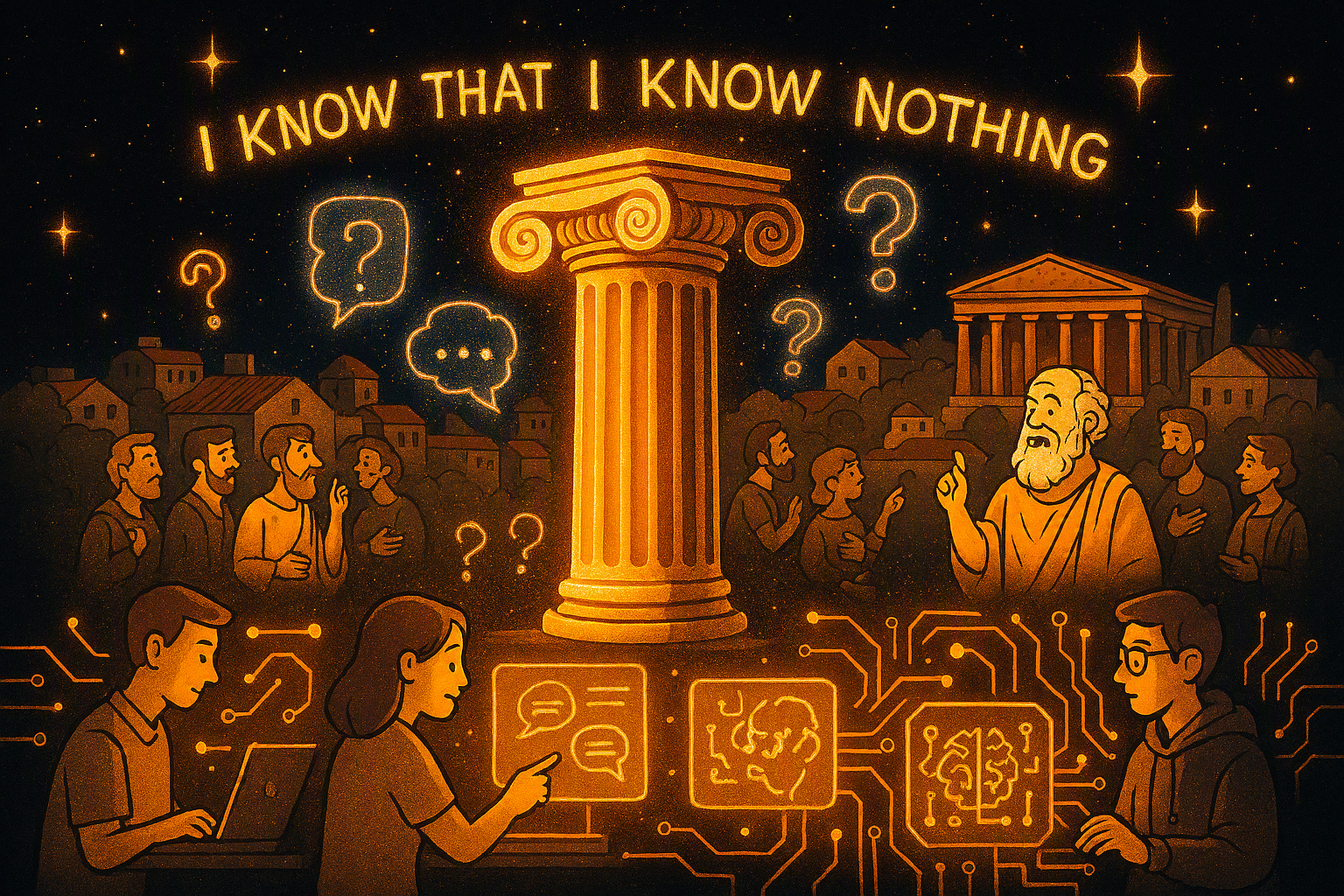
More than 2,400 years ago, in the crowded streets of ancient Athens, Greece 🇬🇷, a unique man walked among ordinary people asking simple but powerful questions.
He did not build magnificent temples 🏛️, write famous books 📚, or create a traditional school 🎓. He had no official title, no desire for wealth 💰, and no interest in fame ⭐.
Yet, his ideas completely transformed the way humans think.
His name was Socrates 🧔♂️, and he became one of the most influential philosophers in human history 🌍.
Today, when we talk about:
🧠 Critical thinking
💬 Meaningful conversations
🎓 Modern education
⚖️ Ethics and morality
🔍 Searching for truth
we are continuing a journey that Socrates started thousands of years ago.
His famous questioning technique is still used today in:
🏫 Universities
💼 Leadership training
🧑🏫 Education systems
🤖 Artificial intelligence research
But who was this mysterious philosopher? Why do his ideas still influence the modern world? 🌎
👤🏛️ The Life of Socrates: A Philosopher Among the People
Socrates was born around 470 BCE in Athens, Greece 🇬🇷, during one of the most fascinating periods of ancient history.
Athens was experiencing a golden age ✨ filled with:
🎭 Art
🏛️ Democracy
🔬 Science
📖 Literature
💡 Philosophy
His father, Sophroniscus, was a stonemason and sculptor 🪨, while his mother, Phaenarete, was a midwife 👩⚕️.
Interestingly, Socrates compared his own philosophy to his mother’s profession.
Just as a midwife helps bring a baby into the world 👶, Socrates believed he helped people “give birth” to knowledge and ideas 💡.
Unlike many wealthy thinkers of his time, Socrates lived a simple life:
👣 He often walked barefoot
👕 He wore simple clothes
🗣️ He spent his days talking with people
He was not interested in money 💰 or political power 👑.
His mission was simple:
✨ Help people understand themselves and search for truth.
🌍🏺 Athens: The World That Shaped Socrates
To understand Socrates, we must understand ancient Athens.
Athens was the birthplace of democracy 🏛️, where citizens gathered to discuss:
⚖️ Laws
🛡️ Wars
👥 Society
💭 Ideas
During this time, professional teachers called Sophists traveled around Greece teaching people how to argue and persuade.
Socrates had a different vision.
For him:
❌ Philosophy was not about winning arguments.
✅ Philosophy was about discovering truth.
One of his most famous ideas was:
“I know that I know nothing.”
This sentence represents intellectual humility 🧠.
Socrates believed that true wisdom begins when we accept that we still have much to learn 📚.
💬🔍 The Socratic Method: The Art of Asking Powerful Questions
The greatest contribution of Socrates is known as the:
🧠 Socratic Method
Instead of simply giving answers, Socrates asked questions ❓.
He believed that questions could reveal:
🔎 Hidden assumptions
🔎 Weak arguments
🔎 Contradictions in thinking
A typical Socratic conversation looked like this:
1️⃣ Asking a Question
Socrates might ask:
💭 “What is justice?”
💭 “What is courage?”
💭 “What is happiness?”
2️⃣ Examining the Answer
A person might say:
“Justice means helping friends and harming enemies.”
3️⃣ Challenging the Idea
Socrates would ask:
❓ “Is harming someone ever truly just?”
❓ “Can a good action create a bad result?”
Through this process, people discovered that their beliefs were sometimes incomplete.
His goal was not to embarrass people 😄.
His goal was to encourage deeper thinking 🌱.
📱🌐 Why Socrates’ Questioning Matters Today
The modern world is full of information:
📲 Social media
🤖 Artificial intelligence
📰 Online news
💻 Digital communication
But more information does not always mean more knowledge.
Socrates would probably ask:
❓ “Is this information true?”
❓ “Why do I believe this?”
❓ “What evidence supports this idea?”
❓ “Could another perspective exist?”
Today, critical thinking is one of the most valuable skills in the 21st century 🚀.
🧘♂️✨ Socrates’ Philosophy: The Search for a Better Life
For Socrates, philosophy was not only an academic subject 📚.
It was a way of living 🌱.
His famous statement:
“The unexamined life is not worth living.”
means that humans should constantly examine:
🧠 Their thoughts
❤️ Their values
🎯 Their goals
⚖️ Their decisions
Socrates believed that true success was not about:
💰 Wealth
🏆 Fame
👑 Status
It was about creating a good character.
⚖️💡 Socrates and Ethics: What Makes a Good Person?
A major part of Socrates’ philosophy was morality.
He asked:
❓ What is goodness?
❓ Why should people act morally?
❓ Can someone knowingly choose evil?
Socrates believed:
✨ A person who truly understands goodness will naturally choose good actions.
This connection between knowledge and virtue became one of the most important ideas in ethics.
📚🤔 Did Socrates Write Any Books?
One of the most fascinating facts about Socrates:
✍️ He never wrote any books.
Everything we know about him comes from his students and historical sources.
The most important source is:
👨🎓 Plato
Plato was Socrates’ most famous student.
Many of Plato’s dialogues feature Socrates as the main character.
Important works include:
📖 Apology – Socrates’ defense during his trial
📖 Crito – Justice and law
📖 Phaedo – His final days
📖 Symposium – Love and beauty
A fascinating question remains:
🤔 Are these truly Socrates’ words, or Plato’s interpretation of his teacher?
⚔️☠️ The Trial of Socrates: Choosing Truth Over Life
In 399 BCE, Socrates was put on trial in Athens.
He was accused of:
⚠️ Corrupting young people
⚠️ Rejecting traditional beliefs
He was sentenced to death.
However, Socrates refused to escape.
Why?
Because he believed that staying loyal to his principles was more important than saving his own life.
He drank a poison called:
☠️ Hemlock
His death became a symbol of:
🕊️ Courage
🧠 Intellectual freedom
🔥 Commitment to truth
🤩📌 Interesting Facts About Socrates
👣 1. He Was a Street Philosopher
Socrates did not teach in a university.
His classroom was:
🏛️ The marketplace
🚶 The streets of Athens
☕ Public conversations
⚔️ 2. He Was Also a Soldier
Socrates served in the Athenian army and was known for his bravery.
💬 3. He Changed Education Forever
Modern discussion-based education methods are inspired by his ideas.
🤖 4. His Ideas Influence AI Research
Today, questioning methods inspired by philosophy help researchers study:
🧠 Reasoning
💡 Knowledge
🤖 Machine intelligence
🎓🌍 Socrates’ Influence on Modern Education
Modern education focuses on:
✅ Asking questions
✅ Independent thinking
✅ Discussion
✅ Problem solving
These ideas are deeply connected to Socratic philosophy.
Many universities still use:
🎓 Socratic Seminars
where students discuss ideas instead of simply memorizing information.
🌟🏛️ The Legacy of Socrates: Why He Still Matters Today
Socrates was not remembered because he had all the answers.
He was remembered because he taught humanity how to ask better questions ❓.
In today’s world:
🌐 Information is everywhere.
📱 Opinions spread quickly.
🤖 Technology changes rapidly.
His message is still powerful:
✨ Think deeply. Question honestly. Search for truth.
More than two thousand years later, Socrates continues to challenge humanity:
“Are we truly thinking, or are we simply accepting what we are told?”
The greatest lesson from Socrates is:
🧠 A curious mind is the beginning of wisdom. 🌟