Some people smash guitars on stage,
others discover elements in the laboratory.
Humphry Davy belonged to the second group—but his impact was at least as electrifying as a rock concert.
If today:
we memorize element names in chemistry class,
people work more safely in mines,
and hearing electricity and chemistry in the same sentence feels normal,
know this: Humphry Davy is behind it.
🔬 Who Was Humphry Davy? (From a Modest Beginning to the Scientific Stage)
Humphry Davy was born in 1778 in England, into a modest family.
University career? ❌
A wealthy sponsor? ❌
But he had these:
Endless curiosity ✔️
The courage to experiment ✔️
The willingness to try without saying, “What if it explodes?” ✔️
He worked in a pharmacy when he was young.
That gave him:
🧪 The confidence to handle chemicals
🧠 An instinct for experimentation
✍️ The discipline of taking notes
Tip: Davy’s secret weapon was simple:
He wrote down every experiment.
It’s still the first habit recommended to scientists today.
⚗️ The Man Who Brought Chemistry to the Stage (Science’s Showman)
When Davy began teaching at the Royal Institution, no one expected this:
science that people would actually watch.
In his lectures he:
Performed explosive experiments 💥
Used light-emitting chemicals ✨
Left the audience (yes, an audience!) holding their breath 😮
For him, science was:
“Not just something to be told, but something to be shown.”
🎯 Practical Lesson:
If visual learning matters so much today, Davy was one of its early pioneers.
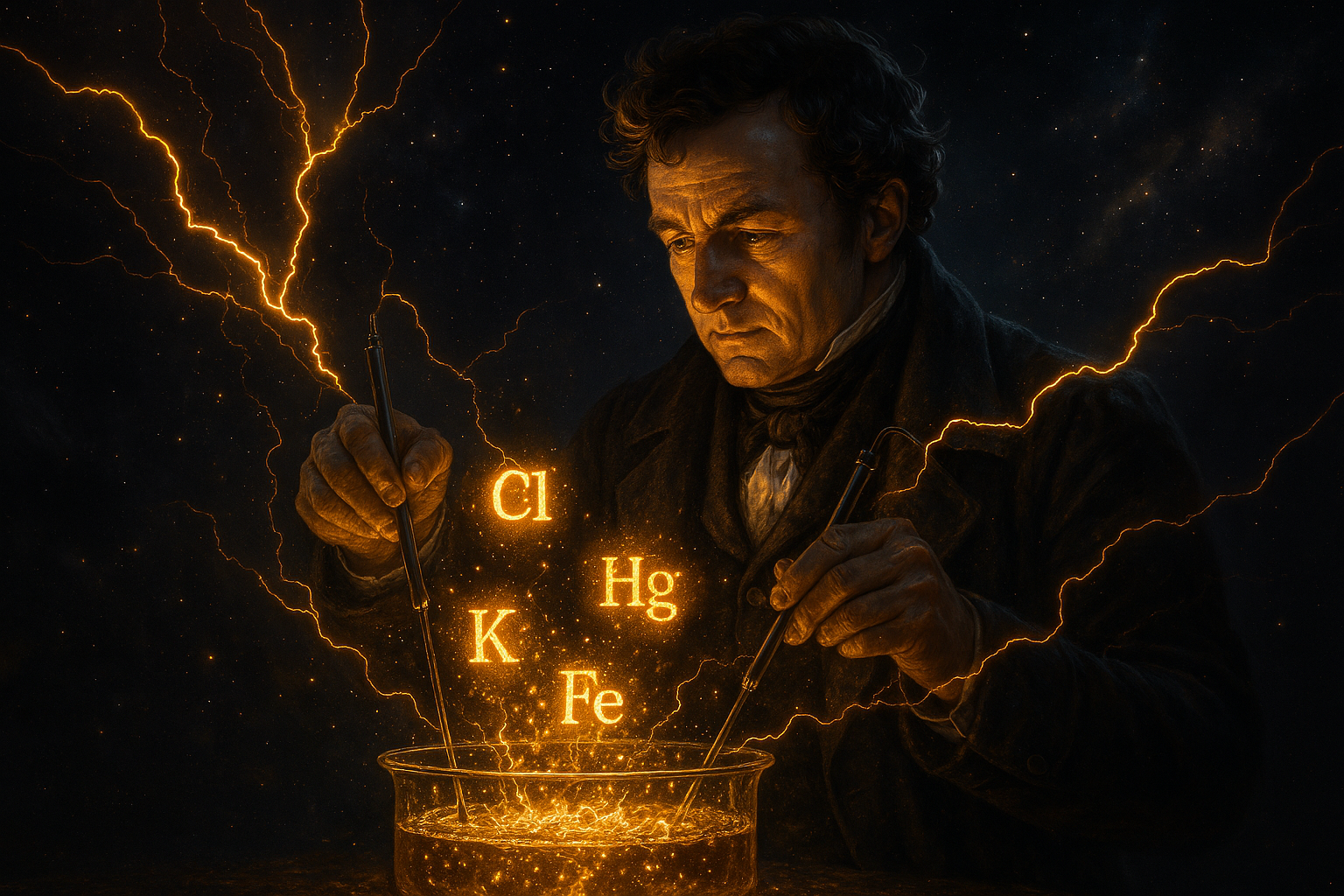
🔌 Hunting Elements with Electricity (A Level-Up Moment in Science)
Davy’s biggest scientific move was this:
Using electrolysis to discover elements.
Until then, people tried to separate substances by:
Heating
Crushing
Mixing
Davy said:
“Let’s try electricity.”
And—BAM! ⚡
He became the first to isolate:
Sodium
Potassium
Calcium
Magnesium
Barium
Strontium
🧠 Educational Note:
Thanks to these discoveries, the foundations were laid for:
Batteries
Fertilizers
Electrolyte balance in medicine
The metals industry
💡 The Safety Lamp: More Than Just a Lightbulb
What was the problem?
In the 1800s, mines were:
Filled with methane gas
Lit with open flames
Explosions were considered “fate”
What did Davy do?
He trapped the flame inside a wire mesh.
What did that achieve?
The flame couldn’t spread
Methane didn’t ignite
Light continued
People survived
💥 = ❌
💡 = ✅
🧠 What Does This Lamp Actually Do? (Technical but Clear)
How the Davy lamp works:
The wire mesh disperses heat
The flame’s temperature can’t reach outside
Flammable gas doesn’t ignite
🎯 Everyday Analogy:
It’s like putting a barbecue inside a glass dome.
The fire exists—but it doesn’t spread.
🌍 Impact on Humanity: The Era of “Safety First” Begins
Thanks to this invention:
Mining accidents dropped significantly
Awareness of workplace safety was born
The idea that “science protects human life” grew stronger
If today we have:
Helmets
Gas detectors
Emergency protocols
the Davy lamp is their ancestor.
👨🏫 Davy as a Mentor to a Genius
Another legendary side of Humphry Davy:
🎓 He was the mentor of Michael Faraday.
Faraday started out as:
A bookbinder
Outside scientific circles
But Davy recognized his talent and supported him.
📌 Life Lesson:
True geniuses don’t just discover—
they allow others to shine.
🧪 What Can We Learn from Humphry Davy Today?
Curiosity is stronger than diplomas
Don’t be afraid to experiment
Take notes
Share knowledge
Connect science to human life
And most importantly:
Science is not only a matter of intellect; it’s a matter of conscience.
🏁 Finale: The Quiet Hero of Science
Humphry Davy was:
Unafraid of explosions
The man who connected electricity and chemistry
A life-saver who protected thousands with a single lamp
A cape-less but legendary hero.
💡 The lamp in his hand illuminated
not only the mines,
but the path of science itself.