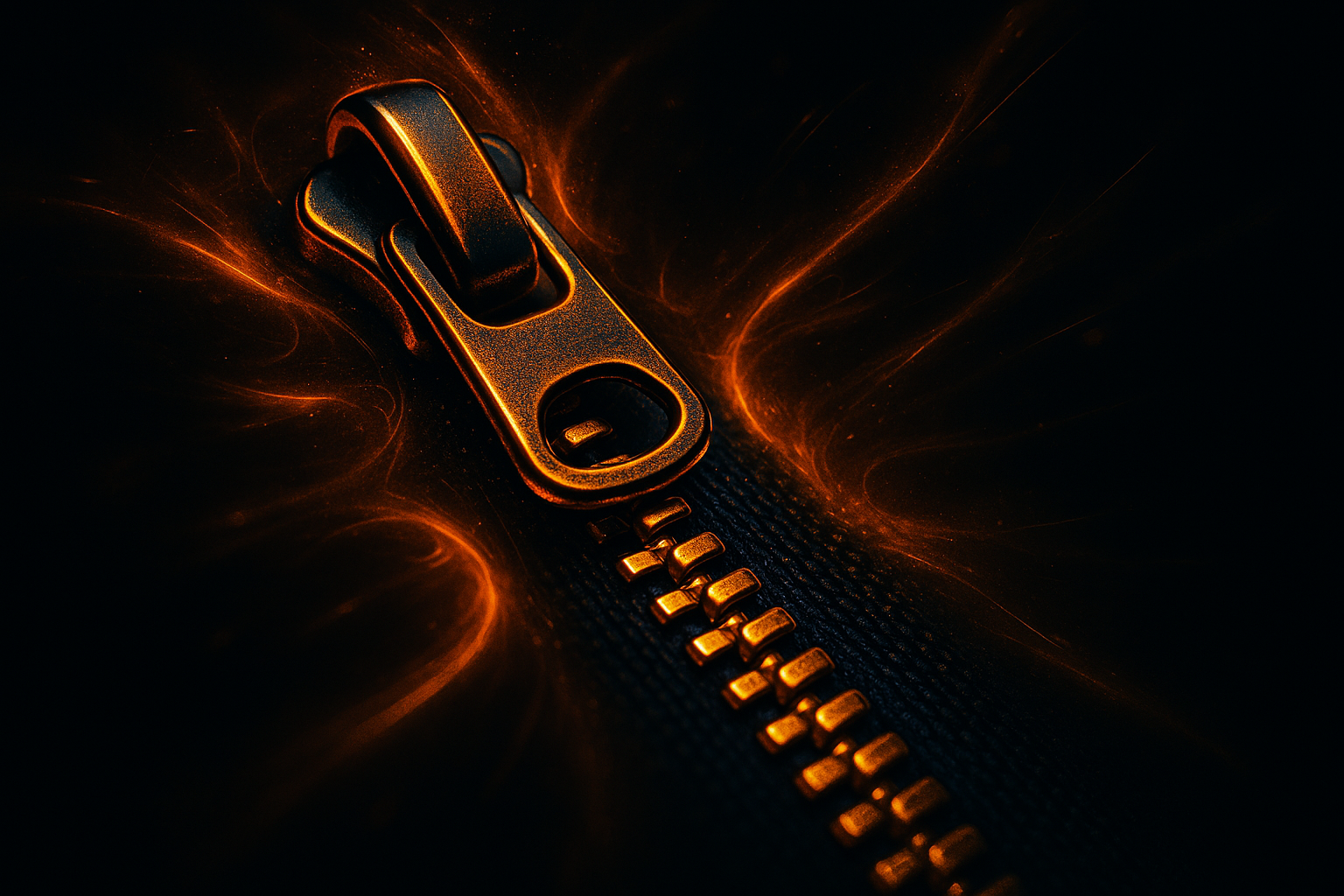
The zipper… It seems so ordinary in our daily lives that we often don’t even notice it. But just imagine: you wake up in the morning, and you have to fasten each button on your pants one by one ⏰😫. Ah, those precious minutes lost! This is exactly where the zipper comes into play, quietly yet profoundly revolutionizing the garment industry 💡👗.
So, how did this small yet functional invention come about? Who created it, how did it develop, and how did it become part of our lives? Let’s explore the fascinating journey of the zipper in detail 🔍🧵.
The First Ideas Behind the Zipper: Seeds of an Invention 🌱
The history of the zipper is older and more interesting than we might think ⏳. Its roots trace back to the mid-19th century. In 1851, American inventor Elias Howe 🧑🔬, known as the inventor of the modern sewing machine, received a patent for a mechanism called the “automatic fastening device” 📜. Howe’s goal was to fasten clothing and shoes more quickly 👞👚. However, Howe’s invention was mechanically complex and impractical for daily use ⚙️❌, so it did not achieve commercial success.
About 40 years later, in 1893, Whitcomb Judson 🧑🔧 introduced a shoe fastening device called the “clasp locker” at the Chicago World’s Fair 👟✨. Judson’s design can be considered the first prototype of the zipper. The mechanism consisted of small hooks that interlocked 🔗. However, the device often jammed, was impractical, and not suitable for mass production 🚫. At this point, the zipper still hadn’t reached its ideal form.
This is where Gideon Sundback comes in 👨🏭. Previous attempts were valuable in terms of ideas, but a reliable, fast, and durable zipper for everyday use did not yet exist. Sundback was the person to fill that gap 🏆.
Gideon Sundback: The Father of the Zipper 👑
Gideon Sundback was born in 1880 in Germany 🇩🇪 and emigrated to Canada at a young age 🇨🇦. He studied electrical engineering ⚡️ and later moved to the United States, where he worked in various engineering roles 🏭. Sundback was highly skilled in mechanical systems, especially in the precise assembly of small parts 🔧.
In 1913, Sundback improved Judson’s design and received a patent for the “Separable Fastener” 📝. Sundback’s invention forms the foundation of modern zippers 🏁. The key innovations were:
Metal teeth design: Small metal teeth interlocked to provide a secure closure 🔩✅.
Slider mechanism: Allowed the teeth to open and close easily 🏃♂️💨.
Durability and safety: Made it suitable for use in clothing and shoes 🛡️👕.
Sundback essentially designed the zipper’s “life-saving” and practical version, creating a revolution in fashion and industry 🌟.
The Zipper’s Early Uses and Popularization 👜👢
The zipper did not immediately become a miracle hit in the fashion world 🌎. At first, it was used in bags, shoes, and children’s clothing 👶🎒. However, by the 1920s and 1930s, the garment industry recognized the advantages of this fast and reliable fastening system 💃🕺.
In particular, the zipper revolutionized women’s fashion 👗✨. Imagine the 1920s, with tight dresses and corsets. Fastening buttons was both tedious and time-consuming ⏳❌. Thanks to the zipper, designers could create clothing that was both stylish and comfortable 🎨👚.
During World War II, the zipper was adopted for military uniforms 🪖. Its durability and quick fastening made it a major advantage in military apparel ⚡️. This helped solidify the zipper’s role in both civilian and military use 🏅.
With the widespread adoption of zippers, different types also emerged:
Metal zippers: Durable, commonly used in pants 👖🔩.
Plastic zippers: Lightweight, suitable for colorful designs 🌈🎽.
Waterproof zippers: Used in outdoor gear and bags 🌧️🎒.
The Zipper’s Impact on Our Lives 💡🛍️
Despite being a small mechanism, the zipper has made a huge difference in our lives. Its effects include:
Fashion and Design Freedom: Designers can now create tight-fitting, body-conscious clothing 👗✨. The zipper combines aesthetics and functionality 🧵💖.
Industrial Efficiency: In mass production, the tedious task of buttoning is eliminated ⚙️⏱️. Clothing can be produced faster and more cost-effectively 💰.
Practical Daily Use: We can open and close clothes and bags quickly 👜👟. Especially helpful for children’s clothing and sports gear 🏃♀️⚡️.
Military and Industrial Use: Durability and safety make zippers a preferred choice for uniforms, bags, and specialized equipment 🛡️🎖️.
Today, zippers are found everywhere—from jackets to bags, tents to shoes 🌍👕. Zipper technology has even been adapted for some automotive and engineering applications 🚗⚙️.
Conclusion: A Small but Powerful Invention 💪✨
At first glance, the zipper may seem like a simple detail, but it is a revolution at the intersection of history, engineering, and design 🏛️🔧👗. Thanks to the experiments of Elias Howe, Judson’s prototypes, and Sundback’s perfected mechanism, the zipper became part of our lives, fundamentally changing the garment industry 🌟.
The story of the zipper shows us that an invention, even if unnoticed at first, can become an indispensable part of life when the right person meets the right time ⏳💡. Next time you put on your pants or open your bag, take a moment to appreciate the story and engineering genius behind those tiny metal teeth 🧵🔩.
In short, the zipper is simple, practical, and small, yet it is an invention that changed the world 🌎💖.