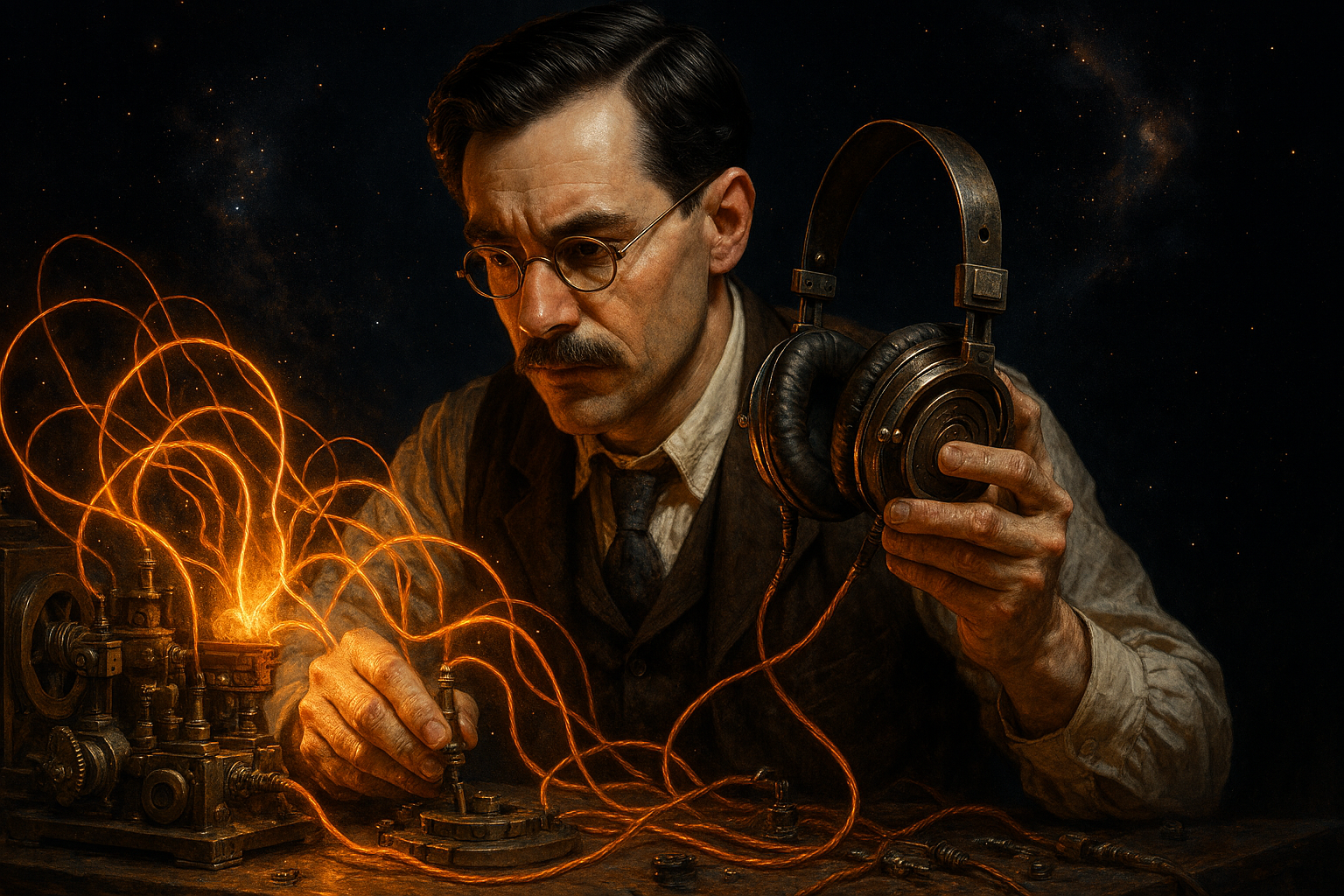
Imagine…
City noise, crowded streets, traffic… But the moment you put on a pair of headphones, you enter a completely different universe. It’s as if you’re stepping through an invisible door. The outside world fades away, your inner world opens.
This is exactly what headphones do:
They are a revolution that not only allows sound to be heard but also personalized.
But the story of this small device is far deeper, scientific, and surprisingly fascinating…
📞 A Need Born from Telephone Operators
The invention of headphones didn’t originate from a romantic music story—it was the result of a very “tiring” job.
At the end of the 19th century, when telephone systems were becoming widespread, communication relied entirely on human effort. Telephone operators had to physically connect incoming calls. Hundreds of calls a day…
👉 Constantly holding heavy telephone receivers
👉 Neck and arm pain
👉 Decreased efficiency
This was a serious ergonomic problem.
Enter the key figure:
Nathaniel Baldwin
In the 1910s, Baldwin developed a headset that freed operators’ hands. This was not merely a matter of comfort—it was a technological leap that increased communication speed and accuracy.
💡 From an academic perspective: This invention is one of the first examples of ergonomics in human-computer interaction.
🔬 How Headphones Work (The Science of Sound)
The inner workings of headphones are far more complex than they appear. But the explanation is quite fascinating.
You can think of a headphone as a tiny speaker—but much more precise.
Basic principle: Electromagnetic induction
Here’s how it works:
🎵 Music or sound arrives as a digital/electrical signal
This signal is sent to the coil in the headphone
A magnetic field is created
The diaphragm (a thin membrane) vibrates
These vibrations turn into sound waves in the air
The brain perceives them as “sound”
📌 In short: Headphones are essentially translators that convert electricity into emotions.
🎖️ From Military to Civilian Life: From Strategic Tool to Entertainment
One of the first major users of headphones was the U.S. Navy. Baldwin’s invention revolutionized radio communication.
Why was it important?
Clear communication in noisy environments
Privacy (not everyone could hear)
Rapid transmission of commands
Headphones were a strategic advantage on the battlefield.
Over time, however, the technology transitioned to civilian use. Radio broadcasting, studio recording, and telephone systems helped popularize headphones.
🎵 Revolution in the Music World: The Era of Personal Sound
In 1979, a product changed everything:
👉 Sony Walkman
With the Walkman:
Music became portable
People experienced music in their own personal world for the first time
Headphones transformed from a necessity into a lifestyle
🎧 Music was no longer a communal experience; it became a personal journey.
🌍 Societal and Cultural Impacts: A Quiet Revolution
The impact of headphones is not limited to technology—they changed society.
🧠 1. Psychological Effects
Reduces stress
Improves focus
Helps regulate emotions
🚶 2. Creating Personal Space
Headphones allowed people to be alone in a crowd.
They became the “escape mechanism” for modern city dwellers.
🎧 3. Identity and Style
Headphones became a fashion accessory:
Large headphones = professional / gamer
Small in-ear = minimal / modern
🎮 4. Digital Experience
They provided advantages in gaming, such as directional sound (footstep detection).
They personalized cinema and VR experiences.
🚀 Headphone Technology Today: The Smart Sound Era
Today, headphones are more than audio devices—they are mini computers.
Modern features:
🔊 Active Noise Cancellation (ANC)
📡 Bluetooth and wireless connectivity
🎤 AI-powered microphones
🌐 Spatial (3D) sound technology
Example:
👉 Apple AirPods
These devices:
Analyze ambient sound
Filter noise
Adjust audio according to user behavior
📌 At this point, headphones have become devices that “listen” as much as they play sound.
👤 The Inventor’s Story: Perseverance and Solitude
Nathaniel Baldwin had a classic “garage inventor” story.
Limited formal education
No laboratory
Conducted experiments at home
Initially rejected, he eventually gained recognition from the U.S. Navy.
📌 This story reminds us: Innovation doesn’t always come from big companies.
💡 Interesting and Lesser-Known Facts
The first headphones weighed nearly 1 kilogram 😅
Single-ear models were more common
Originally made for work, not music
The first stereo headphones appeared in the 1950s
🧠 Practical Tips: Using Headphones
Scientific recommendations:
🎧 Don’t exceed 60% of volume for long periods
⏱️ Take a break every 60 minutes
🧼 Regularly clean in-ear headphones
🔇 Use noise-canceling features (you can lower the volume safely)
🎯 CONCLUSION: A Small Device, a Big Transformation
Headphones are more than a piece of technology.
They are a tangible reflection of humanity’s:
Need for solitude
Desire for self-expression
Urge to escape noise
Today, when you put on headphones, you are essentially:
👉 Silencing the world and starting your own story.
And perhaps the best part is:
This revolution didn’t begin in large laboratories…
It began in a small kitchen.