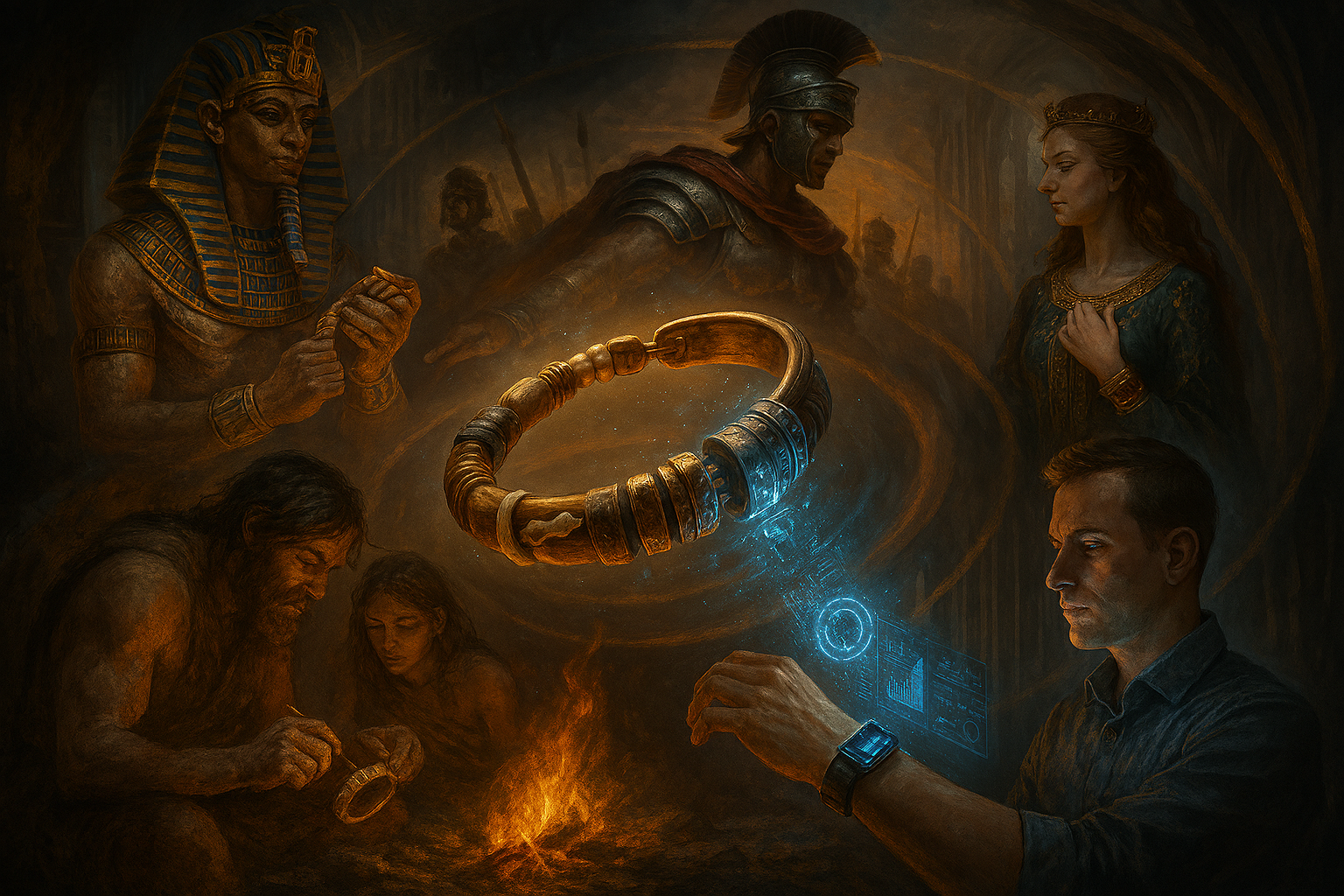
Think about it… In the morning, as you leave home, you put a small bracelet on your wrist. Maybe it’s a gold chain, maybe a leather design, or perhaps a colorful string bracelet woven by a childhood friend.
But what if I told you that behind that tiny accessory lies a human story thousands of years old?
Yes, a bracelet is not just jewelry.
It became a symbol of power
It was believed to offer magical protection
It represented friendship
It signaled wealth
And today, it even carries technology
In short, the bracelet is one of humanity’s aesthetic, cultural, and symbolic inventions.
And this story is quite extraordinary. It includes Stone Age hunters, pharaohs, Roman soldiers, queens, and modern technology.
So, let’s take a journey through time.
🪨 Stone Age: Humanity’s First Bracelet
The story of the bracelet dates back to around 5000–7000 BCE. Writing had not yet been invented, cities did not exist, and humans were mostly hunter-gatherers.
But there was something interesting:
People loved decorating themselves.
Archaeologists discovered jewelry made from stones and bones on the wrists of people in ancient settlements such as Çatalhöyük.
These early bracelets were usually made from:
Sea shells
Animal teeth
Bones
Stone beads
Plant fibers
If today’s jewelry designers saw them, they would probably say:
“Minimalist… but conceptually strong.” 😄
How Were the First Bracelets Made?
Stone Age people were surprisingly creative.
They used simple techniques:
1️⃣ Drilling holes into shells
2️⃣ Polishing stones
3️⃣ Making threads from animal sinew
4️⃣ Stringing beads together
And voilà! The first bracelet was born.
Why Did They Wear Bracelets?
It wasn’t just for decoration.
Research suggests bracelets served several purposes:
• Protective amulets
• Tribal identity
• Social status
• Symbol of hunting success
In a way, bracelets were the LinkedIn badges of the Stone Age.
🏺 Ancient Egypt: The Golden Age of Bracelets
Bracelets truly became an art form during the time of Ancient Egypt.
Egyptians absolutely loved jewelry.
And I mean really loved it.
From pharaohs to ordinary citizens, almost everyone wore jewelry.
Tombs of pharaohs provide incredible evidence of this.
One of the most famous examples is:
Tutankhamun
When his tomb was discovered in 1922, archaeologists made an astonishing discovery:
Hundreds of jewels and bracelets were found inside.
Egyptian Beliefs About Bracelets
Egyptians believed certain stones had magical powers.
For example:
• Lapis Lazuli → Divine protection
• Turquoise → Luck
• Gold → Eternity
That’s why bracelets were not only accessories but also spiritual tools.
An Interesting Fact
In ancient Egypt, some babies were given bracelets right after birth.
Why?
“To keep evil spirits away.”
In other words, the earliest baby bracelets were actually protective amulets.
⚔️ Ancient Greece and Rome: Symbols of Strength
Bracelets experienced another leap in popularity during the times of Ancient Greece and Ancient Rome.
But this time, it wasn’t just about beauty.
It was about power.
Roman soldiers sometimes wore metal bracelets.
These bracelets could symbolize:
Courage
Victory
Military rank
Some bracelets were designed in the shape of snakes.
Why?
Because the snake symbolized strength and rebirth.
Ancient Jewelry Craftsmanship
Jewelry craftsmanship was highly advanced even then.
Artisans used techniques such as:
• Wire wrapping
• Granulation
• Stone setting
This means the foundations of modern jewelry-making were laid over 2,000 years ago.
👑 The Middle Ages: Jewelry of Kings and Queens
During the Middle Ages, bracelets became somewhat exclusive accessories.
They were popular mainly among royalty and aristocrats.
In European royal courts, common designs included:
Gold bracelets
Gem-studded chains
Bracelets carrying family crests
But here’s the ironic part:
Fashion at the time favored long sleeves, so bracelets were often hidden.
People spent fortunes on jewelry… and no one could see it.
Fashion has always had its strange moments.
🏭 The Industrial Revolution: Bracelets for Everyone
In the 18th and 19th centuries, the Industrial Revolution transformed jewelry production.
With machine manufacturing:
• Jewelry became cheaper
• Mass production began
• The middle class gained access to jewelry
Suddenly bracelets were no longer just for royalty.
They became accessories for everyone.
Popular designs of the time included:
Chain bracelets
Charm bracelets
Lock bracelets
🧵 Friendship Bracelets: Small Object, Big Meaning
In the 20th century, string bracelets became popular among young people.
Friendship bracelets originated in Latin American culture and were made like this:
• Woven from colorful threads
• Tied onto a friend’s wrist
• A wish is made
• If the bracelet falls off naturally, the wish is believed to come true
A romantic and charming tradition.
⌚ The Technology Era: Smart Bracelets
Today, bracelets are no longer just jewelry.
They are technology devices.
Modern smart bracelets can:
• Measure heart rate
• Count steps
• Analyze sleep quality
• Track workouts
Bracelets that were once made from bone have now become mini computers.
Humanity has truly come a long way.
👤 So, Who Invented the Bracelet?
Here comes the most interesting part.
The bracelet does not have a single inventor.
It is a collective discovery of humanity.
Different cultures developed bracelets independently throughout history.
However, the earliest examples are believed to have appeared in Mesopotamia and Anatolia.
So the birthplace of the bracelet was most likely the civilizations of the Middle East and Anatolia.
🌍 Benefits and Cultural Importance of Bracelets
Bracelets are not just decorative items.
Throughout history they served many purposes.
Identity
Some tribes recognized their members through bracelets.
Protection
Amulets and charms were often attached to bracelets.
Status
They indicated wealth and social rank.
Memory
They symbolized friendship and love.
Health
Modern smart bracelets monitor health.
✨ A Small Accessory, A Huge Story
One day when you look at your wrist, you may only see a small piece of jewelry.
But that small circle has traveled through:
The Stone Age
Pharaohs
Roman soldiers
Queens and kings
The Industrial Revolution
before reaching you.
So a bracelet is not just an accessory.
It is a small summary of human history worn on the wrist.
And maybe that’s why it remains timeless.
Because some inventions…
don’t follow fashion.
They transcend time. ✨