Imagine a morning.
In front of you, there’s a river. On the other side, there is food, safety—maybe even a new life.
But there is water in between.
And a human can only swim so far.
Right at that moment, humanity thought:
“What if water isn’t an obstacle? What if it’s a road?”
And that thought changed the course of history. 🌊
🌊 1. The First Boat: From a Log to a Revolution
One of the oldest known boats, the Pesse Canoe, dates back to around 8000 BC. It was made simply by hollowing out a tree trunk.
Simple? Yes.
Unimportant? Absolutely not.
🔍 How Was It Made? (Practical Insight)
Early humans used this method:
A thick tree trunk was cut down.
The inside was softened by controlled burning.
Stone tools were used to hollow it out.
The bottom was sealed to make it more water-resistant.
This technique is still used today in making dugout canoes.
💡 Interesting Fact
For a boat not to sink, the weight of the water it displaces must be greater than its own weight.
This is known as Archimedes’ Principle.
Yes… early humans were applying physics long before physics had a name. 😄
🧠 2. Human Brain + Curiosity = Seafaring
The boat was not just a means of transportation.
It:
Made hunting easier
Started river trade
Increased communication between communities
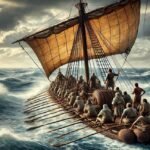
In Ancient Egypt, people used reed boats on the Nile River.
The Phoenicians built a powerful trade network across the Mediterranean.
The sea was no longer a terrifying unknown—it became a gateway to opportunity.
⚓ Practical Insight
Ancient boats included:
Wide hulls for stability
Rhythmic drums to synchronize rowing
Square sails to catch the wind
This was engineering + organization + observation of nature combined.
⛵ 3. The Age of Exploration: Courage Across the Ocean
In the 15th century, ships were no longer traveling only from coast to coast.
Christopher Columbus crossed the Atlantic in 1492.
The fleet of Ferdinand Magellan completed the first circumnavigation of the globe.
How did these ships endure such journeys?
🔧 Technical Details
Multi-layered wooden hulls
Waterproofing with tar
Lateen (triangular) sails to sail against the wind
Use of the astrolabe and compass
Humanity was no longer just floating—we were navigating.
🌍 The Result
Maps expanded.
Cultures mixed.
Trade became global.
The boat was no longer just a vehicle—it was a catalyst for a new era.
🔥 4. Steam Power: Saying Goodbye to the Wind
In 1807, Robert Fulton developed one of the first commercially successful steamboats.
No wind? No waiting.
There was now a machine.
⚙️ Advantages of the Steamboat
Consistent speed
Safer scheduling
Faster trade
Increased migration
Sea transportation became predictable.
And the Industrial Revolution moved onto the water.
🚢 5. Steel Giants and Modern Maritime Power
By the 20th century, wood gave way to steel.
Today:
Container ships carry thousands of containers
Oil tankers transport energy across continents
Cruise ships function like floating cities
📦 Interesting Fact
Around 80–90% of global trade is carried by sea.
So that online order you placed?
It probably traveled on a ship at some point. 😄
🧭 How a Boat Actually Works (Simple and Clear)
There are three main reasons a boat stays afloat:
Buoyant force (Archimedes’ Principle)
Large surface area
Balanced weight distribution
💡 Small Tip
When building a boat:
Keep the center of gravity low
Ensure symmetry in the hull
Use proper waterproof sealing
Even a small hole can create a big problem.
I won’t mention the Titanic… oh wait. 😅
🌍 What Boats Gave to Humanity
✔ Connection between continents
✔ Global economy
✔ Marine science and cartography
✔ Cultural exchange
✔ Fishing and seafood industries
Without boats, the world would be far more isolated.
🤯 An Unusual Perspective
The boat is actually a psychological revolution.
Humanity transformed this fear:
“If I fall into the water, I’ll die.”
into this courage:
“I will travel on top of the water.”
That mental leap laid the foundation for airplanes and spacecraft.
First, we crossed water.
Then, we crossed the sky.
Now, we explore space.
💛 Conclusion: From a Log to a Global Civilization
The boat is:
One of the first engineering achievements
One of the first tools of globalization
One of the earliest large-scale logistical solutions
And perhaps the most romantic invention in human history.
Because everything began when someone looked at the water and said:
“I will move forward on top of it.”
And if the sea still makes our hearts beat a little faster today…
It’s not just the view.
It’s that first spark of courage. 🌊🚤