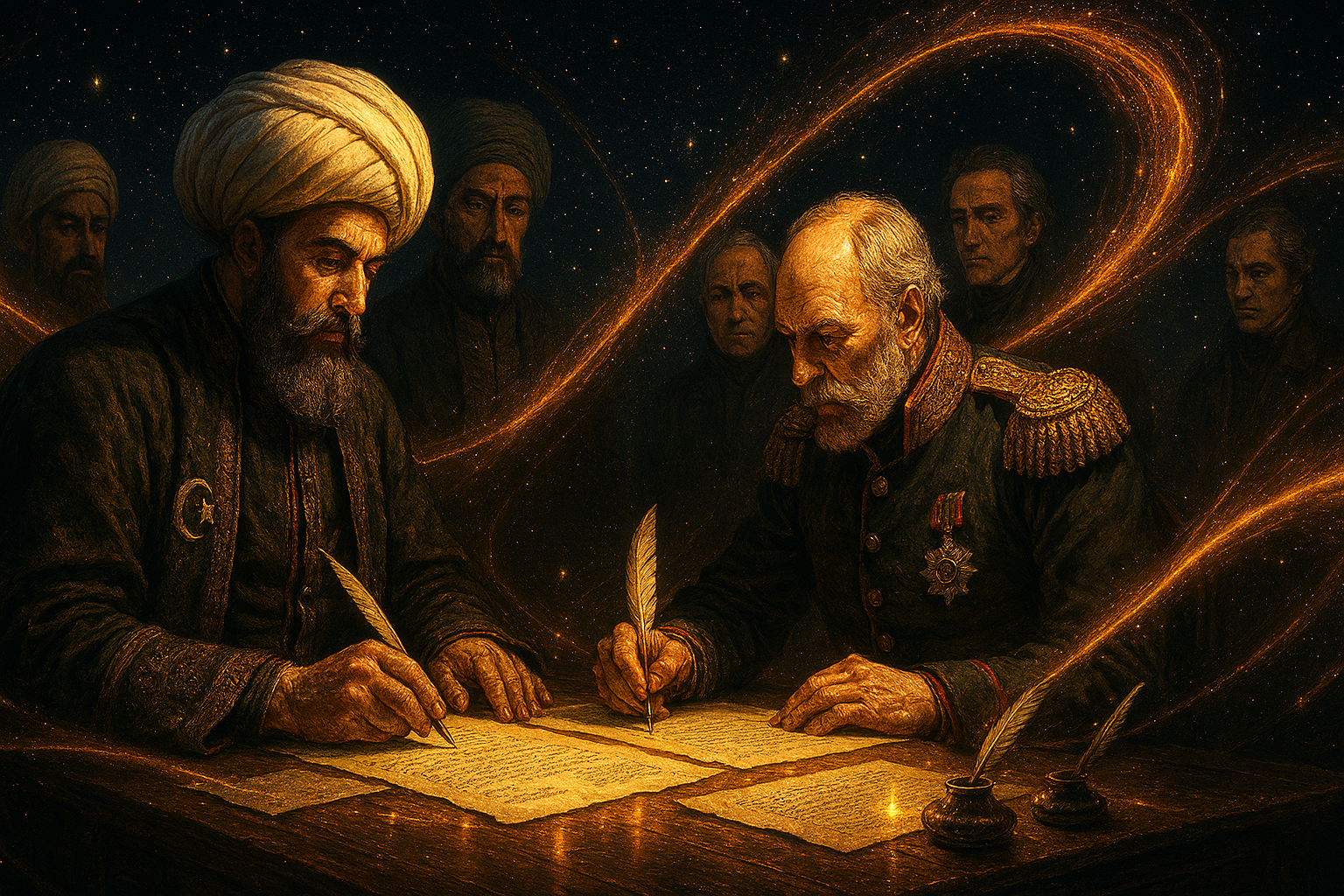
Ah, 1812… For historians, not just the year Napoleon burned Moscow. It was also the beginning of a period when pens spoke at the table and diplomatic wit triumphed over war between the Ottoman Empire and Russia. The Treaty of Bucharest wasn’t just about changing borders; it reflected the strategic moves of empires, the patience of diplomats, and sometimes, the helplessness of states.
🎭 The Scene of the Era: What Were the Ottomans and Russians Experiencing?
From 1806 to 1812, Ottoman-Russian relations could be summed up as a “war-diplomacy-war trilogy.” The Ottomans were watching Napoleon’s moves in Europe while trying to protect their own borders. Russia, on the other hand, was seeking opportunities to expand its northern borders and gain easier access to the Black Sea.
Ottoman situation: The empire faced economic difficulties, provincial uprisings, and a weakening central authority—basically a “we can’t manage work, fun, and borders all at once” scenario.
Russian situation: A strengthening empire, expanding territory, and desire to access the Black Sea—a classic “kill two birds with one stone” strategy.
Given this context, war was inevitable. After several years of conflict, the Ottomans were both militarily and economically exhausted. Russia, however, was determined and used its advantage of resolve to expand its borders.
✍️ Sitting at the Table in Bucharest: Treaty Details
In the summer of 1812, negotiators gathered in Bucharest. Pens were ready, diplomats opened their prepared notes, and the agreement was finally reached. Here are the details and practical points:
Bessarabia Transfers to Russia: This fertile and strategic land north of the Black Sea came under Russian control. The Ottomans became vulnerable in the northeast, and local populations faced a new administration.
Borders Clarified: The Dniester River was recognized as the border. Maps were now changing in Russia’s favor.
Trade and Transit Rights: Although the Ottomans sought to maintain trade rights in the Black Sea, Russia’s growing influence made it difficult, especially in the ports.
End of War: The war officially ended, but one could read the diplomats’ expressions as saying, “We’ll see each other next time.”
💡 Practical tip: The Treaty of Bucharest is often cited in history books as an example of “necessary compromise” to prevent prolonged conflict. Short-term it might look like a loss, but long-term it was a form of “damage control” for peace.
🌍 Effects of the Treaty and Its Historical Contribution
The Treaty of Bucharest was more than a land swap; its consequences were multi-dimensional and long-lasting:
Political Impact: The Ottomans’ weakening image became more evident in Europe. Russia strengthened its position in the Black Sea and expanded influence over the Balkans.
Economic Impact: Losing Bessarabia meant losing its agricultural potential. Merchants and farmers had to adjust to new taxes and administrative changes.
Military Impact: The Ottomans had to develop new defense strategies in the northeast. The Russian threat along the Black Sea coast became more prominent.
Social and Cultural Impact: Local populations were caught between two powers. New laws, taxes, and administrative changes raised the question: “Who’s the new boss?”
💡 Humorous observation: Learning to draw a map is easy; defending the borders is hard. The Ottomans painfully realized this in 1812. Russia, meanwhile, smiled with a “two birds, one stone: land and prestige” mentality.
🕰️ The Broader Historical Context
The Treaty of Bucharest affected not only Ottoman-Russian relations but also the balance of power in Europe:
While Napoleon shook Europe, the Ottomans struggled with their own borders.
Russia strengthened in the Black Sea and gained influence in the Balkans.
The Ottomans tried to maintain their position as a power “watching what’s happening in the West while protecting their borders.”
💡 Tip for history students: Evaluate the Treaty of Bucharest across three dimensions: territorial loss, diplomacy, and power balance. This makes understanding its significance easier.
🎯 Conclusion: Why It Matters
The Treaty of Bucharest was a turning point in Ottoman-Russian relations because:
Borders changed, and the balance of power shifted.
The Ottomans became strategically vulnerable in the northeast.
Russia emerged as a stronger force in the Black Sea and Balkans.
History reminds us once again: every loss carries lessons and strategies for the future.
💡 Humorous ending: The Ottomans moved the pen; Russia moved the map. History, sipping coffee, smiled and said, “Next time, be a little more careful!”