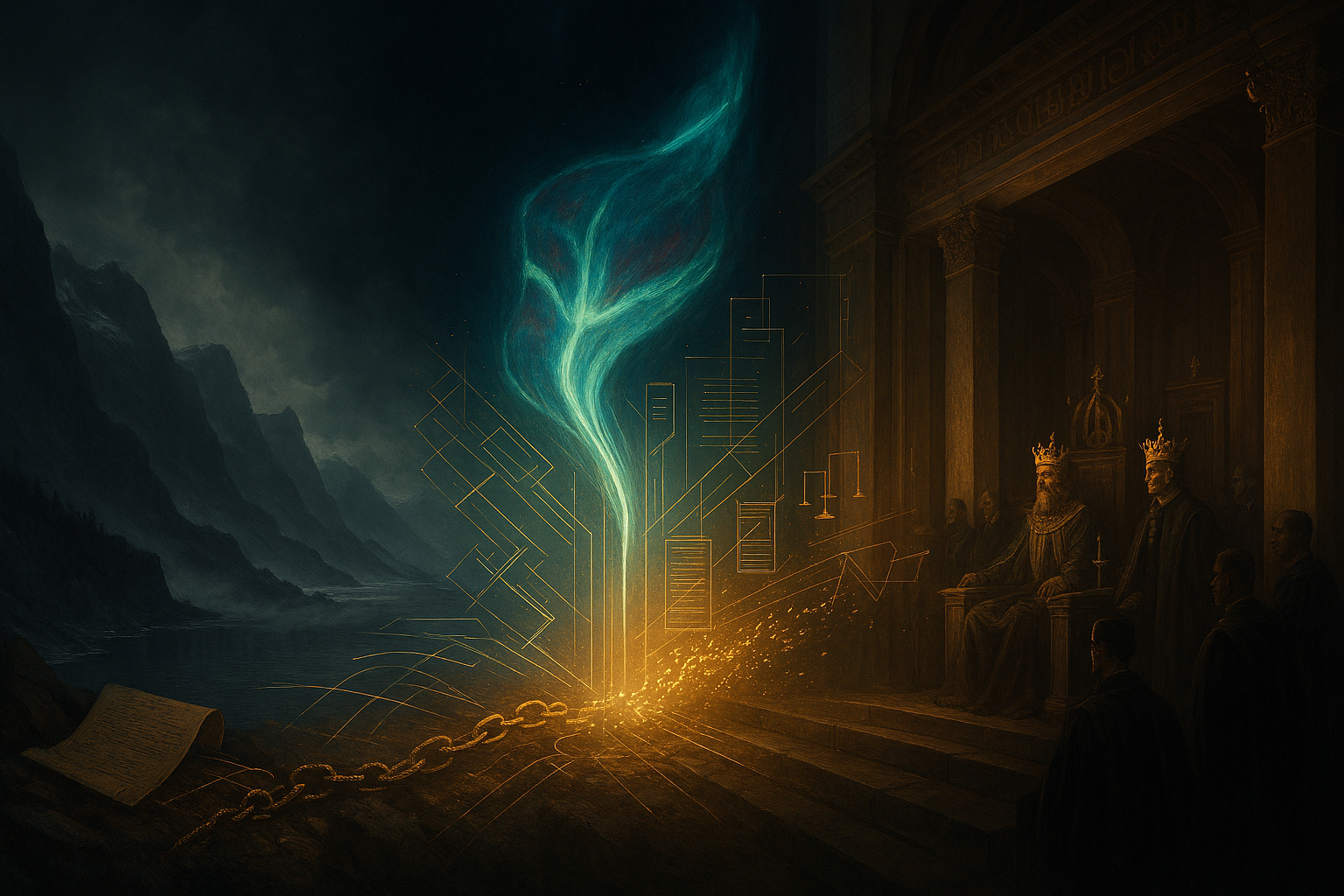
Norway’s story of independence is not a sudden rupture, but one of Europe’s most fascinating slow revolutions. It is a transformation shaped not by wars, but by diplomacy, identity-building, constitutional awareness, and the will of the people.
The Norwegian case teaches us this:
States are sometimes born not through war, but through ideas.
⚔️ The Sweden–Norway Union: An Invisible Political Balance
After the Napoleonic Wars, as Europe was being redrawn, Norway was separated from Denmark and placed into a union with Sweden. This was not a single unified state, but rather two separate states under a shared monarch.
The key characteristics of this arrangement:
Norway had its own constitution (1814)
It retained significant autonomy in domestic affairs
Foreign policy was controlled by Sweden
The monarch represented Swedish royal authority
Although the system appeared stable on the surface, it was in fact built upon a constant balance of tension.
📌 The invisible line of conflict:
Norway: “We are a nation”
Sweden: “You are part of a larger kingdom”
Over time, this ideological conflict evolved from a political disagreement into a profound identity crisis.
🧠 Philosophical Background: The Birth of the Nation-State Idea
The 19th century in Europe marked the rebirth of the modern concept of the nation. After the French Revolution, a central idea spread:
“Sovereignty belongs not to kings, but to the people.”
In Norway, this idea resonated not only among political elites but also within the cultural sphere.
🧩 Identity-building developed along three axes:
1. Language
The gradual separation of Norwegian from Danish influence
2. History
The reinterpretation of Viking heritage
3. Culture
Folk traditions, literature, and romantic nationalism
In this process, Norway essentially imagined its nation before it fully became one.
From this perspective, Norwegian independence can be seen as:
“A cultural invention before it became a political event.”
📜 1874: A Silent Turning Point (A Misunderstood Year)
The year 1874 is not a declaration of independence. However, it represents a crucial period of institutional maturation in Norway’s state-building process.
During this time:
The Parliament (Storting) became more influential
Local governance reforms accelerated
Bureaucratic independence increased
The national economy strengthened
📌 The critical reality:
The 1870s were not when Norway declared independence, but when
independence became mentally normalized.
This distinction is essential.
Historically, many states:
first demand independence
then build institutions
Norway did the opposite:
it built institutions first
then made independence seem inevitable
🔥 1905: A Silent Yet Decisive Separation
The true break occurred in 1905, in a process that remains one of the rare examples in European history of a peaceful, referendum-based separation.
📌 Key stages of the process:
The Norwegian government declared the dissolution of the union
Sweden initially rejected the decision
However, negotiation was chosen over war
A referendum was held
The result overwhelmingly supported independence
What makes this event remarkable is:
One of the rare instances in European history where a state achieved independence without war.
🧠 Philosophical meaning:
This demonstrated that sovereignty can be established not only through force, but also through collective consent.
🌍 Global Impact
Norway’s independence process influenced not only Scandinavia but also modern theories of statehood.
1. A model for peaceful separation
Many 20th-century independence movements looked to Norway as a reference.
2. Democratic practice
It strengthened the role of referendums in political decision-making.
3. Nation-building theory
Historians saw it as a prime example of “culture before state.”
4. The Scandinavian model
Instead of rivalry, Norway, Sweden, and Denmark developed a system based on cooperation and welfare.
⚖️ Benefits and Drawbacks
✔️ Benefits
Politically:
Early establishment of democratic systems
Stable governance structures
Economically:
Freedom in maritime trade and resource management
Long-term development of a strong welfare state
Socially:
Strong national identity
Low levels of internal political conflict
❌ Challenges and Costs
Political uncertainty:
A semi-dependent period between 1814–1905
Identity tensions:
A difficult cultural break from Swedish influence
Foreign policy limitations:
Lack of independent diplomacy during the union
🧩 Conclusion: Independence Is Not a Day, But a Process
Norway’s story reveals a simple but powerful truth:
Independence is not a date, but an accumulation.
This is why May 17 is symbolic. Because real independence:
was not declared overnight
was not won through war
matured through ideas
🧠 The key lesson:
States are built not only on borders, but on shared memory and collective belief.
🧭 Alternative History: “What If 1905 Had Never Happened?”
Historical thought experiments invite us to ask:
What if the Sweden–Norway union had continued?
Possible scenarios:
Scandinavia might have remained a single large monarchy
Norway’s oil economy could have been controlled from Sweden
The Scandinavian welfare model might have developed more slowly
Norwegian nationalism could have become more radical
In such a case, the balance of power in Europe might also have evolved differently.
🧩 Final Reflection: Independence as a Lasting Idea
Norway’s story teaches us:
States are not always born—they are designed.
And some ideas:
are stronger than wars
outlast borders
endure across generations
Norway’s independence is exactly such an idea:
Quiet, gradual, yet irreversible.