History is not just about wars ⚔️, kings 👑, and shifting borders. True history lies in stories that reveal how far humans can go—both in goodness 🌿 and in darkness 🌑.
And Josef Mengele and Auschwitz stand among the darkest, most disturbing of these stories.
Get ready… because this is not just something that happened in the past; it is also a lesson about the limits of human nature, the relationship between science and ethics 🧪⚖️, and how ideology can turn into catastrophe.
Josef Mengele’s Life: Genius or Monstrosity? 🧠⚫
Josef Mengele was born in 1911 in the town of Günzburg, Germany 👶🏻, into a wealthy and respected family. He received a strong education 🎓, studying anthropology and medicine 🩺 at university. He had a particular interest in genetics.
At the time, science in Europe was advancing rapidly 🚀. However, within this progress lurked a dangerous idea: eugenics—the belief that some people are superior to others and that humanity could be “improved” 🧬.
Mengele didn’t just believe in this idea… he wanted to put it into practice.
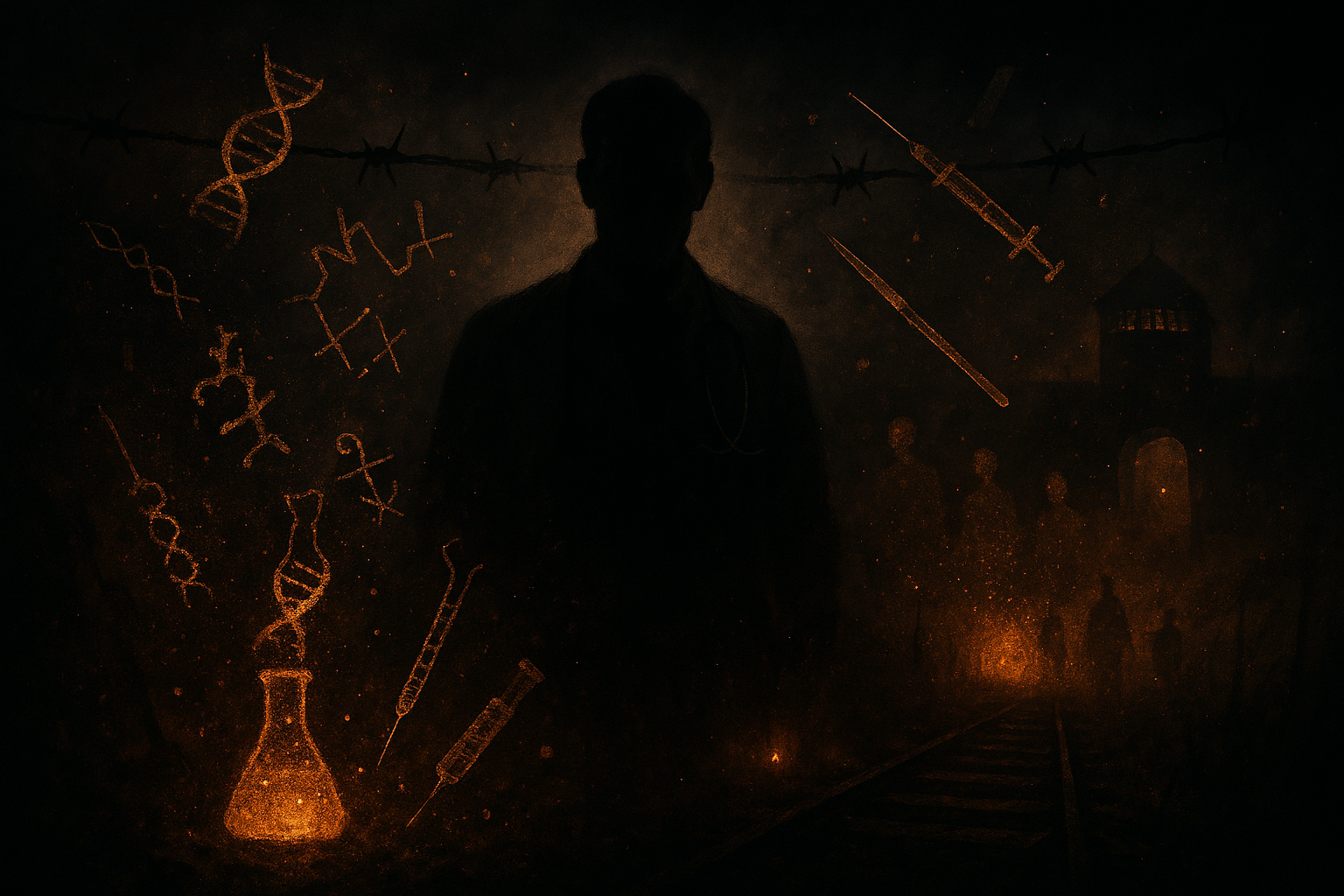
After joining the SS, his path led him to Auschwitz 🚂. And from that moment on, instead of saving lives ❤️🩹 as a doctor should, he became someone who experimented on them.
Here lies the tragedy: Mengele was not ignorant ❌. On the contrary, he was educated. But education without ethics can make a person far more dangerous ⚠️.
Auschwitz: A Stain on History and a Strategic Machine 🏭
Auschwitz was established in the Oświęcim region of Poland 📍. But this choice was no coincidence.
🚆 It was located at a major railway intersection
🏭 It was close to industrial zones
🗺️ It held a central position in Nazi Germany’s eastern strategy
That’s why Auschwitz was not just a concentration camp—it was a system ⚙️.
It consisted of three main parts:
Auschwitz I (main camp)
Auschwitz II-Birkenau (extermination camp)
Auschwitz III (labor camp)
This structure shows that the Nazis carried out genocide in an “organized” manner 📊. This was not chaos—it was a calculated mechanism.
And within this mechanism, figures like Mengele made it even more horrifying 🕳️.
Horror: Daily Life Was a Nightmare 🌑
Life in Auschwitz… was not truly life.
People were brought in by trains 🚂, and often, the moment they arrived, a “selection” process determined their fate:
➡️ Those who could work
➡️ Those sent directly to death ⚰️
Families were torn apart in seconds 💔.
Hunger 🍞❌, disease 🤒, fear 😨, and uncertainty… these were part of daily life. But there were also those specifically chosen by Mengele.
Especially children 👶🏻 and twins 👯—because they were the most “valuable” (!) subjects for his experiments.
Experiments: Systematic Torture Under the Mask of Science 🧪⚠️
Mengele’s experiments were presented as scientific research, but in reality, they lacked ethics ❌, methodology ❌, and humanity ❌.
His work on twins was particularly notable:
🧬 Infecting one twin to compare with the other
🫀 Organ and blood transfers
🥶 Physical endurance tests
☣️ Chemical and biological interventions
What was the goal?
To create the “perfect race” imagined by the Nazis.
The most striking point is this:
Science is meant to understand and heal humanity 💡. But here, it became a tool serving ideology ⚠️.
Why Was It Done? The Intersection of Ideology, Power, and Fear 🏛️
To understand these events, it’s not enough to look only at Mengele. We must understand the spirit of the time 🕰️.
Nazi ideology was built on three pillars:
Belief in racial superiority 🧬
The idea of “cleansing” society ⚔️
Absolute authority and control 🏴
This mindset classified people as “valuable” and “worthless” 📉📈.
From an economic perspective:
💰 Camps provided cheap labor
🏭 They supported the war economy
📊 Human lives were evaluated based on productivity and efficiency
So this wasn’t just about hatred… it was also a systematic system of exploitation ⚙️.
Effects: Deep Wounds from Society to Philosophy 🌍
The actions of Auschwitz and Mengele affected not only that era, but the entire world that followed.
Social Impact 👥
Communities were destroyed. The concept of family was shattered 💔. Trust was deeply damaged.
Philosophical Impact 🧠
The question “What is a human?” was asked again.
The relationship between science and ethics was reexamined ⚖️.
Legal Impact ⚖️
With the Nuremberg Trials:
War crimes were defined
The concept of crimes against humanity emerged
Scientific Impact 🧪
Today’s medical ethics (such as informed consent) developed as a direct result of this dark past.