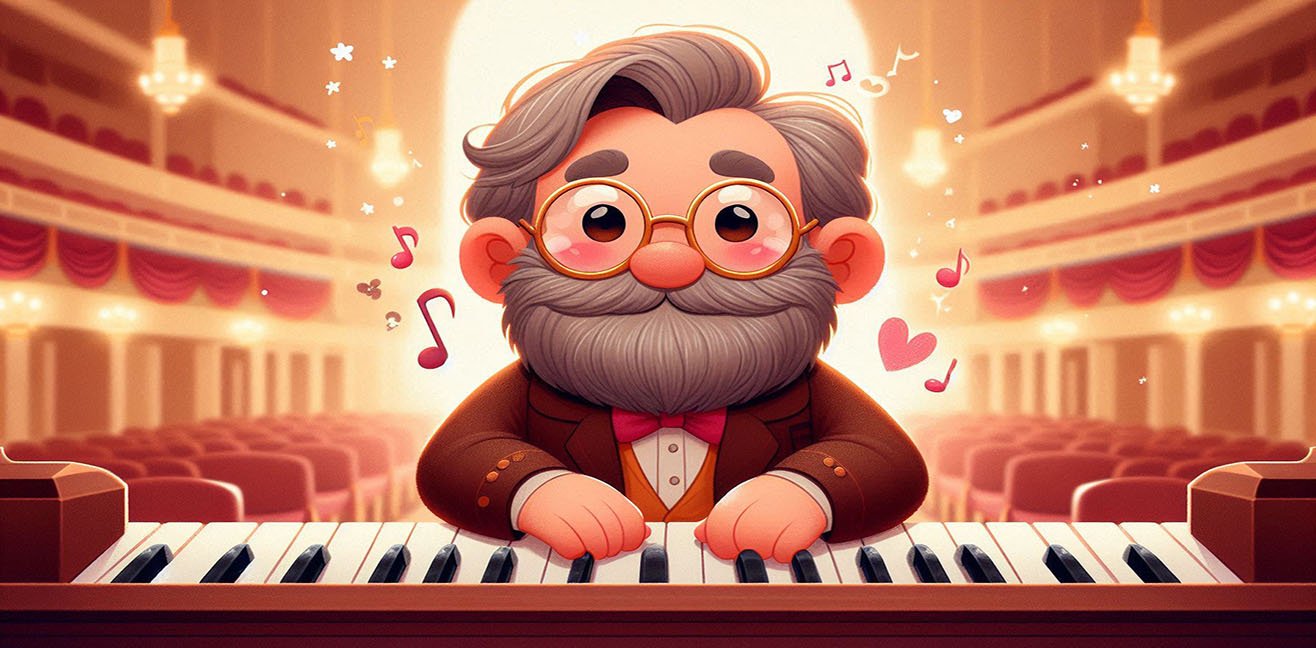
(The heart of Romanticism, the discipline of Classicism, the charisma of the beard)
When Johannes Brahms is mentioned, the waters of classical music come to a standstill. He is neither merely an emotional Romantic nor a rigid Classicist. Brahms is one of those rare masters who managed to write emotion and intellect on the same musical staff, achieving a perfect balance in music. While listening to him, your heart softens—and at the same time your mind nods in admiration, thinking, “How is this level of mastery even possible?”
In this article, we won’t just introduce Brahms; we’ll understand him, learn how to listen to him properly, and discover how to weave his music more naturally into everyday life.
🎹 Who Is Johannes Brahms? (You Can’t Understand the Music Without Understanding the Man)
Johannes Brahms was born on May 7, 1833, in Hamburg. His father was a musician who played the double bass and the horn—so Brahms grew up in a house that smelled of sheet music. But life didn’t offer him a cushioned piano bench.
- He earned money by playing the piano at a very young age
- Harsh working conditions forced him to mature early
- He disliked showiness and avoided fame
This early “school of life” added three key elements to Brahms’s music:
- Deep melancholy
- Strong inner discipline
- An understated yet powerful expression
Practical note: The inward-looking quality often felt in Brahms’s music is a direct reflection of his personality. His music is not meant to be background noise—it demands active listening.
🎶 Brahms’s Music: When Emotion Walks Hand in Hand with Logic
One of the things that makes Brahms unique is his ability to present mathematical structure and emotional intensity at the same time.
What do you hear in Brahms’s music?
- Long, evolving melodies
- Strong bass lines
- Harmonies built layer upon layer
But the real magic lies here:
Emotion never takes complete control.
While many Romantic-era composers were swept away by emotional floods, Brahms seems to say, “Wait a moment—let’s not let this fall apart,” holding his music firmly together.
Listening tip: When listening to Brahms, don’t just follow the melody—pay attention to the accompanying voices. True mastery often hides in the background.
🧠 Writing After Beethoven: It Takes Courage
Brahms carried a heavy destiny. The music world expected one thing from him:
“Be the great symphonist after Beethoven.”
Because of this pressure:
- He published his first symphony at age 43
- He discarded countless works
- He became his own harshest critic
And the result?
🎼 Four symphonies—each a masterpiece.
Educational note: Brahms teaches us that art is not only about producing—but also about knowing when to release.
💔 Clara Schumann: The Music of an Unspoken Love
One of the most delicate chapters of Brahms’s life is Clara Schumann.
- Clara was one of the greatest pianists of her era
- She was both Brahms’s inspiration and confidante
- Their bond was deep—but ultimately unfulfilled
This suppressed emotion emerges in Brahms’s music as:
- Long silences
- Slow, inward-moving passages
- A lingering sense of longing
Listening suggestion: Late at night, put on a Brahms Intermezzo. What you’ll hear won’t be just notes—it will be unspoken sentences.
💿 Major Works of Brahms (Where Should You Start?)
🎼 Symphonies
- Symphony No. 1: Strong Beethoven influence
- Symphony No. 2: Brighter, more pastoral
- Symphony No. 3: Powerful and dramatic
- Symphony No. 4: The darkest and deepest
🎹 Piano Works
- Piano Concerto No. 2: Both virtuosic and philosophical
- Intermezzi: Mini masterpieces that soothe the soul
🎻 Violin Concerto
- Technically demanding
- Emotionally multi-layered
💃 Hungarian Dances
- Influenced by folk music
- Energetic and playful
- The kind that makes you say, “So Brahms could have fun too!”
Beginner’s path:
- Hungarian Dances
- Symphony No. 2
- Intermezzo Op. 117
🎧 How Should You Listen to Brahms? (Golden Rules)
- Use headphones
- Choose a quiet environment
- Don’t rush
- Listen to one piece at a time—think in albums, not playlists
Brahms isn’t meant to be consumed quickly. He’s like a riddle that slowly unfolds.
🕯️ Brahms’s Legacy and His Impact Today
Today, Brahms continues to live on:
- In film scores
- In modern classical compositions
- In piano education repertoires
Because his music doesn’t cater to trends—it speaks to human nature.
🎼 Final Words: Listening to Brahms Is Meeting Yourself
Johannes Brahms doesn’t shout in music. He whispers. But that whisper stays with you for a long time.
If you’re searching for depth in music, Brahms will never leave you halfway.