She stared at me. ‘Mother!’ she exclaimed, ‘there is a woman wants me to give her these porridge.’
‘Well lass,’ replied a voice within, ‘give it her if she’s a beggar. T pig doesn’t want it.’
The girl emptied the stiffened mould into my hand, and I devoured it ravenously.
As the wet twilight deepened, I stopped in a solitary bridle-path, which I had been pursuing an hour or more.
‘My strength is quite failing me,’ I said in a soliloquy. ‘I feel I cannot go much farther. Shall I be an outcast again this night? While the rain descends so, must I lay my head on the cold, drenched ground? I fear I cannot do otherwise: for who will receive me? But it will be very dreadful, with this feeling of hunger, faintness, chill, and this sense of desolation—this total prostration of hope. In all likelihood, though, I should die before morning. And why cannot I reconcile myself to the prospect of death? Why do I struggle to retain a valueless life? Because I know, or believe, Mr. Rochester is living: and then, to die of want and cold is a fate to which nature cannot submit passively. Oh, Providence! sustain me a little longer! Aid!—direct me!’
My glazed eye wandered over the dim and misty landscape. I saw I had strayed far from the village: it was quite out of sight. The very cultivation surrounding it had disappeared. I had, by cross- ways and by-paths, once more drawn near the tract of moorland; and now, only a few f ields, almost as wild and unproductive as the heath from which they were scarcely reclaimed, lay between me and the dusky hill.
‘Well, I would rather die yonder than in a street or on a frequented road,’ I reflected. ‘And far better that crows and ravens—if any ravens there be in these regions—should pick my flesh from my bones, than that they should be prisoned in a workhouse coffin and moulder in a pauper’s grave.’
To the hill, then, I turned. I reached it. It remained now only to find a hollow where I could lie down, and feel at least hidden, if not secure. But all the surface of the waste looked level. It showed no variation but of tint: green, where rush and moss overgrew the marshes; black, where the dry soil bore only heath. Dark as it was getting, I could still see these changes, though but as mere alternations of light and shade; for colour had faded with the daylight.
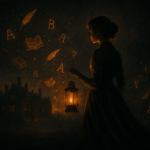
My eye still roved over the sullen swell and along the moor-edge, vanishing amidst the wildest scenery, when at one dim point, far in among the marshes and the ridges, a light sprang up. ‘That is an ignis fatuus,’ was my first thought; and I expected it would soon vanish. It burnt on, however, quite steadily, neither receding nor advancing. ‘Is it, then, a bonfire just kindled?’ I questioned. I watched to see whether it would spread: but no; as it did not diminish, so it did not enlarge. ‘It may be a candle in a house,’ I then conjectured; ‘but if so, I can never reach it. It is much too far away: and were it within a yard of me, what would it avail? I should but knock at the door to have it shut in my face.’
And I sank down where I stood, and hid my face against the ground. I lay still a while: the night-wind swept over the hill and over me, and died moaning in the distance; the rain fell fast, wetting me afresh to the skin. Could I but have stiffened to the still frost— the friendly numbness of death—it might have pelted on; I should not have felt it; but my yet living flesh shuddered at its chilling influence. I rose ere long.