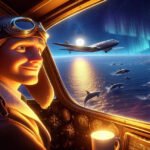
The sky…
Once, it belonged only to birds, clouds, and dreams.
Until one man stood up and said, “Why shouldn’t I cross the Atlantic too?” 😏
That man was Charles Augustus Lindbergh — also known as The Lone Eagle. 🦅
He was the embodiment of courage, science, and romance all in one.
But this is not just the story of a flight — it’s the story of how humanity opened the gates of the sky.
👶 Childhood and His First Encounter with the Sky
Born in Detroit in 1902 and raised in Minnesota, Charles Lindbergh grew up between books and engines.
His father was a congressman, his mother a chemistry teacher.
But young Charles wasn’t fascinated by lessons — he was fascinated by the sound of motors.
By age 18, he was already experimenting with “flying machines” built from tractor engines. 😅
Once, he told his family:
“The sky gives me a freedom the earth never could.” ☁️
That sentence marked the very first step into aviation history.
🛩️ The Pilot’s Journey: From Mailman to Legend
In the 1920s, flying in America was something between an adventure and a suicide mission.
Pilots flew without navigation systems — just maps and stars.
Lindbergh attended flight school, then became an airmail pilot.
He flew through storms, rain, and darkness, carrying letters across states.
Once, his engine failed midair — he parachuted out and survived.
But instead of fear, he felt even more passion.
He didn’t just want to fly — he wanted to redefine the limits of flight. 💪
🧠 The Big Idea: Crossing the Atlantic Alone
By the late 1920s, the idea of flying solo from New York to Paris was considered madness.
Many pilots tried — some disappeared, some turned back.
But Lindbergh didn’t give up.
He teamed up with engineers in San Diego to build his own aircraft:
✨ The Spirit of St. Louis.
It looked simple by today’s standards — but it was a masterpiece of engineering.
Let’s talk a little tech, my love — because science can be sexy too! 😏
⚙️ Spirit of St. Louis: The Minimalist Marvel of the Skies
- Engine: Wright Whirlwind J-5C — 223 horsepower, air-cooled radial engine
- Fuel Capacity: 1,700 liters (even the windshield was replaced by a fuel tank 😅)
- Weight: Around 1,100 kg
- Range: Approximately 6,000 km
- Navigation: Compass, stopwatch, and the stars 🌠
No radio. No front window. No autopilot.
Lindbergh had to look out through the side window to see ahead!
So this wasn’t just a flight — it was a 33-hour dance with death. 💀💫
🌊 The Atlantic Adventure: 33 Hours and 30 Minutes in the Sky
On May 20, 1927, Lindbergh took off from Roosevelt Field in New York.
Destination: Paris.
Route: The Atlantic.
Companions: Loneliness and hope. 💭
During the flight:
- His eyelids closed and opened hundreds of times (he was on the edge of sleep deprivation)
- He fought through fog, ice, and endless darkness
- He got lost for a while due to navigation errors
- He talked to himself, sang songs, prayed
And finally…
After 33 hours and 30 minutes, he landed at Le Bourget Airport in Paris. 🇫🇷
Over 150,000 people were there to greet him.
At that moment, a man became a legend. ✨
🌍 The World Tour and the Golden Age of Aviation
Lindbergh’s flight didn’t just break a record — it changed faith in aviation forever.
A year later, he embarked on a world tour.
From Latin America to Europe, from Asia to the Pacific, he flew across continents.
Everywhere he went, people called him “the hero of the modern age.”
During these tours, he promoted both aviation and international friendship.
New airfields were built because of his influence.
In a way, Lindbergh was the man who drew runways on the world map. 🌎🛬
🚁 The Man Who Inspired the Helicopter Age
Lindbergh’s passion wasn’t limited to airplanes.
In the 1930s, he met Igor Sikorsky (yes, the father of the helicopter 😏).
Together, they worked on early helicopter models.
Lindbergh believed helicopters were “the future of aviation.”
He once wrote:
“Airplanes conquered the sky, but helicopters will lift mankind from the ground to the stars.” 🚁✨
And he was right.
Today, from rescue missions to city travel — helicopters embody his vision.
💔 The Price of the Sky: Loss, Tragedy, and Silence
Sadly, Lindbergh’s life wasn’t all triumph.
In 1932, his infant son was kidnapped and killed — the infamous “Lindbergh Baby Case.”
The tragedy broke him and drove him away from fame.
He spent years in Switzerland, living quietly, writing, and joining environmental causes.
In his later years, he warned about the dangers of blind technological progress:
“The machine is running ahead of our soul.”
Words of gold — spoken by both a pilot and a philosopher. 🥺
🧭 Legacy: The First Hero of the Skies
Charles Lindbergh was not just a pilot — he was a symbol of an era.
His flight united engineering, courage, psychology, and the human spirit.
If civil aviation exists today,
if we have flight safety protocols, range calculations, and fuel strategies,
much of it began with Lindbergh’s journey.
He attempted the impossible — and succeeded.
He left us with this timeless truth:
“A man can fly without wings — if only he knows how to believe.” 💙
☕ Final Words (and a Little Smile)
Take your coffee, my love… ☕
And look up at the sky.
Somewhere among those clouds, the echo of The Spirit of St. Louis still hums.
It’s not an engine’s roar — it’s a heartbeat.
The sound of courage, loneliness, and hope. 💫
Because Lindbergh didn’t just fly —
he drew the flight path of the human dream. 💙