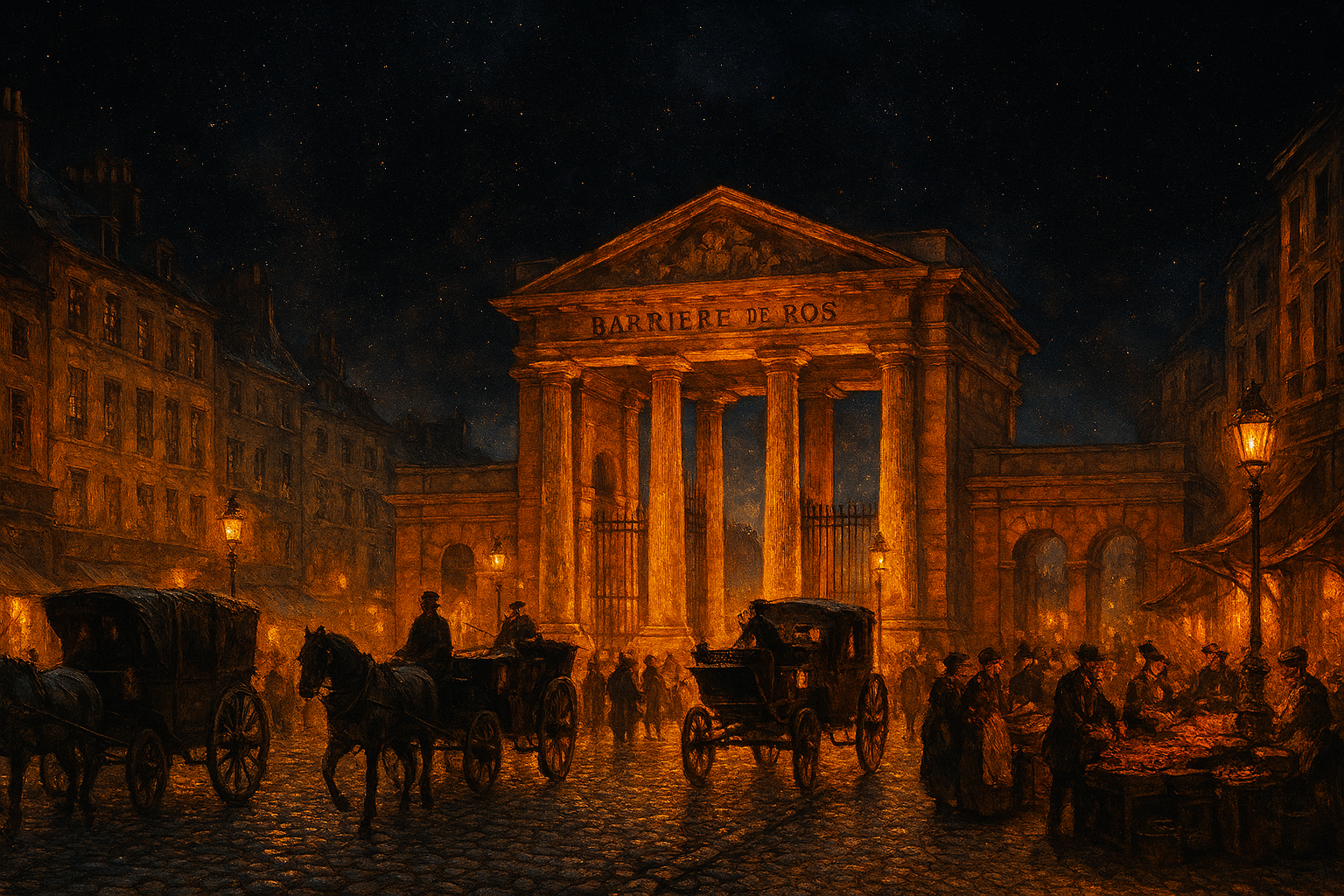
Imagine… a morning 🌅 in 19th-century Paris, walking through the city’s narrow, cobblestone streets. The sound of horse-drawn carriages 🐴, the rustling of laundry-filled baskets 👕🧺, and street vendors shouting 📢 fill the air. Suddenly, a massive structure appears before you: Barrière de Ros 🚪. “Oh, what a lovely gate!”—don’t be fooled. This gate tells a quiet yet profound story about Paris’ history, economy, and social life 📜.
What is Barrière de Ros and Where Did It Come From? 🏗️💰
Barrière de Ros was a customs and tax checkpoint built in Paris, especially in the 19th arrondissement. By the late 18th and early 19th centuries, Paris was rapidly growing 🏙️. The population was rising, trade was booming 🛒, but the city’s treasury was running low 💸, and there was no system to control goods entering the city. That’s when the octroi system came into play.
“Octroi” is French for “taxation” 💶. In other words, every load, package, or vegetable entering Paris had to pay a fee 🥖🍷🥦. Barrière de Ros both filled the city’s coffers and regulated trade.
🔍 Tip: If you look at Paris maps from the period, you’ll see these barriers were strategically placed along main roads 🗺️. They were not random; they were planned to manage and control the city’s growth 🏛️.
Historical Background: Why Was a Barrier Built? ⚔️🏛️
After the 1789 French Revolution, Paris had become a chaotic city ⚡. The monarchy had fallen, a new government was in place, but the economy was still unstable 📉. The city was growing, trade increasing 💹, but revenues were limited.
The purpose of Barrière de Ros was more than just collecting taxes. It also served to monitor the city’s borders, prevent smuggling 🕵️♂️, and control the entry of goods.
📜 Fun fact: Parisians sometimes viewed these barriers as little “comedy stages” 😂. Imagine someone trying to sneak a cheese past the gate and arguing with the officer—a meme-worthy scene for today! 🧀🎭
Daily Life: What Happened at the Barrier? 🥖🍷
Barrière de Ros was more than a gate; it was a center of daily life 🏘️. Every arriving item was inspected, taxes calculated, and sometimes smuggling was carefully monitored 🕵️♀️.
Bread and wine: As the population’s basic necessities, these were strictly checked 🍞🍇.
Smuggling: Always a challenge. Clever vendors and citizens found ways to bypass taxes 🛤️🤫.
Queues and arguments: Stopping on your way to work was frustrating 😤, but it helped fund modern Paris’ infrastructure 🏗️💡.
💡 Practical tip: To better understand daily life in that era, research Paris street markets and the job descriptions of octroi officers 🔎. It offers both historical and sociological insight 🪟.
Social and Economic Impact: The Big Role of Barrière 📊💡
Barrière de Ros had a twofold impact:
✅ Positive Effects:
City budget contribution: Taxes funded new roads, bridges 🌉, streetlights 💡, and public services.
Trade regulation: Goods flow was controlled, and smuggling partially prevented 🛑.
Modernization: Tax revenues allowed the city to invest in infrastructure that laid the foundation for modern Paris 🏛️.
❌ Negative Effects:
Public dissatisfaction: Taxes could be heavy and annoying 😩, forcing people to stop on their way to work ⏳.
Encouraged smuggling: Some people devised creative ways to avoid paying 🎩🕵️♂️.
Business slowdowns: Small businesses sometimes suffered 💸, as tax payments took time and money ⏱️.
📚 Tip: To understand the contribution of the Barrière to Paris’ economy, examine 19th-century budget records 📖. Even a small gate could shape the city’s finances and people’s daily lives.
The Big Lesson Behind Barrière de Ros 🧠✨
History isn’t just about wars, kings, or revolutions ⚔️👑. Sometimes a small city gate 🚪, a customs barrier 🛑, can tell us a lot about a society’s economic, social, and cultural structure.
For Parisians, stopping on their way to work was annoying 😤.
But it financed the city’s modernization and public services 🏗️💡.
Historical lesson: Small obstacles can lead to major changes 🌱.
🤣 Fun note: Today we get annoyed at self-checkout machines 🛒😅, but in the 1800s, people had to argue with real officers. Barrière de Ros was a small yet impactful stage of comedy and drama in history 🎭.
Conclusion: The Silent Hero of History 🏰🕰️
Barrière de Ros stood as a silent hero at the borders of Paris 🛡️. Small obstacles teach big lessons 🌟. This gate shaped both Paris’ economic order and the patience of its people, leaving an unforgettable mark on history 📜.
Who knows? Perhaps one day, as you read these gate stories, you’ll feel like a Parisian walking the streets of the past 👣, realizing that history is written by small but powerful barriers 🗝️✨.