Imagine this… You wake up one morning, and the ground starts shaking, glasses start dancing on tables, chandeliers sway back and forth. Neighbors panic and rush outside, and you’re still struggling to get out of bed. The question crosses your mind: “How strong is this earthquake?” — but there’s no answer…
This is where Charles Francis Richter comes in. Thanks to him, an earthquake is no longer just a subjective “it shook a lot” or “it barely shook” — it can now be expressed in numbers.
🌍 Earthquakes Existed… But Had No Scale
Throughout history, the world has shaken with earthquakes, but people had no way to measure them. In the early 1900s, in America and other parts of the world, earthquakes remained uncertain events. People described them like this:
“I think it was a very strong shake.”
“We barely felt it in our area.”
“The neighbor’s kitchen was destroyed, and we only had glasses rattling.”
Scientists wanted to eliminate this uncertainty. To compare earthquakes, take precautions, and design safe buildings, a measurable system was necessary.
🧠 Enter a Genius: Charles Francis Richter
Charles Francis Richter was born in 1900 near Los Angeles. From a young age, he had a deep interest in mathematics and physics. Even as a child, he had the ability to simplify complex problems and solve them logically — a skill that set him apart from others.
By the 1930s, Richter was working in California in the field of seismology, searching for a solution. At that time, earthquake science was still young, recording devices were limited, and measurements were very complex. Richter applied his mathematical skills while analyzing data coming from seismographs.
Together with his colleague Beno Gutenberg, he developed one of the most logical systems ever created for measuring the magnitude of earthquakes.
📏 The Richter Scale: Like the “Volume” of an Earthquake
The Richter scale became one of the first systems to express earthquake magnitudes numerically. But here’s the key detail: it’s logarithmic.
That means:
A magnitude 5 earthquake → light shaking
A magnitude 6 earthquake → 10 times stronger
A magnitude 7 earthquake → 100 times stronger
Each step represents an exponential increase in energy. An earthquake essentially goes from a “quiet whisper” to a “rock concert” 😄
Thanks to the Richter scale, people can now compare earthquake data, identify risky areas, and take precautions accordingly.
🔍 How Does This Invention Work? Practical Details
The Richter scale uses data from seismographs. Here’s how it works:
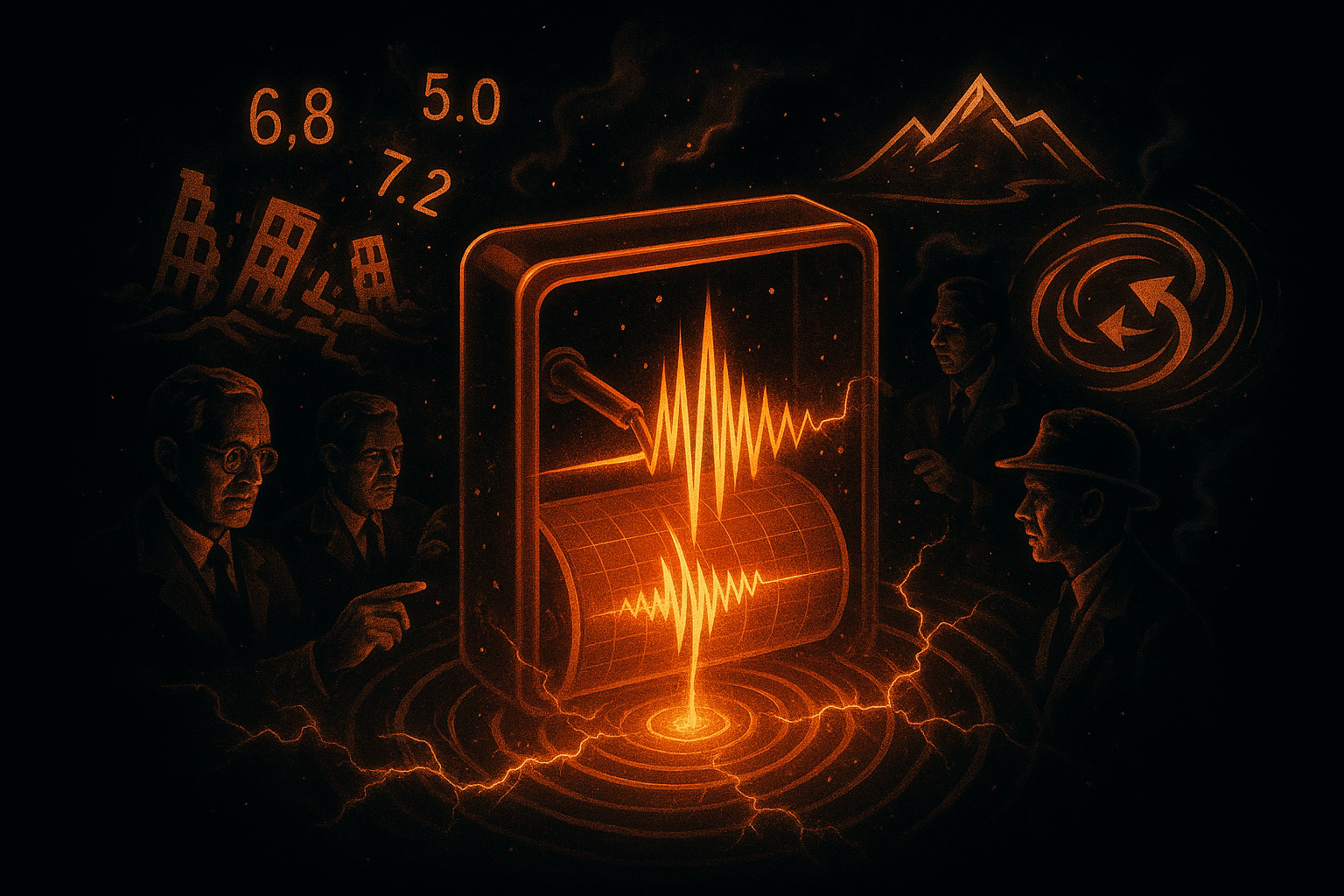
Seismographs record underground vibrations. These devices consist of a needle and a moving drum that accurately tracks ground movements.
Richter takes this data and applies logarithmic calculations to express the magnitude numerically.
The scale starts at 0, and the strongest earthquakes can go up to 9 or more.
💡 Tip: If you ever look at an earthquake record, it’s not the height of the lines that matters, but the logarithmic calculation that determines the magnitude. That’s why some “small-looking” graphs can actually represent very powerful earthquakes.
🚀 What Is This Invention Used For? Benefits and Importance
The benefits of the Richter scale are countless:
🌍 Earthquakes can be compared → Now it’s possible to know which earthquake was stronger.
🏗️ Safe buildings can be designed → Engineers can reinforce structures according to earthquake magnitude.
🚨 Disaster management becomes smarter → Authorities can predict which areas need emergency aid, evacuation, and precautions.
📊 Scientific analysis is possible → Earthquake data can be collected, analyzed, and used to forecast future risks.
🧩 Provides a fundamental tool for scientists → Seismology has become a more quantitative and systematic field.
In short, the Richter scale isn’t just a numbering system — it’s a tool that saves lives, shapes city planning, and guides engineering.