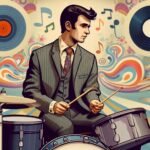
There are some musicians who appear tiny on album covers, yet carve their names into the DNA of music in capital letters. Jim Capaldi belongs exactly to this class. You don’t need a screaming solo or a “look at me” ego to notice him. A song flows, you slip into it without realizing… and that’s precisely where Capaldi has done his job.
This piece is much more than the question “Who was Jim Capaldi?”
It is a guide to how music can be made intelligently.
🎶 1. The Spirit of the Era and Capaldi’s Entrance onto the Stage
The 1960s: Everyone is shouting, Capaldi is listening
1960s England was a musical laboratory:
- The Beatles were redefining pop
- The Rolling Stones were dirtying up the blues (in the best possible way)
- Pink Floyd were blowing minds
- Jazz and folk were flirting with rock
In this environment, Jim Capaldi did one simple but crucial thing:
“He listened to everything, but blindly followed none of it.”
Born in Birmingham, Capaldi, from a young age, was drawn simultaneously to:
- Jazz rhythms
- The feel of the blues
- Folk storytelling
- Psychedelic freedom
This didn’t make him a “style guy,” but a master of balance.
👉 Practical tip:
If you’re involved in music, Capaldi’s approach is a golden rule:
You don’t have to choose a style. Styles can choose you.
🥁 2. His Approach to Drumming: Unshowy but Dangerously Effective
The embodiment of “play less, but play it in the right place”
The first thing you notice when listening to Jim Capaldi’s drumming is this:
Nothing is excessive.
- No unnecessary fills
- No rhythms that suffocate the song
- No drums shouting “Look at me!”
And yet, when the song ends, you feel this:
“This track wouldn’t work without the drums.”
Capaldi didn’t see the drums as an instrument, but as the skeleton of the song.
🎧 Listening exercise:
Traffic – “The Low Spark of High Heeled Boys”
- Don’t listen to the drums on their own—listen to them as the song’s breath
- Notice not where the drums enter, but where they don’t
👉 Tip for drummers:
Capaldi teaches this lesson:
Technique makes you visible; timing makes you unforgettable.
✍️ 3. Songwriting: Lines That Seem Simple but Strike Straight to the Heart
One of rock’s hidden poets
When you look at Traffic’s lyrics, you won’t see grandiose language.
But as you read on, you realize they are:
- Plain
- Honest
- Drawn straight from life
Jim Capaldi’s songwriting is like literature without literary pretension.
Recurring themes include:
- Disappointment
- Hope
- The fleeting nature of time
- The fatigue of being human
Example:
“Dear Mr. Fantasy”
What seems like a song written to a fantasy character is, in truth, a human letter about escape.
👉 Tip for lyric writers:
Capaldi’s method:
- Think big
- Write small
- Make it felt, don’t explain
🎸 4. Traffic: Not a Band, but an Idea
One of the rare groups where genres didn’t fight each other
What made Traffic special:
- Thinking jazz while playing rock
- Evoking psychedelia while telling folk stories
- Never boring the listener, even with long songs
The Capaldi + Winwood partnership was crucial here:
- Winwood: melodic genius
- Capaldi: emotional architect
Thanks to this duo, Traffic was:
- Not entirely experimental
- Not purely pop
- Not simply classic rock
They carved out their own lane.
👉 A Traffic guide for new listeners:
1️⃣ Mr. Fantasy – early-period energy
2️⃣ John Barleycorn Must Die – maturity
3️⃣ The Low Spark of High Heeled Boys – the peak
💿 5. Solo Career: “I Left the Band, but I’m Not Done”
A door into Capaldi’s inner world
In his solo albums, Capaldi becomes more:
- Personal
- Political
- Emotional
Standout albums:
🔹 Oh How We Danced (1972)
Melancholic yet warm. Best listened to alone.
👉 At night, with headphones.
🔹 Whale Meat Again (1974)
Environmental and political themes.
👉 The album that says, “Rock is not just entertainment.”
🔹 Short Cut Drawblood (1975)
Funk- and groove-driven.
👉 Perfect behind the wheel.
👉 Listening tip:
When listening to solo Capaldi, let go of your Traffic expectations.
These albums feel like confessions.
🤝 6. Becoming a Musician’s Musician
A man who could play with everyone without losing himself
Artists Jim Capaldi worked with include:
- Eric Clapton
- George Harrison
- Stevie Wonder
- Paul Weller
This is no coincidence.
Because Capaldi:
- Listened to the song
- Left space
- Left his ego at the door
👉 Lesson for a music career:
Being a good musician matters.
But being a great accompanist makes you immortal.
🕊️ 7. An Enduring Legacy: Why Does He Still Matter Today?
What does Jim Capaldi say in the age of Spotify?
Today, music is:
- Consumed quickly
- Shorter
- Constantly trying to grab attention
Capaldi, on the other hand, whispers the opposite:
“Slow down. Listen. Feel.”
Listening to him today means:
- Reclaiming your attention
- Reconnecting with music
- Escaping the noise
🎼 Final Note: How Should We Remember Jim Capaldi?
Jim Capaldi was:
- Not the loudest voice
- But the one whose absence you feel when the sound stops
To understand him, don’t listen to the moments that shout—
listen to the quiet moments.
Because some people don’t just play music…
they teach music how to behave.