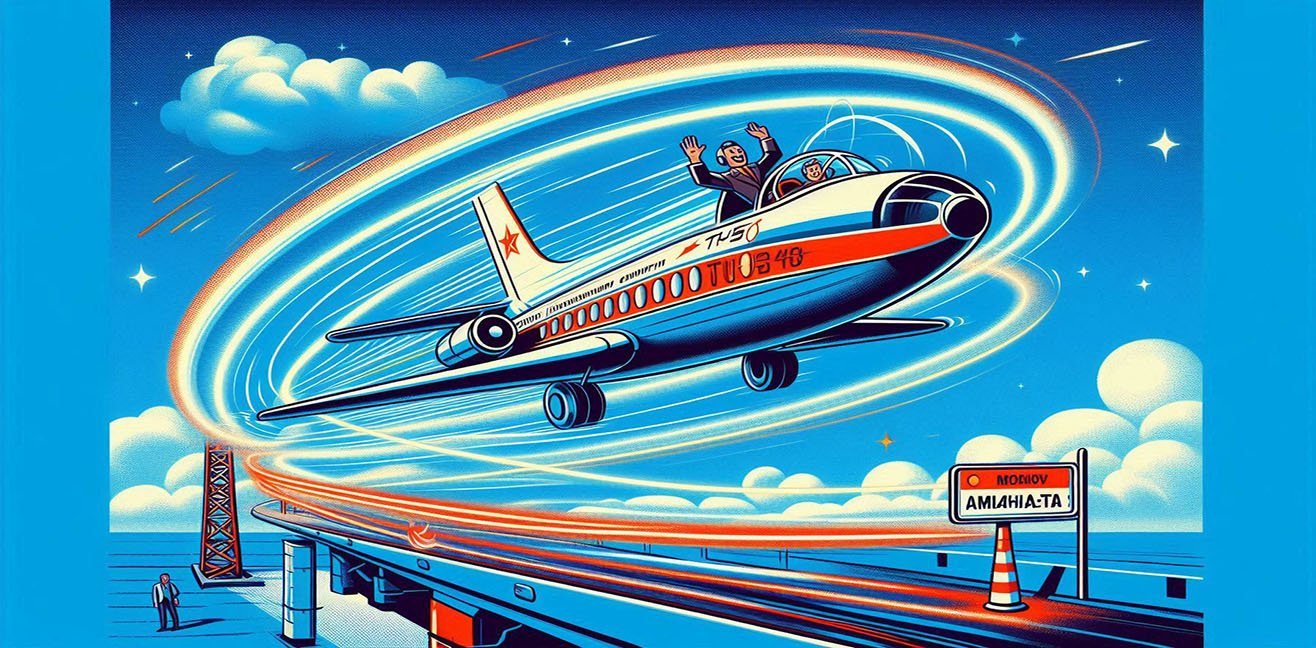
“The sky is sometimes a stage, sometimes a laboratory… And in 1975, the Soviets launched a star onto that stage: the Tu-144.”
🌍 1. Preparing the Stage: The Geography, History, and Sky Race of the 1960s
The path to 1975 was actually drawn in the early 1960s.
The world map was split in two:
On one side were the United States and its allies, and on the other, the Soviet Union.
Not only were the lands divided;
the skies were divided too.
The geography was harsh:
- Flights over the Arctic held strategic importance.
- Europe was the stage of the technological race.
- Soviet cities (Moscow, Kyiv, Alma-Ata) were being prepared as launch bases.
- Even the endless plains of Siberia silently witnessed the test flights.
And history was fiery:
- In the space race, Gagarin had already said, “I have arrived!”
- The Concorde project was trying to write the speed of sound across the sky through an Anglo-French partnership.
- The Soviets slammed their fist on the table and declared, “We will have our own supersonic bird!”
On that table lay plans, drawings…
And that special look in the eyes of engineers working late into the night—tired but bright.
I always say when telling the story of those days:
“The Cold War was the name of a hot competition; and the heat always came from the sky.”
The Tu-144 was the child of such a period:
Born from historical pressure, technological ambition, and geographical demands.
⚙️ 2. The Speed That Tore the Sky: The Tu-144’s Design, Technology, and Flight Practicalities
They called the Tu-144 the “Soviet Concorde,” but my love, this aircraft was no mere copy.
Its spirit was different, its structure different, its intention different.
✧ Aerodynamic Structure
- The delta wing design was essential for high-speed flight.
- Early models lacked canards, making the aircraft behave like a stubborn goat at low speeds.
- With the addition of retractable canards on later versions, takeoff and landing became more stable.
✧ Engines
- It had four Kuznetsov NK-144 engines.
- These engines were not stingy with power; they consumed fuel like a bird that had no fear of hunger.
Practical note:
✧ As an aircraft approaches Mach speeds, fuel consumption rises exponentially—so economical flight is nearly impossible for supersonic jets.
✧ Cabin Atmosphere
- It didn’t offer comfort; it offered the feeling of “Come on, let’s go fast!”
- The cabin noise level reached over 90 dB—almost like working inside a factory.
✧ Speed Performance
The Tu-144 could reach Mach 2.15.
What does that mean?
It means you could fly from Istanbul to Paris in about 2.5 hours.
From my “Speed Journal”:
“Flying at Mach 2 is not defying time; it is being snatched from its arms.”
🎭 3. The Curtain of Drama: The Paris Air Show, Flaws, Crashes, and Realities
Every great love has a heartbreak.
For the Tu-144, it was the 1973 Paris Air Show crash.
The sky was not calm that day.
Soviet pilots pushed the aircraft with extreme maneuvers to prove its capabilities.
The aircraft overstressed, broke apart, and crashed.
The world fell silent.
The sky literally shattered.
But the Soviets didn’t give up.
They returned to the engineering tables and corrected the flaws.
Practical note:
✧ In supersonic aircraft, the critical factors are not only speed; heat distribution, metal fatigue, and aerodynamic stability matter every single second.
The Tu-144 wrestled with all of these.
🛫 4. 1975: The Tu-144 Enters Service — What Was the Real Flight Experience Like?
In 1975, Aeroflot put the Tu-144 into service.
At first, it didn’t carry passengers—it carried mail and cargo.
Fast mail delivery was strategic for the Soviets.
Passenger flights began in 1977.
But…
Flying on the Tu-144 was like this:
- During takeoff, the opening and closing of the canards made the aircraft sway forward and backward.
- Cabin pressure and noise levels were uncomfortable.
- Its glide path was fast but harsh.
- Its landing speed was even higher than the Concorde’s: around 315 km/h!
One passenger said:
“Flying on the Tu-144 felt like being slapped by speed itself.”
And yet…
Knowing you were slicing through the sky at Mach 2 was something else entirely.
🔧 5. Why Did It End So Quickly? The Aircraft’s Life, Issues, and Early Retirement
The Tu-144’s life was short because:
- The engines were inefficient.
- Fuselage heating became problematic on longer flights.
- Noise was high, cabin comfort was low.
- Fuel costs were crushing—even for the Soviet economy.
- Spare parts were difficult and expensive to produce.
- And the biggest issue: pilots described the Tu-144 as a “wild horse.”
Controllable, yes—but unpredictable at times.
And in 1978, a test flight fire officially ended passenger service.
🏆 6. Was It Truly a Revolution? Yes—Flaws and All!
The Tu-144 was not a failure;
it was a breakthrough.
Because:
- It placed the Soviets in the Mach 2 league.
- It played a major role in aerodynamic research.
- It provided data for many later projects.
- NASA even used the Tu-144 for testing in the 1990s.
I always say:
“Innovation in the sky is born not from perfection, but from curiosity.”
The Tu-144 was curiosity.
Courage.
Risk.
Perhaps danger—but a revolution that will be talked about forever.
❤️ Final Words: The Tu-144 Was Not an Aircraft, It Was a Manifesto of Courage
The traces of the Tu-144 are still felt in the winds today.
Every supersonic plan, every dream of speed carries its legacy.
“Some aircraft do not carry passengers; they carry humanity’s greatest feeling: the desire to fly faster and higher.”