Imagine going to a hospital, needing blood, and hearing the doctor say:
“We have some blood, but we have no idea if it will work with yours.”
Today, that sounds terrifying. But for hundreds of years, doctors did not know about blood types, compatibility, or even exactly how blood moved around the human body.
The history of blood transfusion is full of brilliant discoveries, strange experiments, dangerous mistakes, and a few ideas that sound almost unbelievable today.
So, how did we go from experimenting with animal blood to modern blood banks?
Let’s travel through the history of blood transfusion.
❤️ First, Doctors Had to Understand Blood
Before doctors could successfully transfer blood from one person to another, they needed to understand what blood actually did.
For centuries, ideas about the human body were heavily influenced by the ancient Greek physician Galen. His medical theories remained influential for more than a thousand years.
Then, in 1628, English physician William Harvey published an important discovery.
He demonstrated that the heart pumps blood continuously around the body through a circulatory system.
Today, this sounds obvious.
At the time, it was revolutionary.
Think of it this way: before learning how to refill a swimming pool, you first need to understand where the pipes go.
Harvey had helped medicine understand the pipes.
The next question was:
Could blood be transferred from one body to another?
🐕 The First Experiments Were Not on Humans
Scientists soon began experimenting with animals.
In the 1660s, English physician Richard Lower performed blood transfusion experiments involving dogs.
In one famous experiment, blood was transferred from one dog into another.
And the receiving dog survived.
This was a major moment.
Scientists now had evidence that blood could move directly from one living animal into another.
Naturally, someone eventually asked:
“Could we try this with humans?”
The answer was yes.
Unfortunately, the next idea was considerably stranger.
🐑 When Doctors Gave Animal Blood to Humans
In 1667, French physician Jean-Baptiste Denis performed some of the earliest documented transfusions into humans.
But he was not transferring human blood.
He used animal blood, including blood from lambs.
Why?
At the time, some people believed that an animal’s characteristics might somehow influence the person receiving its blood.
A lamb, for example, was associated with gentleness.
Doctors did not yet understand the immune system, blood groups, or transfusion reactions.
Some patients survived small transfusions, but others developed serious complications.
After controversial cases and deaths associated with early transfusion experiments, the practice became heavily restricted or abandoned in several places.
Blood transfusion largely disappeared from mainstream medicine for more than a century.
🧑⚕️ Human-to-Human Transfusion Changes Everything
The next major chapter came in the early 19th century.
British obstetrician James Blundell was deeply concerned about women dying from severe bleeding after childbirth.
He believed that human blood should be used instead of animal blood.
In 1818, Blundell performed one of the earliest documented human-to-human blood transfusions.
His early attempts were risky and not always successful, but the basic principle was correct:
Human patients should receive human blood.
There was still one enormous mystery.
Sometimes transfusion seemed to work.
Sometimes the patient became dangerously ill.
Doctors did not know why.
The answer was already inside the blood.
🅰️ 🅱️ The Discovery That Made Transfusion Much Safer
Around 1900, Austrian physician and scientist Karl Landsteiner made one of the most important discoveries in transfusion medicine.
He discovered that human blood was not all the same.
Different people had different blood groups.
His work led to the identification of the ABO blood group system.
The main ABO blood types are:
A, B, AB, and O.
This explained one of the great mysteries of early transfusion.
If incompatible blood types are mixed, red blood cells can react with antibodies in the recipient’s plasma. The cells may clump together and be destroyed, potentially causing a severe and even fatal transfusion reaction.
In simple terms:
🩸 Not every person’s blood is compatible with every other person’s blood.
Landsteiner’s discovery transformed transfusion medicine.
For this work, he later received the Nobel Prize in Physiology or Medicine in 1930.
➕ ➖ What Does the Positive or Negative Mean?
You may know your blood type as something like:
A+, O-, or AB+.
The positive or negative sign is connected to another important blood group system: the Rh system.
One especially important Rh antigen is called RhD.
If your red blood cells carry the RhD antigen, you are generally described as Rh positive.
If they do not, you are Rh negative.
The Rh factor became especially important in transfusion medicine and pregnancy.
Modern blood matching therefore involves much more than simply asking whether someone is “Type A” or “Type O.”
🩸 Is O Negative Really the Universal Donor?
You may have heard:
“O negative is the universal donor.”
There is some truth to this, but it needs an important explanation.
For red blood cell transfusions, O-negative red cells can often be given in emergencies when there is not enough time to determine the patient’s blood type.
That makes O-negative blood extremely valuable.
However, blood compatibility is more complicated than the famous “universal donor” phrase suggests.
Hospitals still perform blood typing, antibody screening, and compatibility testing whenever possible.
There are also many blood group antigens beyond ABO and Rh.
So modern transfusion medicine is not simply:
“You’re O? Great, give it to everyone!”
🧪 Another Problem: Blood Does Not Like Sitting in a Bottle
Even after scientists understood blood groups, another practical problem remained.
Blood clots.
That makes storing it rather difficult.
In the early 20th century, researchers discovered that substances such as sodium citrate could help prevent donated blood from clotting.
This was a huge advance.
Blood no longer always had to move directly from donor to patient.
It could increasingly be collected, stored, transported, and used later.
That opened the door to something we now take for granted:
🏥 The Blood Bank
During the early decades of the 20th century, methods for preserving and storing blood improved significantly.
Large-scale blood collection became particularly important during wartime, when enormous numbers of injured soldiers required treatment.
By the time of World War II, blood collection, storage, and transportation systems had become much more organized.
Blood was becoming a medical resource that could be prepared before an emergency happened.
🎒 A Bag of Blood Is More Complicated Than It Looks
Modern donated blood usually does not simply remain as “whole blood.”
It can be separated into different components.
For example:
🔴 Red blood cells carry oxygen.
🟡 Plasma is the liquid portion of blood and contains proteins, antibodies, and clotting factors.
🟠 Platelets help the body form clots and stop bleeding.
This means one blood donation may potentially help more than one patient because different components can be used for different medical needs.
A patient with severe anemia may need red blood cells.
A patient with certain bleeding problems may need plasma.
Another patient may need platelets.
Modern transfusion medicine is therefore much more precise than simply giving someone “a bag of blood.”
🔬 What Happens Before Donated Blood Reaches a Patient?
Modern blood transfusion involves many safety steps.
Depending on the country and blood service, donated blood is tested for important infectious diseases. The donor’s blood type is determined, and hospitals perform compatibility testing before transfusion.
One important process is called crossmatching.
In simplified terms, the laboratory checks whether the donor’s red blood cells are compatible with the recipient’s blood.
It is like a biological compatibility test before the transfusion begins.
Doctors and nurses also carefully identify the patient and monitor them during transfusion because reactions can still occur even with modern safety systems.
🤯 Did You Know?
Here are some fascinating facts about blood:
🩸 An average adult has roughly five liters of blood, although the exact amount varies with body size and other factors.
❤️ Your heart continuously circulates blood through an enormous network of blood vessels.
🔴 Red blood cells contain hemoglobin, the protein that carries oxygen.
⏳ Red blood cells typically circulate for about 120 days before being removed and replaced.
🏥 Blood cannot simply be manufactured like an ordinary medicine on demand. Donated human blood remains essential for many transfusion needs.
🧬 ABO and Rh are only part of the story. Scientists recognize many different blood group systems.
🚑 Why Are Blood Transfusions Important Today?
Blood transfusions can be essential in many situations, including:
major surgery
serious accidents and trauma
severe bleeding
complications during childbirth
some cancers and cancer treatments
severe anemia
certain inherited blood disorders
For some patients, a transfusion is an emergency treatment.
For others, transfusions may be a regular part of long-term medical care.
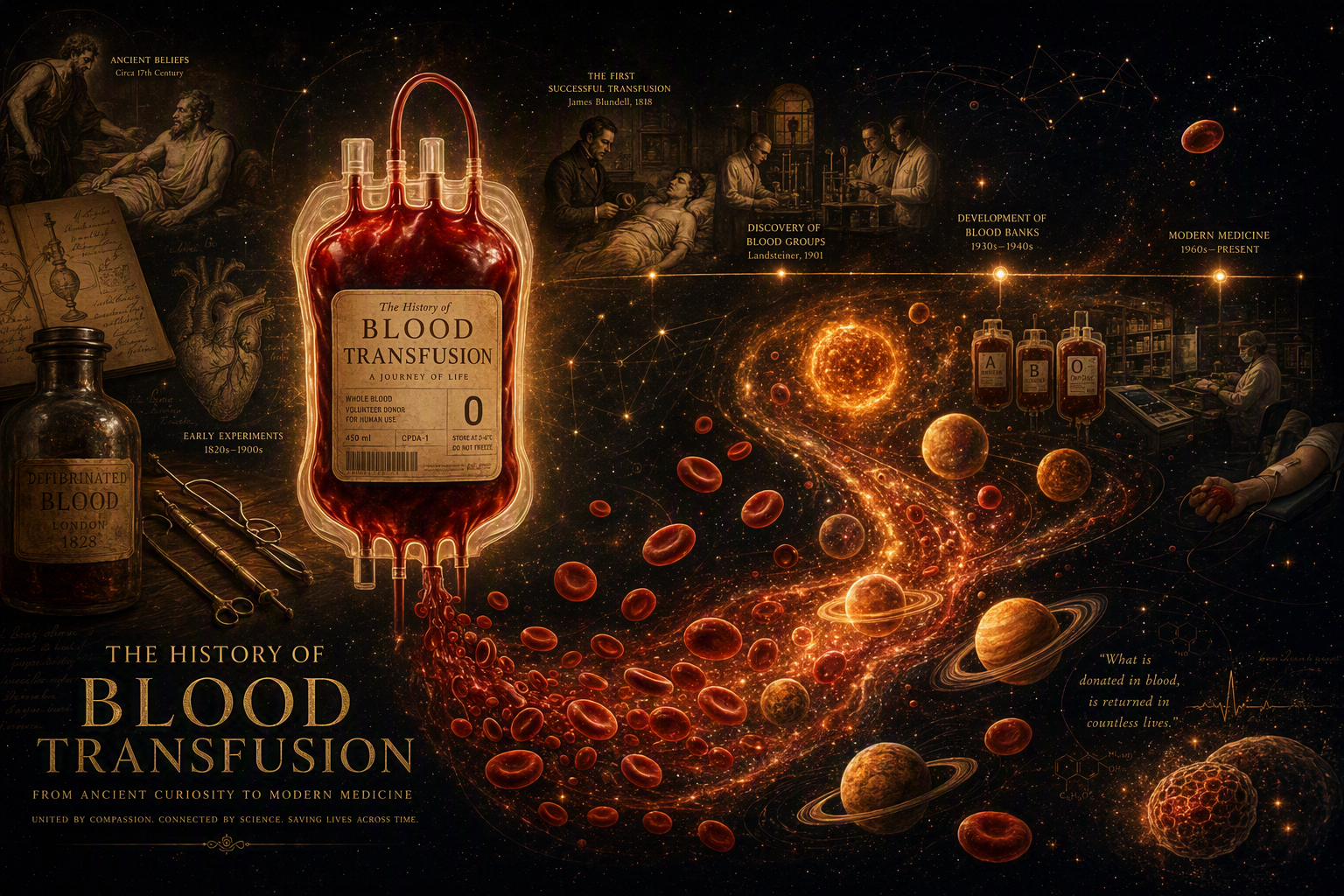
⏳ A Quick Journey Through Time
1628 — William Harvey describes the circulation of blood.
⬇️
1660s — Richard Lower performs transfusion experiments between animals.
⬇️
1667 — Jean-Baptiste Denis performs early animal-to-human transfusions.
⬇️
1818 — James Blundell performs an early human-to-human transfusion in an attempt to treat severe bleeding.
⬇️
1900–1901 — Karl Landsteiner identifies major differences between human blood groups, leading to the ABO system.
⬇️
Early 1900s — Anticoagulants and storage techniques improve, making stored blood increasingly practical.
⬇️
1930s–1940s — Blood banking expands, with organized collection and storage becoming increasingly important.
⬇️
Today — Blood is typed, screened, separated into components, carefully matched, and transfused under strict medical procedures.
🩸 From Lamb Blood to Modern Medicine
The history of blood transfusion shows something fascinating about medical progress.
Doctors did not suddenly discover the perfect method.
They experimented.
They made mistakes.
They asked new questions.
They developed better technology.
And most importantly, they learned more about how the human body works.
A procedure that once involved transferring animal blood into humans eventually became a carefully controlled medical treatment based on immunology, laboratory testing, blood banking, and more than a century of scientific research.
The next time you see a simple bag of donated blood, remember:
Behind that bag is a story involving dogs, lambs, pioneering doctors, Nobel Prize-winning discoveries, world wars, laboratory science, and hundreds of years of medical history.
Sometimes the most ordinary-looking things in a modern hospital have the most extraordinary histories.