You remember yesterday.
You can describe what you ate, where you went, what someone said to you, or perhaps a mistake you wish you could undo.
But here is a strange question:
Where is yesterday now?
We usually speak as if the answer is obvious. Yesterday is gone. The past no longer exists. Only the present is real.
But philosophers have spent centuries questioning whether this is actually true.
What if the past has not disappeared at all?
What if your childhood, yesterday morning, and even the moment you started reading this article still exist somewhere in the structure of reality?
The philosophy of time leads us into one of the strangest debates about existence itself.
🕰️ Augustine: What Exactly Is Time?
One of the most famous early discussions of time comes from Saint Augustine, who lived in the fourth and fifth centuries.
In Confessions, Augustine famously observed that time seems perfectly understandable until we try to explain what it actually is.
Think about the problem.
The past has already happened.
The future has not happened yet.
And the present seems to disappear almost immediately.
So what exactly are we talking about when we talk about time?
Augustine connected our experience of time closely with the mind.
The past survives through memory.
The future appears through expectation.
The present exists through attention.
Imagine remembering your first day at school.
That day is not physically happening around you anymore. The classroom may have changed. The people may have moved away. Years may have passed.
Yet something from that moment remains accessible through your consciousness.
But this raises a difficult question:
Are you remembering something that no longer exists, or are you somehow accessing a part of reality that still exists?
Augustine’s reflections did not settle the question.
They made it deeper.
⏳ Aristotle: Time Needs Change
Long before Augustine, Aristotle connected time with motion and change.
For Aristotle, time was not simply an invisible substance flowing through the universe. Our understanding of time was closely connected to recognizing change — something being before and something being after.
Imagine a universe where absolutely nothing changes.
No planets move.
No atoms vibrate.
No thoughts occur.
Nothing grows.
Nothing decays.
Would time still be passing?
Your first instinct might be yes.
But how could anyone tell?
Without change, there would be no clock, no heartbeat, no sunrise, and perhaps no meaningful distinction between one moment and another.
This creates a fascinating possibility:
Maybe time is not something that moves. Maybe time is how we measure change.
🌊 Heraclitus: Everything Flows
The ancient Greek philosopher Heraclitus presented an almost opposite way of thinking about reality.
He emphasized constant change.
His philosophy is famously associated with the image of a river: you cannot step into exactly the same river twice because the water is constantly moving.
And so are you.
Your cells change.
Your beliefs change.
Your memories change.
Your body ages.
Even while reading this sentence, the world is becoming different.
From this perspective, reality seems less like a collection of permanent moments and more like an ongoing process.
But there is a problem.
If everything is constantly changing, what connects the person you were ten years ago with the person reading this today?
You say:
“That was me.”
But in what sense?
🧠 Presentism: Only Now Is Real
One influential philosophical position is called presentism.
The basic idea is surprisingly simple:
Only the present exists.
The past existed, but it does not exist anymore.
The future will exist, but it does not exist yet.
Imagine reality as a spotlight moving across a dark stage.
Whatever the spotlight illuminates is now.
Everything behind it is gone.
Everything ahead of it has not yet become real.
This matches everyday experience remarkably well.
You cannot visit yesterday.
You cannot shake hands with your ten-year-old self.
You cannot physically retrieve a conversation from 2014.
It appears that the past has vanished.
But presentism immediately encounters a strange problem.
Consider this statement:
“Socrates taught Plato.”
That statement seems objectively true.
But if Socrates, Plato, and the event itself no longer exist, what exactly makes the statement true now?
The presentist needs an explanation for how facts about nonexistent things can remain true.
🧊 Eternalism: Maybe the Past Never Disappeared
Now things become much stranger.
Another major position is eternalism.
According to eternalism, past, present, and future events are all equally parts of reality.
Your childhood does not exist now in the ordinary sense.
But it may still exist at its own location in time.
Think of space.
Istanbul and Tokyo can both exist even though you are currently standing in only one of them.
You would never say:
“Tokyo doesn’t exist because I’m not there.”
An eternalist asks:
Why should time be completely different?
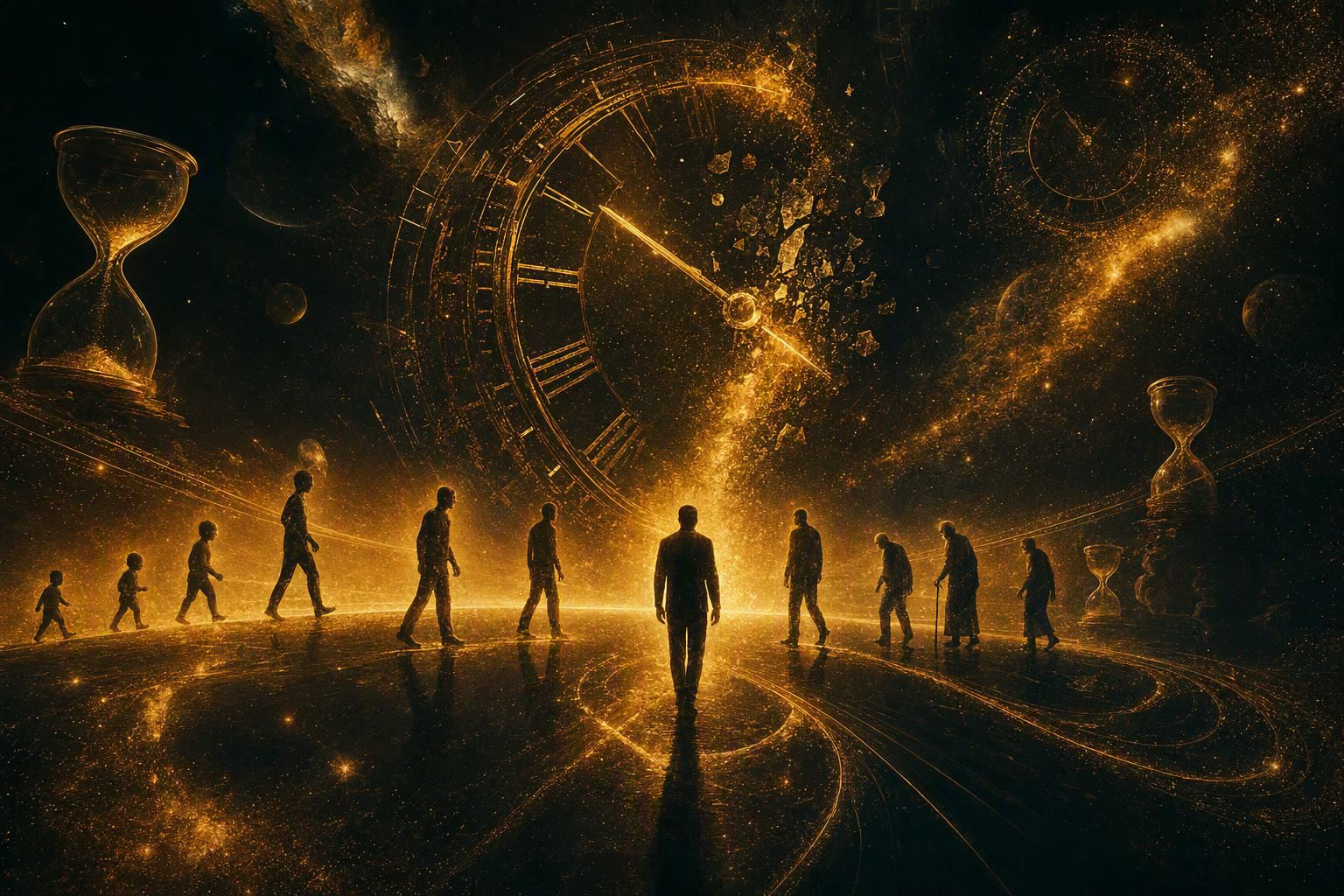
Perhaps 1990, 2026, and 2100 are somewhat analogous to different locations in a larger four-dimensional reality.
You experience only one temporal location at a time.
That does not necessarily mean the others are unreal.
This view is often associated with the idea of a block universe.
Reality would then resemble an enormous structure containing every event in spacetime.
Your birth.
This morning.
This sentence.
Your final day.
All occupying different positions within the structure.
If this is correct, then the past did not disappear.
You simply left it behind from your perspective.
🚂 Einstein Makes the Problem Even Stranger
Modern physics made philosophical debates about time considerably more complicated.
In Albert Einstein’s theory of relativity, there is no simple universal clock shared by every observer in the universe.
Observers moving differently can disagree about whether distant events occur simultaneously.
This is important because the ordinary idea of a single cosmic NOW becomes difficult to maintain.
Suppose two events happen far apart in space.
One observer may regard them as simultaneous.
Another observer moving relative to the first may not.
So whose present is the real present?
There may be no unique answer supplied by physics.
The philosopher Hilary Putnam famously argued that relativity creates serious difficulties for views according to which only the present is real.
But the philosophical consequences remain debated.
Physics can describe relationships between events with extraordinary precision.
Whether those equations prove that past and future events literally exist is another question.
That step takes us from physics into metaphysics.
🔥 The Arrow of Time: Why Can We Remember Yesterday but Not Tomorrow?
There is another mystery.
Time appears to have a direction.
You remember breakfast.
You do not remember tomorrow’s dinner.
A glass falls from a table and shatters.
We never normally watch shattered pieces spontaneously jump together and form a perfect glass.
Why?
One important physical concept here is entropy.
According to the second law of thermodynamics, entropy tends to increase in an isolated system.
Very roughly, physical systems tend to evolve from less probable, more ordered arrangements toward more probable arrangements.
This gives us what physicists call a thermodynamic arrow of time.
But even here, philosophical questions remain.
Does time itself actually flow toward the future?
Or do physical processes simply have an asymmetric structure that makes us experience a direction?
Those are not necessarily the same claim.
🧩 McTaggart: Maybe Time Isn’t Real at All
In 1908, British philosopher J. M. E. McTaggart published one of the most provocative arguments in the philosophy of time.
He distinguished between two ways of organizing events.
The A-series describes events as:
past → present → future
The B-series describes events according to relations such as:
earlier than → later than
For example:
Your birth is earlier than today.
Today is later than your birth.
Those relationships do not seem to change.
But something’s status as past, present, or future constantly changes.
Your next birthday is currently future.
Eventually it becomes present.
Then it becomes past.
McTaggart argued that our ordinary conception of temporal passage involves contradictions and concluded, remarkably, that time itself is unreal.
Many philosophers reject his argument.
But his challenge remains enormously influential.
Perhaps what we call the “flow of time” is not a property of the universe at all.
Perhaps it is a feature of consciousness.
🧠 Is the Present Created by Your Brain?
Consider something happening right now.
You see these words.
Your brain receives visual information, processes it, interprets symbols, and constructs a conscious experience.
That process takes time.
So the “present” you experience may already involve information about events that happened slightly earlier.
This leads to an unsettling possibility:
Perhaps we never experience the exact present.
Instead, consciousness may construct a useful window that we call “now.”
If so, the present might be less like a razor-thin cosmic boundary and more like a feature of perception.
And then another question appears:
If the present is partly constructed by the brain, why should we assume that our intuitive feeling that the past has “disappeared” tells us something fundamental about the universe?
📸 What About Memory?
Imagine looking at a photograph of yourself at age six.
The child in the photograph was you.
But that child had different thoughts.
A different body.
Different fears.
Different knowledge.
Perhaps even a completely different understanding of the world.
Where is that child?
Presentism gives one answer:
That child no longer exists.
Eternalism offers another:
That child exists at an earlier temporal location, just as another city exists at another spatial location.
And some philosophical approaches to identity make the question even more complicated.
Perhaps there is no single permanent “you” traveling through time.
Perhaps what exists is a chain of psychologically and physically connected versions of you.
The question “Does the past still exist?” therefore becomes connected to another:
Do your past selves still exist?
🚪 Could You Ever Return to the Past?
This is where philosophy meets science fiction.
If the past still exists in some sense, could we travel there?
Not necessarily.
Something can exist without being accessible from your current position.
Even if eternalism is correct, it does not automatically provide a mechanism for moving freely between temporal locations.
General relativity contains unusual mathematical possibilities involving spacetime, including solutions with closed timelike curves.
But whether anything resembling practical travel into the past is physically possible is an entirely different question.
And then come the paradoxes.
Suppose you travel into the past and prevent your grandparents from meeting.
Then you would never be born.
But if you were never born, who traveled into the past?
The famous grandfather paradox illustrates how quickly our ordinary ideas about cause and effect become unstable when backward time travel enters the discussion.
🤯 A More Disturbing Question
Suppose eternalism is correct.
Think of the worst day of your life.
Has it really ended?
From your current perspective, yes.
But if every moment exists within spacetime, perhaps that painful moment permanently occupies its temporal location.
Now think about the happiest moment of your life.
Perhaps that has not disappeared either.
Somewhere in the structure of spacetime, that version of you is still laughing.
Still hearing those words.
Still seeing that person.
Still experiencing that exact moment.
This idea can sound beautiful.
It can also sound terrifying.
⚖️ So, Does the Past Still Exist?
There is no universally accepted philosophical answer.
Presentism says reality exists only now.
Eternalism says past, present, and future are all parts of reality.
Other theories attempt to preserve a genuinely changing universe while allowing the past to remain real in some sense.
And thinkers such as McTaggart have challenged the assumption that temporal passage is fundamental at all.
Modern physics has transformed the debate but has not simply solved the metaphysical question.
Perhaps the deepest problem is that we experience reality from inside time.
We cannot step outside the universe, look at its entire history, and see whether time is flowing or whether every moment is already part of a larger structure.
We are participants in the thing we are trying to understand.
🌌 One Final Thought
Stop reading for five seconds.
Look around you.
Notice where you are.
Listen to whatever sounds are nearby.
This moment feels completely real.
But soon it will become something you call the past.
What happens to it then?
Does reality erase it?
Does it continue to exist somewhere in spacetime?
Does it survive only as information and memory?
Or was the distinction between “now” and “then” partly created by your mind from the beginning?
Perhaps the strangest possibility is this:
The past may not be a place that disappeared.
It may simply be a place in time that you can no longer reach.