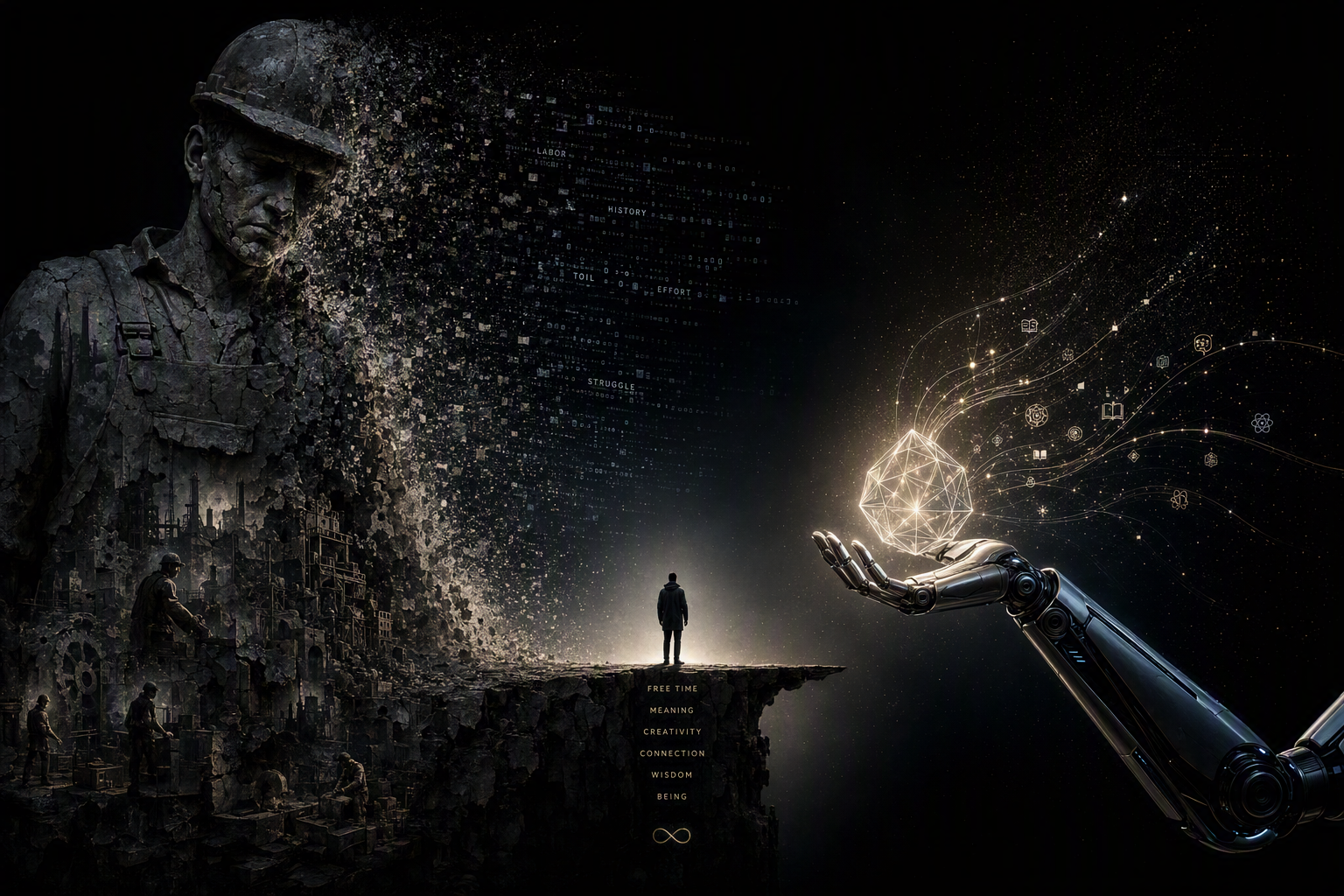
For centuries, humanity has defined its worth by its toil ⛏️. From the ancient Greek hierarchy of labor to the Protestant work ethic that turbocharged the Industrial Revolution 🏭, we have stitched our identity into our occupations 👔. When someone asks, “What do you do?” 🗣️ they are rarely asking about your passions; they are asking about your economic output 💰.
Yet, we stand at a precarious cliff edge in 2026 🧗♂️. With generative AI 🧠, hyper-advanced automation 🦾, and the looming promise of Universal Basic Income (UBI) 💵, the horizon of a “post-work society” is no longer science fiction 🚀. It is a looming logistical and philosophical reality 🔮.
But as machines prepare to liberate us from the assembly line and the spreadsheet 📉, a chilling existential question emerges: If labor ends, what happens to human dignity? 🤔
📉 The Marxist Nightmare: The Horror of Forced Idleness
To understand our modern anxiety about a post-work world, we must first consult Karl Marx 🧔🏻♂️. Marx envisioned a post-work utopia where automation frees humanity from drudgery ⛓️, allowing people to “hunt in the morning, fish in the afternoon, rear cattle in the evening, [and] criticize after dinner 🎣🌾.”
However, early 21st-century capitalism has twisted this dream into a nightmare 🌪️. In our current ecosystem, our labor is tied to our survival 💳. If machines take our jobs without a radical restructuring of wealth, the result isn’t liberation; it is mass disenfranchisement 📉. Without structural UBI, a post-work economy spells a dystopian neo-feudalism where a handful of tech oligarchs own the means of automation 🏰, while the rest of humanity is rendered economically obsolete 🚫. In this scenario, losing your job doesn’t mean freedom—it means losing your right to exist comfortably 🛑.
🏛️ The Aristotelian Trap: The Danger of “Leisure” Without Virtue
Even if we solve the economic distribution problem through UBI, a deeper philosophical crisis remains, one anticipated by Aristotle 🏛️.
Aristotle distinguished between aszkholia (labor/work) and schole (leisure) ⚖️. To the Greeks, leisure wasn’t binge-watching Netflix or scrolling through TikTok 📱; it was the active pursuit of higher virtues, philosophy, and civic duty 📚. Aristotle warned that most people do not know what to do with true freedom 🕊️.
Look around today 👀. We already suffer from an epidemic of alienation and “bullshit jobs” 🏢 (as anthropologist David Graeber called them). If work vanishes entirely, what fills the vacuum 🕳️? Without the forced structure of a 9-to-5, will humanity elevate itself to cultural and intellectual greatness, or will we sink into a profound, digital apathy 🛋️? If our primary source of self-esteem evaporates, how do we prevent a global existential depression 🌧️?
⚡ The Existentialist Revolt: Reclaiming Authenticity Beyond the Resume
This is where Jean-Paul Sartre 👓 and existentialism offer a radical lifeline ⚓. Existentialism argues that “existence precedes essence”—we are not born with a predefined purpose 🧭. Capitalism tries to hand us a pre-packaged essence: You are an accountant, a software engineer, a barista ☕.
When labor ends, the crutch of corporate identity is kicked away 🩼. Sartre would argue that this terrifying vacuum is precisely where true freedom begins 🔥. In a post-work utopia, you are no longer a cog in a macroeconomic machine ⚙️. You are forced to confront the ultimate question: Who are you when no one is paying you to be useful 🪞?
Dignity shifts from being a metric of productivity to a metric of creation 🎨. We stop measuring human value by GDP contribution and start measuring it by emotional depth, artistic expression, community building, and curiosity 🌻.
✨ Redefining Dignity for the AI Era
The transition to a post-work society will force humanity through its greatest philosophical identity crisis 🌀. We must unlearn the toxic cultural conditioning that equates breathing with earning 🫁.
Dignity cannot remain tethered to economic utility ⚓. As machines take over the labor that drains our bodies, our ultimate challenge is not technological—it is spiritual and philosophical 🌠. We have to invent a culture where a human being is valued simply for being, rather than for producing ❤️.
💡 Reflection Question: If your job, title, and income stream were completely erased tomorrow by an AI, what would give your life meaning the day after 🌅?
What aspect of this post-work future intrigues you the most—the economic survival via UBI 💸, or the psychological struggle of finding purpose without a career 🧭?