The paradigm shift from centralized cloud computing to decentralized edge intelligence is one of the most profound transformations in modern technology 💻. For decades, the mantra of the tech industry was simple: send all data to the cloud ☁️, let massive server farms crunch the numbers, and send the result back. Today, that model is cracking under the weight of latency, bandwidth limits, privacy regulations, and skyrocketing energy costs 📉.
Let’s expand our journey into the technical depths, real-world mechanics, advanced development workflows, and the fascinating future of Edge AI and On-Device Machine Learning 🤖✨.
Part 1: 🏗️ The Architectural Anatomy of an Edge AI System
To truly understand why Edge AI represents a masterclass in engineering 🛠️, we must look at how traditional cloud architectures compare with edge pipelines.
The Cloud vs. Edge Bottleneck ⚡
The Cloud Pipeline ☁️: Sensor Data 📊 $\rightarrow$ Serialization $\rightarrow$ Network Transmission (TCP/IP, Cellular/Wi-Fi) $\rightarrow$ Cloud Ingestion Gateway $\rightarrow$ GPU Cluster Inference $\rightarrow$ Response Transmission $\rightarrow$ Client Action. Total latency: 100ms to several seconds ⏳.
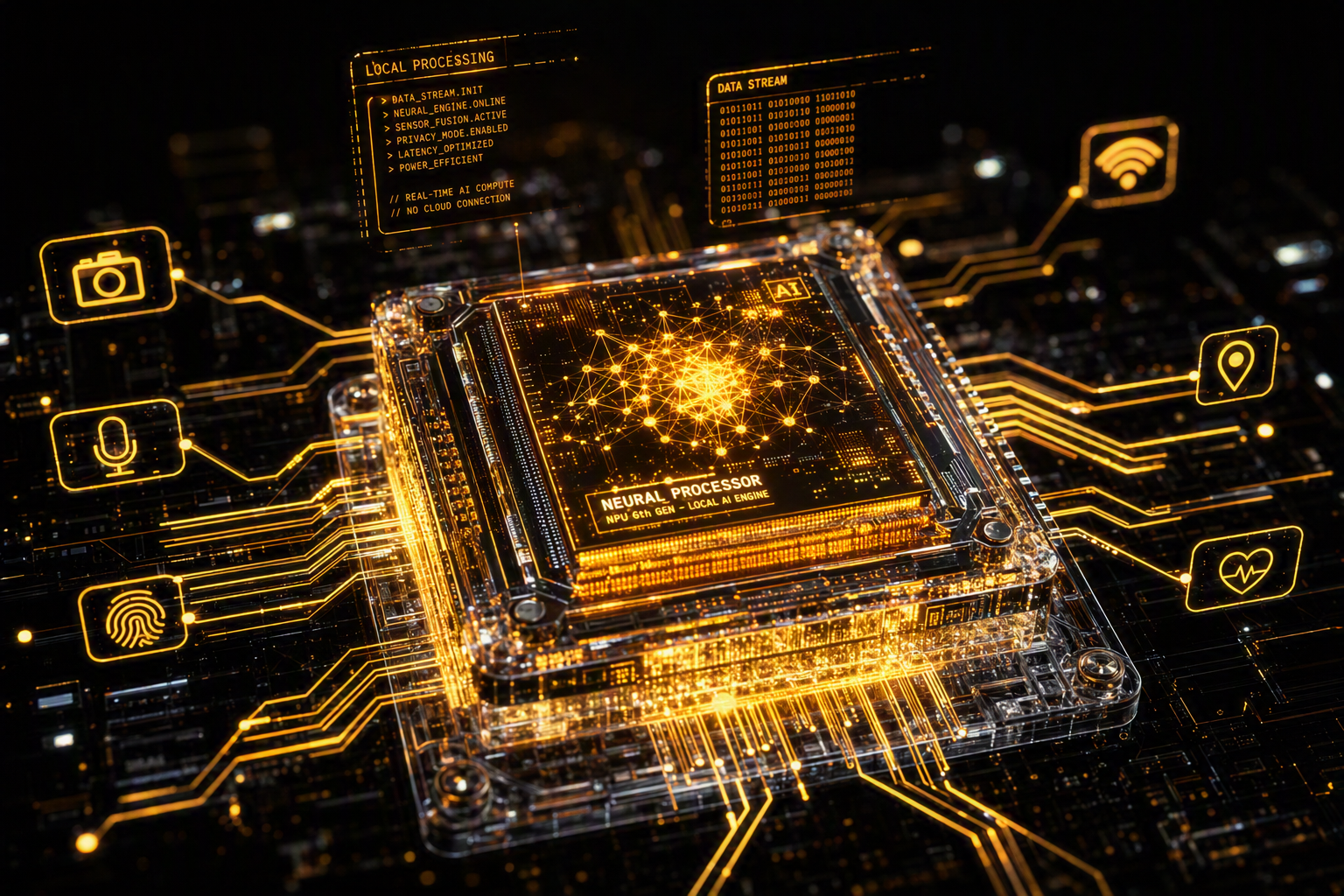
The Edge Pipeline 📱: Sensor Data 📊 $\rightarrow$ Local NPU / Microcontroller Inference $\rightarrow$ Immediate Action ⚡. Total latency: Sub-millisecond to single-digit milliseconds 🚀.
In mission-critical environments like autonomous navigation 🚗, robotic surgery 🏥, or drone swarm coordination 🛸, a 100-millisecond delay can mean the difference between a successful maneuver and a catastrophic failure 💥. Edge AI completely bypasses network congestion and points of failure 🛡️.
Part 2: 🧙♂️ The Engineering Wizardry—How Do We Fit Giants into Pockets?
Training a state-of-the-art neural network requires thousands of high-end GPUs consuming megawatts of power 🔋. Running that same model on a smartphone or a battery-powered IoT sensor sounds like putting a jet engine inside a bicycle 🚲💨. Engineers achieve this miracle through a triumvirate of optimization techniques:
Quantization (From FP32 to INT8/INT4) 📉:
Standard models use 32-bit floating-point numbers (FP32) to store weights and biases. Quantization translates these into 8-bit integers (INT8) or even 4-bit integers (INT4) 🗜️.
The Result: The memory footprint shrinks by up to 75% to 87%, while inference speeds multiply, with an almost negligible drop in accuracy 🎯.
Pruning and Sparsity ✂️:
Many neurons and connections in a deep neural network contribute very little to the final output. Pruning involves systematically “snipping” these redundant connections, creating a sparse network that requires far fewer computational cycles ⚙️.
Knowledge Distillation 👨🏫👩🎓:
This is the “teacher-student” paradigm. A massive, complex “teacher” model (like a 70-billion parameter LLM) trains a smaller, nimble “student” model (a Small Language Model or SLM) to mimic its behavior 🧠. The student retains a high degree of intelligence while fitting comfortably on consumer hardware 📱.
Part 3: 🌍 Deep-Dive Industry Use Cases
Let’s explore how different sectors are leveraging edge intelligence to redefine what is possible offline 📶❌:
Autonomous Drones in Search & Rescue 🚁: When rescue drones fly deep into dense forests or collapsed disaster zones after an earthquake 🏚️, cellular infrastructure is usually wiped out. Running computer vision models locally on edge boards allows these drones to autonomously detect heat signatures, human forms, or structural hazards in real-time without needing a live base station link 🌲👀.
Next-Gen Wearables & Medical Diagnostics ⌚💓: Modern smartwatches act as silent sentinels. Instead of streaming your continuous ECG data or heart rate variations to a corporate cloud, local anomaly-detection networks analyze your biometric streams on-device 🔒. If an irregular rhythm is detected, it triggers an instant alert while ensuring your sensitive health data remains strictly private 🛡️.
Industrial Internet of Things (IIoT) & Smart Manufacturing 🏭⚙️: Heavy industrial machinery vibrates constantly. By mounting low-power microcontrollers running TinyML models directly onto motor casings, factories can monitor acoustic signatures 🎧. The system detects micro-vibrations indicative of bearing wear weeks before a breakdown occurs, saving millions in unplanned downtime 💰.
Part 4: 🛠️ Advanced Practical Blueprint for Developers
If you are a software engineer or data scientist aiming to build your first production-grade edge deployment, follow this comprehensive workflow 📋:
Select the Right Runtime & Framework 🧩:
Mobile (iOS/Android) 📱: CoreML (Apple) and TensorFlow Lite / MediaPipe (Google).
Microcontrollers / TinyML 💻: TensorFlow Lite for Microcontrollers, Edge Impulse, or STM32Cube.AI.
Cross-Platform / High-Performance IoT 🌐: ONNX Runtime with hardware acceleration delegates (DirectML, TensorRT, or NNAPI).
Optimize for Power and Thermal Budgets 🌡️🔋:
Always monitor TOPS/W (Tera Operations Per Second per Watt). A model that achieves high accuracy by pegging a mobile CPU at 100% utilization will overheat the device and drain the battery in minutes, resulting in poor user experience and automatic thermal throttling by the operating system 🔥.
Implement Hybrid Fallbacks 🔄:
Design your application architecture intelligently. Run fast, lightweight classification or detection tasks on the edge locally ⚡. If a high-confidence anomaly or complex query occurs that requires broader context, then securely queue and push a compressed payload to the cloud for heavy analysis ☁️.
Part 5: 💻✨ Creative AI Prompts for Inspiration
Expand your creative horizons or generate technical concepts with these specialized prompts 🎨:
For Advanced Concept Art & Design 🖼️:
“A hyper-detailed, cinematic macro shot of a microscopic neural processing chip glowing with bioluminescent blue circuits inside a transparent smart-ring, futuristic tech laboratory background, ray-traced lighting, 8k.”
For System Architecture Brainstorming 📊:
“Act as a Principal Edge Computing Architect. Design a resilient, offline-first data pipeline for an autonomous agricultural rover operating in a remote vineyard with zero cellular coverage. Detail the sensor suite, local model quantization strategy, and local SQLite data synchronization protocol.”
Which specific domain of edge intelligence—such as offline Small Language Models on mobile devices 📱, or TinyML on microcontrollers 🔌—would you like to explore or outline code for next?