Thought as Process vs. Thought as Identity 🔄👤
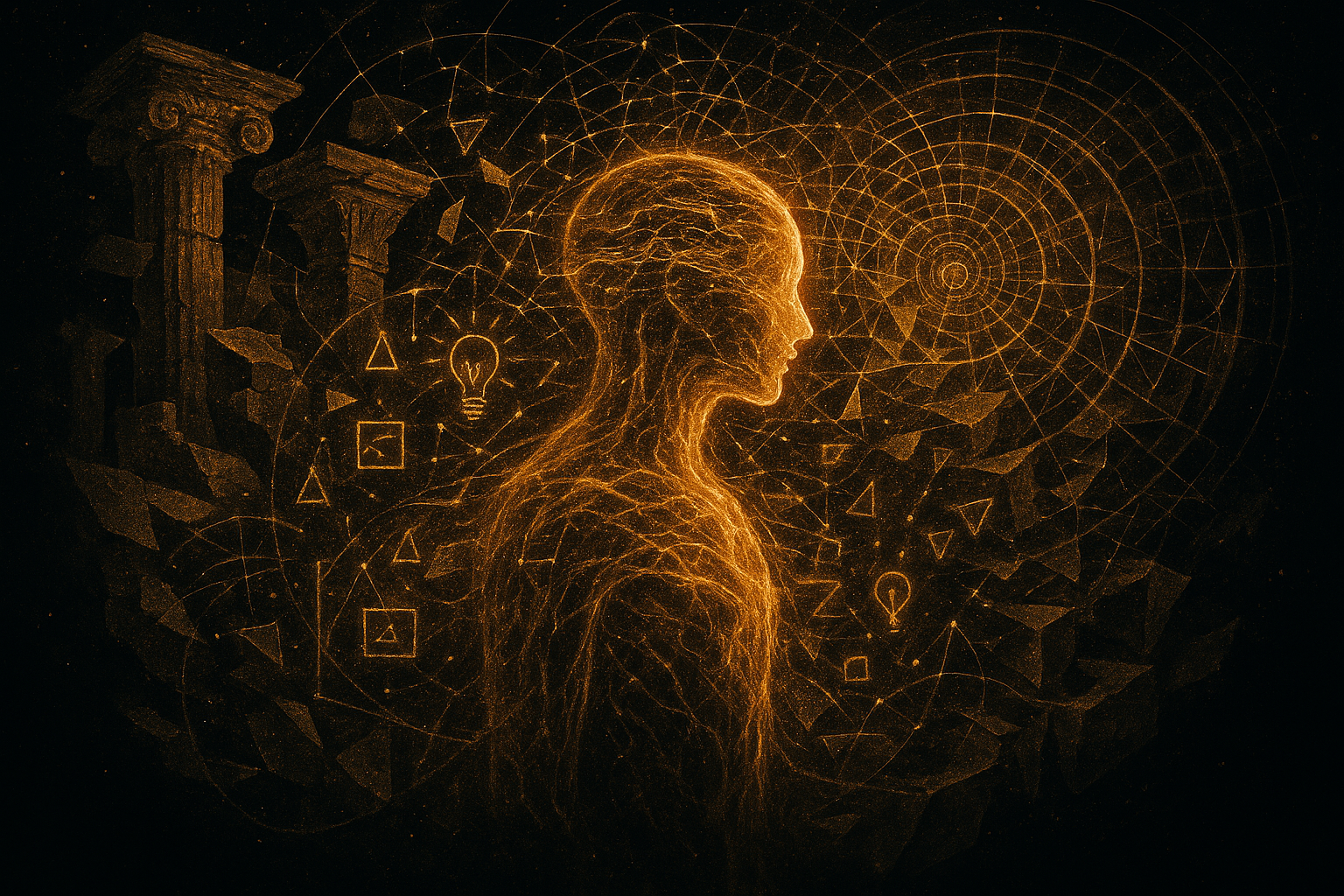
Thought is often treated as something we have — a mental event that appears and disappears within consciousness. Yet a deeper philosophical and psychological perspective suggests something far more unsettling: thought is not merely something we possess, but something that continuously constructs what we call the “self.”
From a cognitive standpoint, human beings generate thousands of thoughts daily, most of which are automatic, repetitive, and unconscious. Neuroscience increasingly shows that what we experience as “personal identity” is largely the outcome of habitual neural patterns rather than deliberate conscious design.
This leads to a profound question:
If most thoughts are repetitive and automatic, to what extent is the “self” truly original?
Philosophers like David Hume argued that the self is not a stable entity but a “bundle of perceptions” — a constantly shifting flow of mental events. In this sense, identity is not the thinker behind thought, but the pattern of thinking itself.
But then we must ask:
If thought produces the self, who is observing thought?
Plato’s Forms vs. Modern Cognitive Science 🏛️🧬
Plato proposed that beyond the physical world lies a realm of perfect, unchanging Forms — absolute truths such as Beauty, Justice, and Goodness. According to him, the material world is merely a shadow of this higher reality.
Modern cognitive science, however, reverses this metaphysical structure. Instead of accessing eternal truths, the human brain actively constructs reality through prediction, memory, and sensory integration. Perception is not a passive reception of truth, but an active simulation of the external world.
Thus, Plato and neuroscience arrive at a paradoxically similar conclusion from opposite directions:
What we experience is not reality itself, but a mediated representation of it.
This raises a critical philosophical question:
If both ancient metaphysics and modern science agree that perception is indirect, then what is the ontological status of “reality” itself?
How Thought Shapes the Perception of Reality 🌍🧠
Human perception is not neutral. It is filtered through expectation, belief, and prior experience. Cognitive psychology refers to this as confirmation bias — the tendency to interpret information in ways that reinforce existing beliefs.
From this perspective, thought is not merely interpretive; it is structurally formative. It shapes not only how we understand reality, but what we are capable of perceiving as reality in the first place.
William James captured this psychological principle when he wrote:
“The greatest discovery of my generation is that human beings can alter their lives by altering their attitudes of mind.”
If this is true, then thought is not a passive reflection of reality but an active participant in its construction.
This leads to a radical implication:
Reality is not simply “seen” — it is partially generated by the structure of thinking itself.
A Philosophical Dilemma: Can Thought Validate Itself? ⚖️🧠
Here emerges a deep epistemological paradox: if all knowledge is produced through thought, how can thought objectively evaluate its own reliability?
It becomes analogous to attempting to clean a mirror using the reflection inside it.
Nietzsche challenged the assumption of objective truth, suggesting that what we call “truth” often reflects underlying psychological needs and power structures rather than pure objectivity.
Michel Foucault extends this critique further, arguing that knowledge systems define the boundaries of what can be thought in the first place. In this sense, thinking is never fully free; it is shaped by historical, linguistic, and institutional frameworks.
This leads to a difficult question:
Are our thoughts truly our own, or are they expressions of structures we do not consciously control?
Final Reflection: Thought as the Invisible Architect 🧠✨
Ultimately, thought may not simply be a cognitive tool, but an invisible architecture that organizes perception, constructs identity, and mediates reality itself.
We do not merely think within thought — we exist within it.
This transforms the central philosophical question:
Not “What do I think?”
But rather “What kind of thinking is producing me?”
Because once thought turns inward and begins to observe itself, it ceases to be just a process.
It becomes a profound psychological mystery — and perhaps, the deepest structure of human existence.