There are moments in science that feel almost too perfect to be planned ✨ Not because they are carefully designed—but because they are beautifully accidental.
Penicillin is one of those moments.
It didn’t arrive with fireworks or dramatic announcements 🎇 It showed up quietly… on a forgotten petri dish, sitting in a messy London laboratory.
And then it changed everything 🌍
👨🔬 Alexander Fleming: The Reluctant Hero of a Clean Mess
Alexander Fleming was not the kind of scientist who obsessed over spotless benches or perfectly organized notes 🧪 Quite the opposite, actually.
His laboratory at St. Mary’s Hospital in London had a reputation—part working space, part controlled chaos 📚🧫 And strangely enough, that chaos played a role in one of medicine’s greatest breakthroughs.
Fleming was studying bacteria in the 1920s, at a time when infections were terrifyingly powerful 🦠 A simple cut could spiral into sepsis. Pneumonia often meant death. Medicine had tools—but not answers.
Fleming wanted something revolutionary:
A substance that could kill bacteria… without harming the human body 💊
He just didn’t expect nature to hand it to him while he was on holiday 🌿
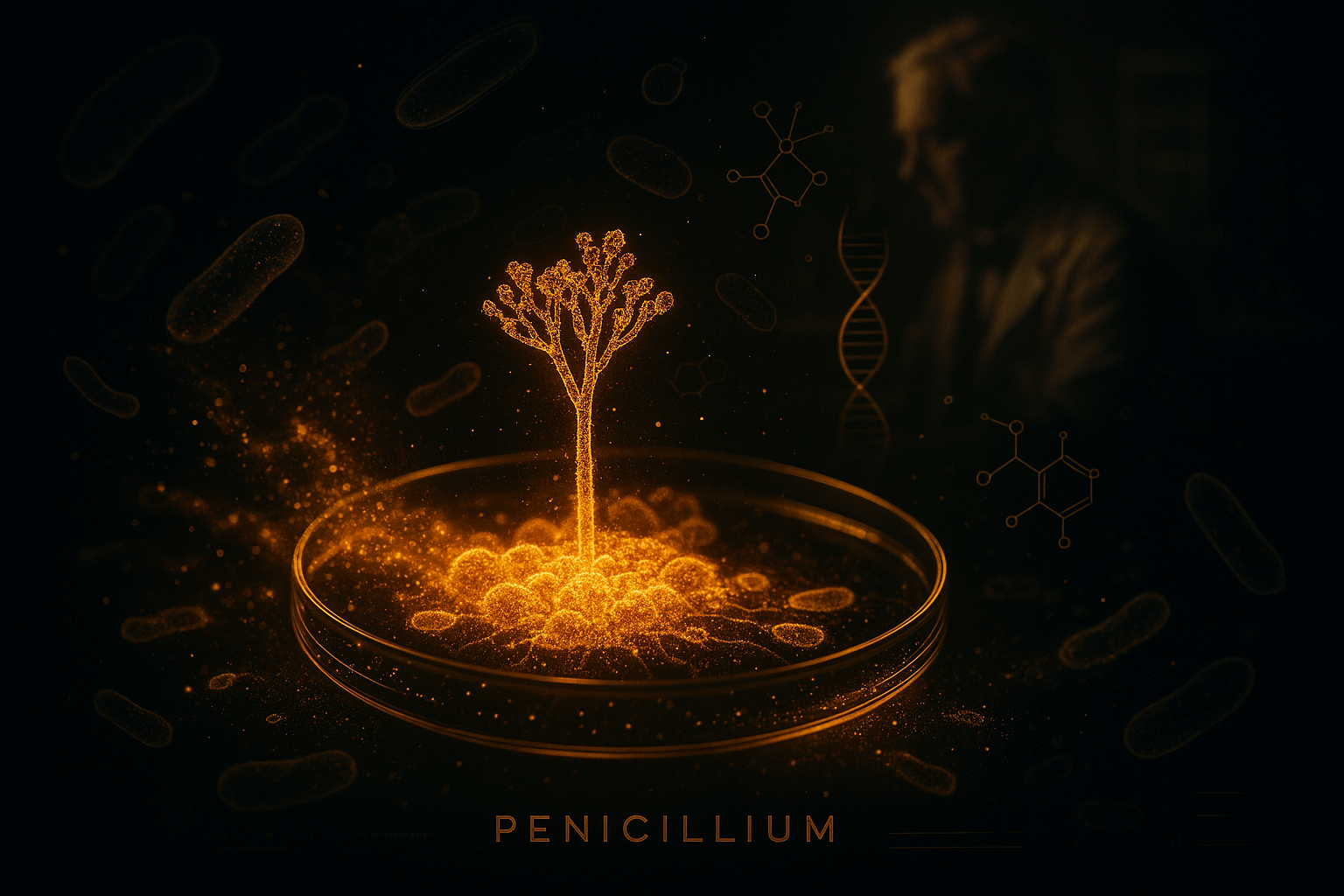
🧫 The Petri Dish That Wasn’t Supposed to Matter
In 1928, Fleming returned to his lab after being away for a few weeks 🏥 When he came back, he expected routine cleanup—old plates, discarded experiments, normal lab chaos.
But one dish made him pause.
It had been contaminated with mold 🍄 Normally, that’s the kind of mistake you throw away without a second thought.
But Fleming didn’t.
He leaned in 👀
And what he saw didn’t make sense at first.
Around the mold, the bacteria had completely disappeared—as if something had drawn an invisible circle of silence 🤯
No bacteria. No growth. Just emptiness.
That mold was identified as Penicillium notatum 🧫
And the substance it produced was something the world had never properly seen before:
Penicillin 💊
💊 So What Is Penicillin, Really?
Penicillin is an antibiotic—one of the most important drug classes in modern medicine 🧬
But what makes it special is how elegantly it works ⚙️
Bacteria survive because they have a protective cell wall 🧱 like armor.
Penicillin doesn’t attack directly. Instead, it sabotages construction 🏗️
🚫 Blocks cell wall formation
💥 Weakens bacterial structure
⚡ Causes bacteria to collapse
It’s almost poetic—the bacteria don’t get violently destroyed… they simply fall apart because they can’t hold themselves together anymore.
And the most important part?
It targets bacteria, not human cells 🧍♂️✨
That’s what made it revolutionary.
⚙️ The Discovery That Refused to Become a Medicine (At First)
Here’s the twist most people don’t expect 😮
Fleming didn’t change medicine overnight.
After publishing his findings, almost nothing happened 📄
Why?
Because penicillin was extremely difficult to isolate and produce in usable quantities at the time.
So for years, it remained:
A fascinating observation… trapped in a scientific paper 📚
A “almost miracle” waiting for technology.
🧪 Oxford Scientists: Turning Idea Into Reality
More than a decade later, scientists at Oxford University—Howard Florey and Ernst Boris Chain—picked up Fleming’s forgotten discovery 🔬
And they pushed it forward.
Hard.
They worked on purification, extraction, and production methods ⚗️
Slowly, penicillin stopped being an idea and became a medicine 💉
And then… the world went to war 🌍⚔️
🪖 World War II: When Penicillin Became a Lifeline
During World War II, more soldiers died from infections than from bullets 🩸
Wounds became deadly. Medicine struggled. Hospitals were overwhelmed.
Then penicillin entered the battlefield 💊
Suddenly:
🩹 Infections became treatable
🏥 Amputations decreased
🪖 Soldiers survived wounds that were previously fatal
It wasn’t just treatment.
It was hope in liquid form ✨
🌍 The Birth of the Antibiotic Era
Before penicillin:
🦠 Infections were often death sentences
🏥 Surgery was extremely risky
👶 Childbirth carried high danger
After penicillin:
💊 Infections became manageable
🧬 Medicine became more powerful
📈 Life expectancy increased
This was the beginning of the antibiotic era 🌍
Medicine was no longer helpless against bacteria.
🧠 The Man Behind It All
Fleming was never the loud “I changed the world” type 🧑🔬
He was humble, almost uncomfortable with fame.
In 1945, he shared the Nobel Prize with Florey and Chain 🏅
And he kept repeating one idea:
Penicillin wasn’t invented—it was discovered 🌿
Nature had already done the work. Humans just noticed it.
✨ Final Thought
This story is almost too simple to be real:
A messy lab 🧪
A forgotten dish 🧫
A bit of mold 🍄
And from that… a revolution 💊🌍
Sometimes science doesn’t shout.
Sometimes it quietly changes everything.
One accident. Millions of lives saved. 💙