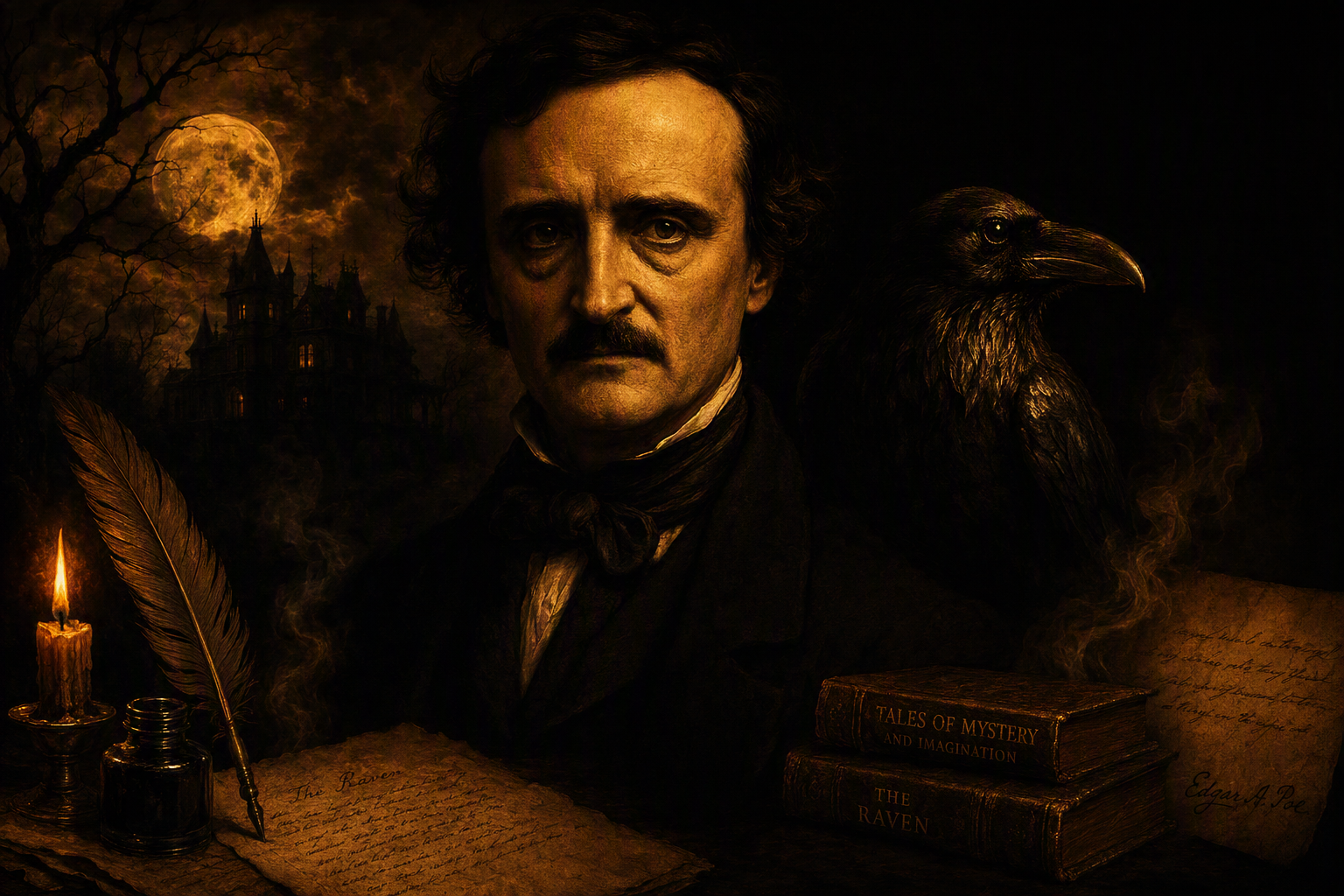
Few writers have managed to make darkness feel as strangely beautiful as Edgar Allan Poe. 🌑
Mention his name and certain images immediately appear: 🐦⬛ ravens, 🕯️ candlelit rooms, ⚰️ mysterious deaths, 🫀 beating hearts beneath wooden floors, 🏚️ lonely mansions, premature burials, madness, and people who definitely should not be trusted with sharp objects. 😅
But Edgar Allan Poe was much more than simply “the creepy writer with the raven.”
He was a poet, literary critic, editor, short-story writer, pioneer of detective fiction 🔎, and one of the most influential figures in Gothic literature.
His stories explored fear not simply as something hiding outside the window…
…but as something already living inside the human mind. 🧠🌑
And perhaps most appropriately for a man who spent his career writing mysteries, Poe eventually became the central character in one himself.
⚰️ His death remains mysterious to this day.
So, who exactly was Edgar Allan Poe?
👦 A Childhood Marked by Loss
Edgar Poe was born in Boston, Massachusetts, on January 19, 1809, to actors David and Elizabeth Poe. 🇺🇸
Tragedy entered his life almost immediately.
His father disappeared from the family while Poe was very young, and his mother died in 1811 when Edgar was only two years old. 💔
He was then taken in by John and Frances Allan of Richmond, Virginia. Although they raised him, they never formally adopted him.
Poe later incorporated their surname into his own:
✒️ Edgar Allan Poe
His relationship with John Allan was difficult, particularly over money.
Poe attended the University of Virginia 🎓, but financial problems and gambling debts contributed to his departure.
Later, he joined the U.S. Army and eventually entered the United States Military Academy at West Point. 🪖
That didn’t work out either.
Poe deliberately neglected his military duties and was court-martialed and dismissed in 1831.
If Poe’s early life sounds like the beginning of a Gothic novel… 📖
Unfortunately, things were only getting started. 🌑
✍️ From Struggling Writer to Literary Original
Poe wanted to make his living through writing at a time when doing so was extremely difficult.
He worked as an editor and literary critic while publishing poetry and short fiction. 📰
As a critic, he developed a reputation for being remarkably sharp.
And “sharp” is the polite word. 😬
Poe could be brutal when reviewing writers he considered mediocre. His aggressive criticism earned him enemies, but it also made him one of the most recognizable literary critics of his era.
Meanwhile, his own fiction was becoming increasingly distinctive.
Instead of simply asking:
👻 “What if something frightening happened?”
Poe seemed more interested in another question:
🧠 “What happens to a human mind when it begins to collapse?”
That difference became essential to his work.
🧠 Poe Didn’t Just Write Horror — He Entered the Human Mind
Modern horror often gives us monsters, killers, supernatural creatures or enormous quantities of blood. 🩸
Poe frequently needed none of them.
🚪 A sound could be enough.
🏚️ A room could be enough.
💭 A memory could be enough.
😰 A guilty conscience could certainly be enough.
His narrators are often unreliable, obsessive, paranoid, terrified or mentally unstable.
Even better, some desperately insist that they are perfectly sane while behaving in ways that strongly suggest otherwise. 😅
One of the best examples appears in “The Tell-Tale Heart.” 🫀
The unnamed narrator murders an old man, hides his body beneath the floorboards and initially believes he has committed the perfect crime.
Then the police arrive. 🚔
While speaking to them, the narrator begins hearing what sounds like the dead man’s heartbeat beneath the floor.
Thump.
Thump.
Thump. 🫀
It grows louder.
And louder.
And louder.
Eventually, overwhelmed by guilt and paranoia, the murderer confesses.
The genius of the story lies in what Poe refuses to explain.
Is the heart actually beating?
Almost certainly not.
But that doesn’t matter.
The narrator believes he can hear it.
The true monster isn’t underneath the floorboards.
🧠 It’s inside his head.
🐦⬛ “The Raven” and the Word That Became Immortal
If one work transformed Poe into a literary celebrity, it was his 1845 poem “The Raven.”
The poem follows a grieving man visited late at night by a mysterious raven. 🌙
The bird enters his room and eventually settles above the door.
Then it begins answering him with one word:
🐦⬛ “Nevermore.”
At first, the situation is strange.
Then it becomes disturbing. 😨
The grieving narrator begins asking increasingly emotional questions, especially about his lost love, Lenore. 💔
The raven continues providing the same answer.
Nevermore.
One of the poem’s most famous lines reads:
🐦⬛ “Quoth the Raven ‘Nevermore.’”
Simple.
Memorable.
And after enough repetition… deeply unsettling.
“The Raven” made Poe famous ⭐, but fame did not make him financially secure.
That contradiction followed him throughout his career: enormous literary influence paired with persistent financial struggle.
🫀 “The Tell-Tale Heart”: Guilt Has a Sound
Published in 1843, “The Tell-Tale Heart” remains one of Poe’s most famous short stories.
Its opening immediately introduces the narrator’s unstable state of mind.
He insists that he isn’t mad while explaining, in increasingly disturbing detail, how carefully he planned a murder. 🔪
Perfectly normal behavior, obviously. 😅
The narrator isn’t primarily motivated by money or revenge.
He becomes obsessed with the old man’s eye. 👁️
Poe describes it as resembling the eye of a vulture.
That’s it.
Apparently, for this narrator, having an unpleasant eye is enough to trigger an extremely complicated murder plan.
But beneath the bizarre premise is a serious psychological idea:
🧠 People cannot always escape themselves.
The narrator successfully hides the physical evidence of his crime.
What he cannot hide is his guilt.
Poe turns conscience into sound. 🫀
🐈⬛ “The Black Cat”: When the Narrator Is the Monster
If you thought The Tell-Tale Heart was uncomfortable, meet “The Black Cat.” 🐈⬛
Published in 1843, the story follows another unreliable narrator whose violence and alcoholism gradually destroy his life.
A black cat named Pluto becomes central to his increasingly horrifying behavior.
The story includes murder, guilt, cruelty, psychological deterioration…
…and one exceptionally unfortunate decision involving a wall. 🧱😬
Again, Poe’s real subject isn’t simply violence.
💥 It is self-destruction.
His characters frequently understand that they are moving toward disaster and somehow continue walking directly toward it.
It’s the literary equivalent of seeing a door clearly marked:
🚪⚠️ “DO NOT OPEN. TERRIBLE THINGS INSIDE.”
Naturally…
They open it. 😅
🏚️ “The Fall of the House of Usher”
Another masterpiece, “The Fall of the House of Usher,” was published in 1839.
The narrator visits his childhood friend Roderick Usher, who lives with his sister Madeline in an ancient and decaying mansion.
Almost immediately, everything feels wrong. 🌑
🏚️ The building is deteriorating.
😰 Roderick is mentally and physically unwell.
👩 Madeline suffers from a mysterious illness.
And the atmosphere practically screams:
🏃 “PLEASE LEAVE THIS HOUSE IMMEDIATELY!”
Naturally, nobody does.
Poe makes the mansion more than a setting.
Its physical decay mirrors the deterioration of the Usher family itself.
The house becomes almost another character.
This technique became enormously influential in Gothic fiction and horror: the environment doesn’t simply contain the fear.
🏚️ The environment becomes part of it.
🔎 Wait… Poe Helped Invent Detective Fiction?
Yes!
This is where Poe becomes even more interesting.
The man famous for ravens 🐦⬛, graves ⚰️ and madness 😵💫 also helped establish the detective-fiction genre.
In “The Murders in the Rue Morgue” (1841), Poe introduced C. Auguste Dupin, an intelligent amateur investigator who solves an apparently impossible crime through observation and logical deduction. 🔍
Sound familiar?
Dupin appeared before Sherlock Holmes. 🎩🔎
Long before readers followed Arthur Conan Doyle’s famous detective through London, Poe had already developed many elements that would become staples of detective fiction:
🔍 A brilliant investigator
🧩 Strange clues
👮 Baffled police officers
🧠 Logical deduction
📖 A companion observing the detective
❓ An apparently impossible mystery
Arthur Conan Doyle later acknowledged Poe’s importance to detective fiction.
So whenever a fictional detective walks into a room, notices one tiny detail everyone else missed and announces exactly what happened…
Edgar Allan Poe helped build that tradition. 🔎
⚰️ Poe’s Fascination With Death
Death appears constantly in Poe’s writing.
But Poe wasn’t simply obsessed with corpses and graves for shock value.
He was fascinated by the boundary between life and death.
What if someone you loved returned? 👻
What if someone were buried before actually dying? ⚰️😨
What if grief became so powerful that reality itself seemed unstable?
Stories such as “The Premature Burial” explored a genuine nineteenth-century fear:
⚰️ Being mistakenly declared dead and buried alive.
For Poe, death wasn’t always the frightening part.
Sometimes the frightening part was not knowing whether death had truly occurred.
💔 Love, Loss and Virginia Clemm
Poe’s personal life also contained profound tragedy.
In 1836, he married his cousin Virginia Clemm, who was 13 years old at the time; Poe was 27.
Virginia later developed tuberculosis.
She died in 1847, aged only 24. 🕯️
Her long illness and death devastated Poe.
Loss had followed him from childhood into adulthood, and themes of grief, memory, death and idealized love repeatedly appeared in his poetry.
One of Poe’s most beautiful later poems, “Annabel Lee,” describes a love that remains powerful even beyond death. 🌊💔
Its famous opening creates an almost fairy-tale atmosphere:
🌊 “It was many and many a year ago…”
But as with so much of Poe’s writing, beauty and death quickly become inseparable.
🧠 Why Poe’s Horror Still Feels Modern
One reason Poe still feels surprisingly modern is that his horror frequently works psychologically.
Consider some of his favorite themes:
😰 Paranoia
🌀 Obsession
🌑 Isolation
💔 Grief
🍷 Addiction
🫀 Guilt
😵💫 Anxiety
💥 Self-destruction
⚰️ Fear of death
🧠 Fear of losing control
These aren’t supernatural monsters.
They’re human experiences.
Poe understood that readers don’t always need to see a monster.
Sometimes it’s more frightening when we aren’t completely sure whether there is a monster at all. 👁️
💬 Famous Edgar Allan Poe Lines
Poe’s writing is filled with dramatic and memorable language.
From “The Raven”:
🐦⬛ “Quoth the Raven ‘Nevermore.’”
From “The Tell-Tale Heart”:
🫀 “Why will you say that I am mad?”
And from “The Philosophy of Composition”:
✒️ “Beauty is the sole legitimate province of the poem.”
His ideas about beauty, melancholy and artistic construction reveal something important about him.
Poe didn’t believe powerful writing happened accidentally.
He thought carefully about rhythm, atmosphere, structure and emotional effect. 🎭
🌑 The darkness was designed.
⚰️ And Then Poe Himself Became a Mystery…
This is perhaps the strangest chapter of his story.
On October 3, 1849, Poe was found in Baltimore in serious distress.
Accounts describe him as confused and in poor physical condition. He was taken to Washington College Hospital, where he died on October 7, 1849.
He was only 40 years old. 🕯️
And here’s where things get mysterious. 🔎
The exact cause of his death remains uncertain.
Over the years, researchers and biographers have proposed numerous explanations, including illness, alcohol-related complications and other medical causes.
One famous theory involves “cooping” — a form of nineteenth-century election fraud in which victims were allegedly abducted, forced to vote repeatedly and sometimes given disguises or alcohol. 🗳️
It’s an intriguing theory.
But it has never been conclusively proven.
The surviving evidence simply isn’t strong enough to give us a definitive answer.
Which means the creator of some of literature’s greatest mysteries left behind one final mystery:
❓ What actually killed Edgar Allan Poe?
Very Poe.
Extremely Poe. 🐦⬛
🎭 His Greatest Plot Twist Came After His Death
Poe’s reputation was also complicated by Rufus Wilmot Griswold, a literary rival who became one of Poe’s earliest biographers.
Shortly after Poe’s death, Griswold published a hostile obituary and later presented Poe as an unstable and deeply troubled figure.
Some of Poe’s problems were certainly real, but scholars have challenged parts of Griswold’s portrayal.
Ironically, the attempt to damage Poe’s reputation may have helped make him even more fascinating to later generations.
Poe gradually became almost indistinguishable from the atmosphere of his own stories.
🌑 The lonely genius.
🕯️ The mysterious poet.
💀 The tortured writer surrounded by death.
🐦⬛ The man behind the raven.
A literary legend was born.
🌍 Poe’s Influence Is Everywhere
Poe died in 1849, but his fingerprints remain all over modern storytelling.
His influence can be found in:
👻 Horror fiction
🧠 Psychological thrillers
🔎 Detective stories
🏚️ Gothic literature
🕵️ Mystery novels
🚔 Crime fiction
📜 Poetry
🎬 Cinema
📺 Television
🎮 Popular culture
Writers such as Arthur Conan Doyle were influenced by his detective fiction, while generations of horror writers followed paths Poe helped establish.
And perhaps his greatest achievement is that his stories remain readable.
🫀 The Tell-Tale Heart still feels tense.
🐈⬛ The Black Cat is still disturbing.
🏚️ The Fall of the House of Usher still feels claustrophobic.
🐦⬛ The Raven still sounds hypnotic.
More than 170 years after his death, Poe can still make a quiet room feel slightly less comfortable. 🌑
🐦⬛ Why Do We Still Read Edgar Allan Poe?
Because Poe understood something fundamental about fear.
The scariest place isn’t necessarily a haunted castle. 🏰
It isn’t a graveyard. ⚰️
It isn’t a dark forest. 🌲
Sometimes it’s simply…
🧠 The human mind when nobody else is watching.
His characters hear things that may not exist, see meaning where there may be none, destroy what they love, become trapped by guilt, and desperately try to convince us — and themselves — that everything is under control.
Usually…
It isn’t. 😨
That is why Edgar Allan Poe remains much more than an old-fashioned horror writer.
🧠 He helped shape psychological horror.
🔎 He helped establish detective fiction.
💔 He transformed grief and madness into unforgettable literature.
✒️ He influenced generations of writers.
And then, with almost unbelievable poetic appropriateness, he left the world under mysterious circumstances that people are still debating today.
🌑 A master of mystery in life, literature… and death.
And somewhere in the darkness, the raven still has the final word: