Imagine waking up tomorrow and discovering that every clock has disappeared.
No phone clock. No wristwatch. No alarm. No clock on your computer. No microwave blinking 12:00 at you because nobody ever bothered to set it.
Someone asks:
“What time is it?”
And your best answer is:
“Well… the Sun is over there, so maybe lunch?”
For most of human history, that was surprisingly close to reality.
Today, time controls almost everything we do. Trains leave at specific minutes, schools follow schedules, computers perform billions of operations every second, and GPS satellites require incredibly precise timing just to tell us where we are.
But humans were not born knowing that a day contains 24 hours, an hour contains 60 minutes, and a minute contains 60 seconds.
We had to invent ways to measure time.
And that story begins not with gears or batteries, but with the sky.
☀️ Before Clocks: Nature Was the Clock
The earliest humans did not really need to know whether it was 10:37 a.m.
Their lives were organized around natural events.
The Sun rose.
The Sun reached its highest point.
The Sun disappeared.
The Moon changed shape.
Seasons came and went.
For hunters, farmers, travelers, and early communities, these patterns were enough.
Instead of saying:
“Meet me at 7:30 tomorrow morning,”
someone might effectively organize life around something like:
“We leave after sunrise.”
The problem was that civilization became more complicated.
Agriculture required people to understand seasons. Religious ceremonies had to happen at particular times. Governments needed calendars. Merchants needed schedules.
Humans needed something more precise than:
“The Sun looks pretty high right now.”
🌞 The Sundial: Let the Sun Do the Work
One of humanity’s earliest solutions was beautifully simple:
Put a stick in the ground.
Seriously.
A vertical object casts a shadow. As Earth rotates, the apparent position of the Sun changes across the sky, causing the shadow to move.
By marking different shadow positions, people could estimate the time of day.
This basic principle eventually developed into the sundial.
Ancient civilizations, including the Egyptians, used shadow-based timekeeping thousands of years ago.
The idea was brilliant because the mechanism required almost no moving parts.
The Sun provided the power.
Earth provided the movement.
The shadow provided the display.
There was just one small problem.
Actually, several.
What happens at night?
No Sun.
What happens when it is cloudy?
Good luck.
What happens if you move the sundial to another location?
Its accuracy can change.
The sundial was clever, but humanity needed a clock that did not depend on good weather.
💧 Water Clocks: Time Starts Flowing
One important solution was the water clock, often called a clepsydra.
Instead of measuring the movement of a shadow, these devices measured the controlled movement of water.
Imagine a container with a tiny opening near the bottom.
Water slowly escapes.
Marks inside the container show how much time has passed according to the changing water level.
Other designs worked in reverse: water flowed into a container and the rising level indicated elapsed time.
Water clocks appeared in several ancient civilizations, including Egypt, Greece, China, and other parts of the ancient world.
Their major advantage was obvious:
They could work without sunlight.
For the first time, timekeeping could continue indoors and at night.
But water clocks had their own problems.
Water flow can change depending on pressure, temperature, container shape, and other physical conditions.
And freezing temperatures presented an especially obvious engineering challenge.
A frozen water clock is technically very good at measuring one thing:
absolutely nothing happening.
🕯️ Candles, Incense and Burning Time
Humans experimented with many other methods.
Marked candle clocks could estimate time by measuring how much of a candle had burned.
In parts of Asia, incense clocks used carefully prepared incense that burned at relatively predictable rates.
There were also hourglasses, where sand flowed through a narrow opening from one chamber into another.
Hourglasses became especially useful because they were portable and did not depend on sunlight.
But these devices generally measured duration better than they displayed a continuously standardized time of day.
Humanity was getting better at measuring time.
The next challenge was building a machine that could repeatedly count it.
⚙️ The Mechanical Clock Changes Everything
During the Middle Ages, mechanical clocks began appearing in Europe.
Early mechanical clocks were very different from the elegant watches we know today.
They could be enormous.
Some were installed in towers, churches, monasteries, and public buildings.
And many early examples did not even have the familiar clock face we expect today.
Instead, they could announce time by ringing bells.
This connection survives in language. The English word “clock” is related to medieval words associated with bells.
The revolutionary idea behind mechanical clocks was that time could be measured through a repeating mechanical process.
A stored source of energy—often a descending weight—could drive a system of gears.
But there was a major engineering problem.
If you simply attach a weight to gears, gravity wants to make everything move too quickly.
The machine needs something that releases energy in controlled steps.
Enter one of the most important mechanisms in clock history:
The Escapement
The escapement regulates the release of energy from the clock’s gear system.
Instead of allowing the mechanism to spin freely, it lets the gears advance in small, controlled increments.
That familiar:
tick… tock… tick… tock…
is closely connected to this process in many mechanical clocks.
Suddenly, a machine could divide continuous motion into countable pieces.
That was a huge technological breakthrough.
🔔 When Towns Began Living by the Clock
Large public clocks gradually changed everyday life.
Before widespread personal clocks, people often relied on church bells, tower clocks, and other public signals.
A clock tower effectively became a city’s giant shared wristwatch.
Workers could organize activities around common times.
Markets could operate according to schedules.
Religious services could begin at agreed hours.
Meetings could become more precise.
Eventually, society became increasingly synchronized.
This represented a profound cultural change.
People were no longer simply following daylight.
They were increasingly following the clock.
🕰️ Why Does a Clock Have 12 Hours?
Here things become especially interesting.
Our modern system of timekeeping contains ideas inherited from ancient civilizations.
Ancient Egyptians used systems that divided daylight and nighttime into sections, and traditions involving groups of twelve became influential in the development of the 24-hour day.
But ancient “hours” were not necessarily identical to our modern fixed hours.
If daylight was divided into twelve portions, then a daytime hour during summer could be longer than one during winter.
Eventually, mechanical timekeeping encouraged the use of equal-length hours.
Today:
1 day = 24 hours
But then another question appears.
Why does an hour contain 60 minutes?
🔢 Why 60 Minutes and 60 Seconds?
For this, we have to travel much further back.
Ancient Mesopotamian mathematics—especially Babylonian traditions—made extensive use of a base-60, or sexagesimal, number system.
Sixty is a remarkably convenient number because it can be divided evenly by many smaller numbers:
2, 3, 4, 5, 6, 10, 12, 15, 20 and 30.
That makes fractions easier to handle.
The mathematical heritage of these systems influenced how angles and astronomical calculations were expressed.
Over centuries, the divisions associated with hours, minutes and seconds developed into the system familiar today.
So every time you say:
“Give me 60 seconds,”
you are using a convention with roots stretching back thousands of years.
Your smartphone may be modern.
Your concept of a minute definitely isn’t.
🎯 The Pendulum Revolution
Mechanical clocks improved dramatically in the 17th century.
A crucial breakthrough came from Dutch scientist and inventor Christiaan Huygens, who built a practical pendulum clock in 1656.
The pendulum offered something clockmakers desperately wanted:
a highly regular repeating motion.
A pendulum swings:
left…
right…
left…
right…
Under controlled conditions, those oscillations can provide a stable rhythm for a clock mechanism.
Pendulum clocks became far more accurate than many earlier mechanical clocks.
This transformed precision timekeeping.
But there was an obvious limitation.
Pendulums work wonderfully when they remain relatively still.
Put one on a moving ship and things become much more complicated.
And that became a serious problem.
🌊 The Clock That Helped Sailors Find Their Way
For sailors crossing oceans, determining latitude was comparatively manageable using observations of the sky.
Determining longitude was much harder.
Longitude measures how far east or west you are.
One powerful method required comparing the local time aboard a ship with the time at a known reference location.
Earth rotates 360 degrees in approximately 24 hours.
That means roughly:
15 degrees per hour.
If sailors could accurately know the time at their reference location while also determining local solar time, the difference could help calculate longitude.
Simple idea.
Extremely difficult engineering problem.
A ship moves.
Temperatures change.
Humidity changes.
Traditional clocks could lose or gain time.
Even a small error could translate into a significant navigational error.
⚓ John Harrison and the Longitude Problem
An English carpenter and clockmaker named John Harrison spent decades developing extraordinarily accurate marine timekeepers during the 18th century.
His designs were intended to maintain accurate time despite the difficult conditions aboard ships.
Harrison’s work contributed enormously to solving the practical longitude problem.
The result was bigger than simply building a better clock.
Accurate marine timekeeping helped sailors determine their positions more reliably during long voyages.
In this sense, improvements in clocks helped improve navigation itself.
A machine designed to measure time became a machine that could help humans understand where they were on Earth.
And strangely enough, that relationship between time and location continues today.
We’ll come back to that.
⌚ How Clocks Became Personal
For centuries, accurate clocks were expensive mechanical instruments.
Then clockmaking improved.
Mechanisms became smaller.
Pocket watches became increasingly common.
Eventually, watches moved from pockets to wrists.
Wristwatches existed before World War I, but military use helped demonstrate the practical advantage of checking the time quickly without reaching into a pocket.
During the 20th century, wristwatches became everyday objects.
Time had completed an extraordinary journey.
First it was in the sky.
Then it was measured by shadows.
Then water.
Then towers.
Then pockets.
Finally:
your wrist.
But clock technology was about to change again.
💎 Quartz: A Tiny Crystal That Keeps Time
Mechanical watches rely on springs, gears and carefully engineered moving components.
Quartz clocks use a very different principle.
Quartz has a fascinating physical property called piezoelectricity.
When electrical energy is applied appropriately to a quartz crystal, it can oscillate at a highly stable frequency.
A common quartz watch crystal oscillates at:
32,768 Hz.
Why such a strangely specific number?
Because:
32,768 = 2¹⁵
Electronic circuits can repeatedly divide that frequency by two until they obtain a convenient one-second signal.
This made quartz clocks inexpensive, compact and remarkably accurate for everyday use.
During the 20th century, quartz technology transformed the watch industry.
Suddenly, extremely good timekeeping no longer required an expensive masterpiece of miniature mechanical engineering.
A tiny vibrating crystal could do the job.
⚛️ Atomic Clocks: When a Second Became Physics
But scientists wanted even greater precision.
Mechanical clocks depend on mechanical motion.
Quartz clocks depend on crystal oscillations.
Atomic clocks use the extraordinarily consistent behavior associated with atoms.
Modern scientific timekeeping commonly uses cesium-133.
The official SI definition of the second is based on a specific transition associated with the cesium-133 atom.
One second corresponds to:
9,192,631,770 periods of the radiation associated with that transition.
Yes.
We went from:
“The Sun seems to be over there.”
to:
“Count exactly 9,192,631,770 oscillations.”
Humanity may have slightly overachieved.
Atomic clocks are extraordinarily precise and are fundamental to modern science and technology.
And you probably benefit from them more often than you realize.
🛰️ GPS Is Secretly a Giant Clock System
When your phone tells you where you are, satellites are involved.
But GPS is not simply about satellites knowing their locations.
It depends critically on precise timing.
GPS satellites transmit signals containing timing information.
Your receiver compares when signals from multiple satellites arrive.
Because radio signals travel at approximately the speed of light, tiny differences in arrival time correspond to differences in distance.
From those measurements, the receiver can calculate its position.
But light travels about:
300,000 kilometers per second.
So even incredibly tiny timing errors can produce substantial positioning errors.
That means your navigation app depends on extremely accurate clocks.
When your phone says:
“Turn right in 200 meters,”
you are benefiting from thousands of years of human attempts to answer:
“What time is it?”
🚂 Clocks Also Changed Society
The invention of increasingly accurate clocks did more than improve technology.
It changed human behavior.
Industrialization made standardized schedules increasingly important.
Factories organized work into shifts.
Schools developed timetables.
Businesses established opening hours.
Appointments became increasingly precise.
Railways created an especially important challenge.
When communities relied mainly on local solar time, nearby towns could have slightly different local times.
That was manageable when travel was slow.
Then trains arrived.
Railways needed coordinated schedules.
A train cannot operate efficiently if every station effectively has its own interpretation of noon.
This helped encourage the adoption of standardized time systems and eventually modern time zones.
The clock was no longer simply measuring society.
Society was reorganizing itself around the clock.
🌍 Time Zones: Because Noon Isn’t Everywhere at Once
Earth rotates.
So when the Sun is high over one part of the planet, another part may be experiencing midnight.
Historically, communities often used their own local solar time.
But global transportation and communication made that increasingly inconvenient.
During the 19th century, standardized time zones became increasingly important, especially alongside railway and telegraph networks.
Today, the world operates through internationally coordinated systems of time.
And even now, things are not completely simple.
Countries choose their own official time zones.
Some use offsets that differ by half an hour or even 45 minutes from neighboring zones.
Daylight-saving rules vary.
Political decisions can change national time standards.
So after thousands of years of trying to organize time…
we still occasionally ask:
“Wait, what time is it there?”
🧠 Did We Invent Time—or Just Clocks?
This leads to a surprisingly philosophical question.
Humans clearly did not invent change.
Day becomes night whether clocks exist or not.
People age.
Planets orbit.
Stars evolve.
Events occur in sequences.
But humans did invent standardized systems for describing and measuring temporal intervals.
Hours are conventions.
Minutes are conventions.
Seconds are standardized units.
A clock does not create time.
It creates a repeatable process that allows us to measure change against another regular change.
A pendulum swings.
A quartz crystal vibrates.
An atom undergoes a measurable transition.
And we count.
In a sense, every clock is saying:
Something regular happened again.
And again.
And again.
🤯 Some Fascinating Facts About Timekeeping
Mechanical clocks were once among the most sophisticated machines humans could build.
Clockmakers developed extraordinary skills in precision engineering long before modern electronics existed.
The word “clockwise” comes from the direction in which clock hands traditionally move—a convention influenced by the motion of shadows on sundials developed in the Northern Hemisphere.
Quartz watches commonly use crystals oscillating at 32,768 times per second.
Atomic timekeeping is so precise that modern global navigation and telecommunications depend on it.
And relativity adds another extraordinary twist:
clocks do not always tick at exactly the same rate under different conditions.
According to Einstein’s theories of relativity, motion and gravity affect the passage of time.
This is not merely theoretical.
Satellite navigation systems have to account for relativistic effects to maintain their accuracy.
So at the highest levels of precision, building a clock becomes partly a problem of understanding the structure of the universe itself.
🚀 What Comes After Atomic Clocks?
Scientists continue developing even more precise clocks.
One major area of research involves optical atomic clocks, which use atomic transitions at much higher frequencies than traditional microwave-based atomic clocks.
Greater precision could help scientists study tiny changes in Earth’s gravitational field, test fundamental physics, improve navigation, and potentially measure extremely small differences in elevation.
Future clocks may become so sensitive that they do much more than tell us the time.
They may help us measure the planet itself.
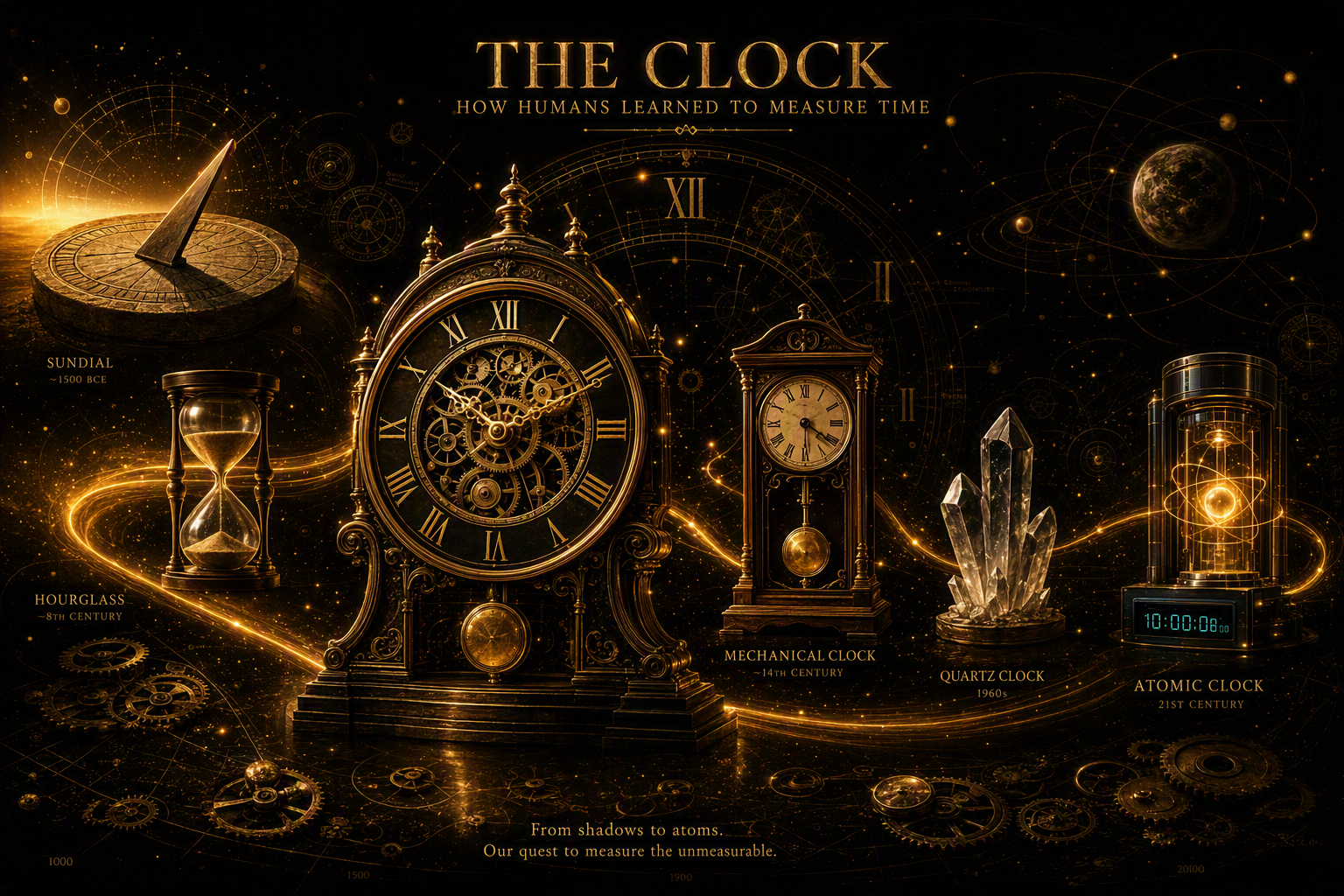
🕰️ From Shadows to Atoms
The history of the clock is really the history of humanity becoming obsessed with precision.
We began by watching the Sun.
Then we watched shadows.
We let water drip.
We burned candles.
We poured sand through glass.
We built gears.
We swung pendulums.
We vibrated quartz crystals.
Finally, we began counting atomic transitions.
And each improvement changed what humans could do.
Accurate clocks helped organize cities, navigation, science, industry, transportation, telecommunications, computers and satellite systems.
Yet the basic question has remained unchanged for thousands of years:
What time is it?
The answer simply became much, much more precise.
So the next time you glance at your phone and see 10:53, remember:
Behind those four little digits are ancient astronomers watching the sky, engineers designing gears, sailors crossing oceans, vibrating crystals, atomic physics and satellites orbiting thousands of kilometers above Earth.
All because humans looked at the moving Sun one day and apparently decided:
“We should probably start measuring this.”