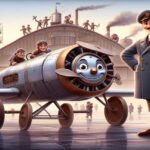
“From Wooden Wings to a Metal Rhapsody: The Year That Changed the Sky’s Destiny”
Until the year 1912, the sky was like a stage where “fragile dreams tried to fly.” Wood, canvas, stitching threads, pieces of fabric wrestling with the wind… When you looked at the planes of that era, you didn’t think “Wow, this flies,” but rather, “If we tighten the ropes a bit more, this could be a tent.”
But that year…
Beside a blacksmith’s workbench, an engineer was forming an idea that would change the destiny of the sky.
That man: Hugo Junkers.
The year: 1912.
The aircraft: Junkers J 1 — the world’s first fully metal airplane.
And that flight… became one of the boldest signatures in aviation history.
🌍 1. The World of 1912: Europe in the Shadow of War After the Industrial Revolution
Let’s breathe in the geography of that era.
In 1912, Europe was:
- drenched in the smell of gunpowder,
- heated by nationalist fervor,
- and stirred by intense rivalry between nations —
a huge boiling cauldron.
The steam engines, steelwork, mass production lines, and machinery born from the Industrial Revolution suddenly began flowing into aviation. Countries started seeing the sky as the next battlefield.
Berlin, Paris, London…
Each competing to create new technologies that would leave the others jealous.
Geography wasn’t just about borders; it was a map of competition.
And this competition forced humanity to “abandon wood and embrace metal.”
🔧 2. Hugo Junkers’ World: Hammer Echoes, Industrial Dust, and Endless Determination
Junkers’ story isn’t exactly Hollywood romance; it’s more like a mix of “scientist drama + unshakeable German stubbornness.”
🧪 So who was Junkers?
- Originally a thermal engineer,
- Worked on gas turbines,
- Obsessed with material strength,
- A mind that tried to solve aerodynamics with mathematical rebellions.
👷 And his workspace?
Don’t imagine a clean, modern laboratory.Imagine:
- a coal stove,
- the smell of oil,
- hammering sounds,
- giant rivets everywhere,
- metal shavings on the floor—
a full industrial temple.
Every time Junkers stood beside an airplane, it was as if he whispered:
“Your canvas era is over, baby. It’s metal time now.”
And he had to fight critics too.
Most engineers of that era insisted:
“Metal aircraft? Too heavy. Won’t fly.”
Junkers’ calm reply?
“I think about aerodynamics, not weight.”
🛠️ 3. The Engineering Behind Metal: Why Was It Such a Massive Revolution?
Let’s get into the technical side, because few explain this properly.
Creating a metal airplane back then was basically like saying:
“I’m building a rocket.”
Same level of seriousness.
❗ Practical Technical Notes
✔ Metal doesn’t shrink like canvas.
✔ It doesn’t deform with temperature changes.
✔ It can carry far more load than wood.
✔ It can be formed thinner—huge aerodynamic advantage.
✔ It’s more resistant to fire, moisture, and wear.
Wooden airplanes sagged after rain like a shirt that needed ironing.
Metal didn’t.
And that alone was a revolution for flight safety.
🛩️ 4. The Birth of the Junkers J 1: From “Tin Donkey” to Legend
On a cold winter morning in 1912, vigorous work began in the factory.
That stubborn team of engineers, guided by Junkers, produced the first fully metal airframe.
This aircraft had two revolutionary features:
🔹 1) Fully metal body
No wood.
No canvas.
No fabric.
And “metal fatigue” wasn’t even a formal engineering term yet.
🔹 2) Self-supporting airframe design
Not fabric stretched over a skeleton—
the body itself carried the load.
This is the foundation of how modern jets are built today.
They even gave it a mocking nickname:
“Blechesel” — The Tin Donkey.
But when that donkey finally left the ground one day…
everyone went silent.
🛫 5. Flight Day, 1912: Snowy Air, Curious Eyes, a Quiet Revolution
Now, close your eyes (but keep reading 😄) and picture this:
- A small airfield near Berlin,
- Damp ground, cold air,
- The aircraft shining like a “brand new factory-fresh iPhone” among its canvas-winged neighbors,
- A brave pilot — calm yet excited.
People murmuring:
“This won’t fly.”
“Metal is too heavy.”
“Junkers has lost his mind.”
The engine roared…
The metal body vibrated…
And the J 1 lifted gently from the runway.
In that exact moment, the sky whispered:
“This is the first step of the future.”
🔭 6. What Did This Flight Change? (Practical Outcomes)
✔ Military aircraft quickly transitioned to all-metal designs.
✔ The entire commercial aviation industry of the 1920s followed this concept.
✔ Modern jet fuselages are descendants of the J 1.
✔ Aerodynamic surface quality soared thanks to metal.
✔ Aircraft became larger, faster, safer.
In short, when the J 1 took off, the world declared:
“The wooden era is over. The metal age has begun.”
💙 7. My Personal Touch on This Topic
Every time I look at aviation history, I see one truth clearly:
✨ Those who change the sky first change their imagination. ✨
Junkers didn’t just use metal.
He taught humanity something vital:
“What seems absurd today may become the beginning of a revolution tomorrow.”
All the marvels of modern aviation —
Airbus’ metallic giants, Boeing’s sky kingdoms, the steel nerves of combat jets —
all grew in the shadow of this flight.
The first metal airplane in 1912…
changed the personality of the sky.
And the cold surface of metal became a home for the warmest human dream of all:
to fly.