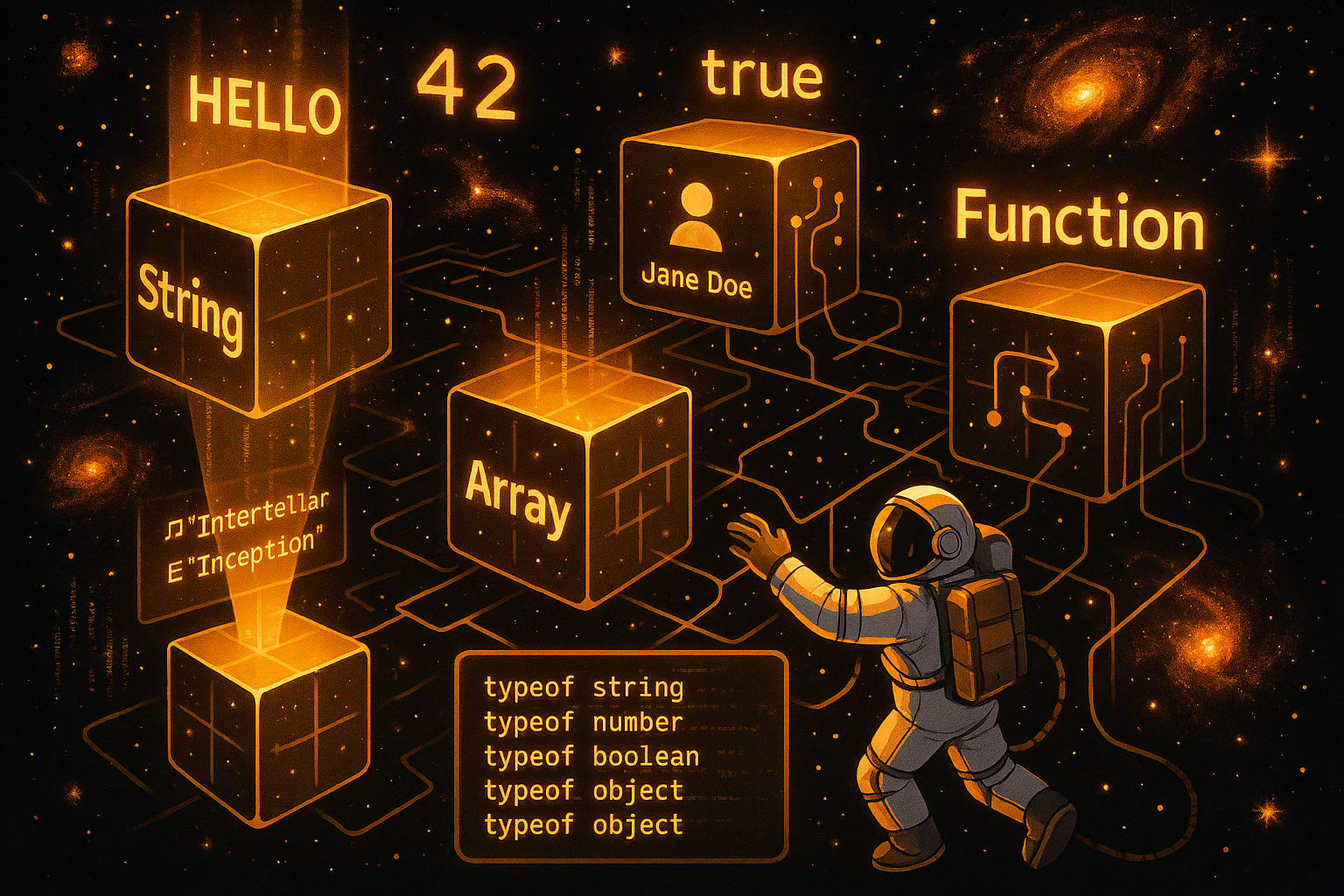
JavaScript is one of the most popular programming languages in the world. It powers websites, web applications, mobile apps, games, and even server-side systems.
When you start learning JavaScript, one of the first and most important concepts you need to understand is data types.
Think of data types as different “containers” that tell JavaScript what kind of information you are working with. A name, a number, a yes/no answer, and a list of items are all stored differently because they represent different kinds of data.
In this guide, we will explore JavaScript data types step by step with fun examples, practical code snippets, and mini projects. Let’s begin our coding adventure! 💻✨
1. What Are Data Types in JavaScript? 🤔
A data type defines what kind of value a variable can store.
For example:
let username = "Alex";
let age = 25;
let isOnline = true;
Here:
"Alex"is a String25is a Numbertrueis a Boolean
JavaScript needs to know what type of information it is handling so it can perform the correct operations.
For example:
let price = 10;
let quantity = 3;

console.log(price * quantity);
Output:
30
JavaScript knows these values are numbers, so it can multiply them.
2. JavaScript Data Types Overview 🧩
JavaScript has two main categories of data types:
Primitive Data Types
Primitive values store simple information.
They include:
String
Number
BigInt
Boolean
Undefined
Null
Symbol
Non-Primitive Data Types
These store collections or complex structures.
They include:
Object
Array
Function
Let’s explore each one!
3. String: Working with Text 📝
A String is used to store text.
Examples:
let name = "Emma";
let message = 'Hello JavaScript!';
Strings can contain:
Names
Sentences
Passwords
Addresses
Messages
Example:
let country = "Turkey";

console.log(country);
Output:
Turkey
Combining Strings (Concatenation)
You can combine texts using the + operator.
Example:
let firstName = "John";
let lastName = "Smith";

let fullName = firstName + " " + lastName;

console.log(fullName);
Output:
John Smith
Modern Way: Template Literals ✨
Template literals make combining strings easier.
Example:
let username = "Sarah";
let age = 22;

console.log(`My name is ${username} and I am ${age} years old.`);
Output:
My name is Sarah and I am 22 years old.
4. Number: Working with Numbers 🔢
JavaScript uses the Number type for:
Integers
Decimals
Calculations
Examples:
let score = 95;
let price = 19.99;

console.log(score);
console.log(price);
Mathematical Operations
let a = 10;
let b = 5;

console.log(a + b);
console.log(a - b);
console.log(a * b);
console.log(a / b);
Output:
15
5
50
2
Real-Life Example: Shopping Calculator 🛒
let productPrice = 50;
let quantity = 4;

let total = productPrice * quantity;

console.log(`Total price: $${total}`);
Output:
Total price: $200
5. Boolean: True or False Logic ✅❌
A Boolean can only have two values:
true
false
Example:
let isLoggedIn = true;

console.log(isLoggedIn);
Output:
true
Booleans are commonly used in:
User authentication
Game logic
Website settings
Conditions
Example:
let hasPermission = false;

if(hasPermission){
    console.log("Access granted");
}
else{
    console.log("Access denied");
}
Output:
Access denied
6. Undefined: A Value That Does Not Exist Yet ❓
When a variable is created but has no value, JavaScript gives it:
undefined
Example:
let username;

console.log(username);
Output:
undefined
This means:
“JavaScript knows this variable exists, but it has no information yet.”
7. Null: An Empty Value 🗑️
null means intentionally empty.
Example:
let selectedUser = null;

console.log(selectedUser);
Output:
null
A developer might use null when:
A user logs out
A search returns no result
A value needs to be reset
Example:
let currentPlayer = "Alex";

currentPlayer = null;

console.log(currentPlayer);
8. BigInt: Handling Huge Numbers 🌎
Sometimes numbers are too large for the normal Number type.
BigInt solves this problem.
Example:
let hugeNumber = 123456789012345678901234567890n;

console.log(hugeNumber);
The letter n tells JavaScript:
“This is a BigInt value.”
Used in:
Scientific calculations
Cryptography
Large databases
9. Symbol: Creating Unique Values 🔐
Symbols create unique identifiers.
Example:
let id1 = Symbol("user");
let id2 = Symbol("user");

console.log(id1 === id2);
Output:
false
Even though they have the same description, they are completely different.
Symbols are mostly used in advanced JavaScript development.
10. Objects: Storing Multiple Information Together 📦
Objects store data in key-value pairs.
Example:
let person = {
    name: "Emily",
    age: 30,
    job: "Developer"
};

console.log(person);
Output:
{
 name:"Emily",
 age:30,
 job:"Developer"
}
You can access information:
console.log(person.name);
Output:
Emily
Real-Life Example: User Profile 👤
let user = {
    username: "coder123",
    email: "coder@email.com",
    premium: true
};

console.log(user.username);
Output:
coder123
11. Arrays: Storing Lists of Data 📚
Arrays store multiple values in one variable.
Example:
let fruits = [
    "Apple",
    "Banana",
    "Orange"
];

console.log(fruits);
Output:
["Apple","Banana","Orange"]
Access items by position:
console.log(fruits[0]);
Output:
Apple
Remember:
JavaScript arrays start counting from 0.
Mini Project: Favorite Movies List 🎬
let movies = [
    "Interstellar",
    "Avatar",
    "Inception"
];

movies.push("Titanic");

console.log(movies);
Output:
[
"Interstellar",
"Avatar",
"Inception",
"Titanic"
]
12. Functions: Reusable Code Blocks ⚙️
Functions are also a type of object in JavaScript.
Example:
function sayHello(){
    console.log("Hello Developer!");
}

sayHello();
Output:
Hello Developer!
Functions help you:
Avoid repeating code
Organize projects
Build complex applications
13. Checking Data Types with typeof 🔍
JavaScript provides the typeof operator.
Example:
let age = 25;

console.log(typeof age);
Output:
number
More examples:
console.log(typeof "Hello");
console.log(typeof true);
console.log(typeof []);
console.log(typeof {});
Output:
string
boolean
object
object
14. Mini Project: Simple Weather App ☀️
Let’s combine different data types!
let city = "London";
let temperature = 18;
let isSunny = true;

console.log(`Weather Report`);
console.log(`City: ${city}`);
console.log(`Temperature: ${temperature}°C`);
console.log(`Sunny: ${isSunny}`);
Output:
Weather Report
City: London
Temperature: 18°C
Sunny: true
Here we used:
✅ String
✅ Number
✅ Boolean
15. Mini Project: Online Shopping Cart 🛍️
let product = {
    name: "Laptop",
    price: 1000,
    available: true
};

let quantity = 2;

let totalPrice = product.price * quantity;

console.log(`Product: ${product.name}`);
console.log(`Total: $${totalPrice}`);
Output:
Product: Laptop
Total: $2000
This small project uses:
Object
Number
Boolean
String
16. Common Beginner Mistakes ⚠️
Mistake 1: Confusing Numbers and Strings
Example:
let number1 = "10";
let number2 = 5;

console.log(number1 + number2);
Output:
105
Why?
Because "10" is text, not a number.
Correct:
console.log(Number(number1) + number2);
Output:
15
Mistake 2: Forgetting Array Positions
Wrong:
let colors = ["red","blue"];

console.log(colors[2]);
Output:
undefined
Because there is no third item.
17. Why Understanding Data Types Matters 🚀
Knowing data types helps you:
✅ Write cleaner code
✅ Find bugs faster
✅ Build better applications
✅ Understand JavaScript logic
✅ Work with APIs and databases
Every website, app, and software project depends on handling data correctly.
Final Thoughts 🎯
JavaScript data types are the foundation of programming. Before creating amazing websites, games, or applications, you need to understand how JavaScript stores and manages information.
Start by practicing:
Create variables
Experiment with different data types
Build small projects
Use typeof to explore values
Remember:
Great programmers are not just people who write code. They understand the data behind the code. 💻✨
Keep experimenting, keep learning, and enjoy your JavaScript journey! 🚀