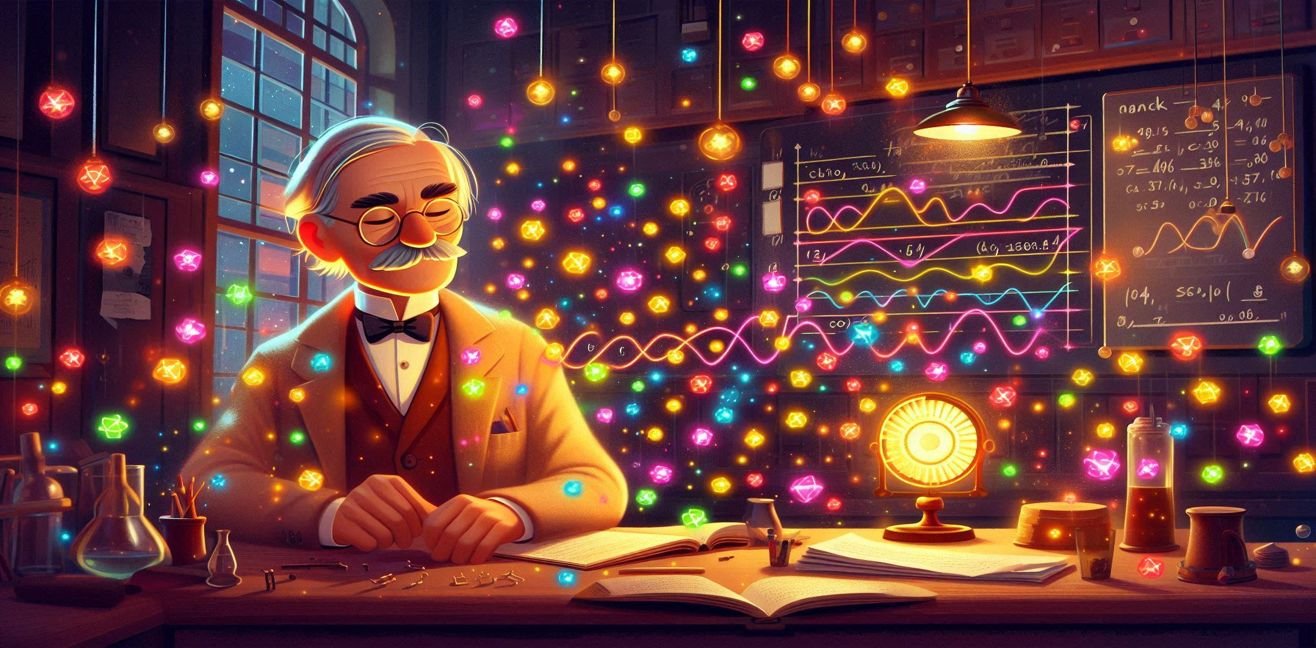
The universe might look like a calm painting from the outside; the sun rises, birds fly, and we sip our coffee… But once atoms and energy enter the scene, things get chaotic! The behavior of energy, light, and matter becomes impossible to explain with classical physics. And the one who lifted this veil of chaotic mystery was a brave physicist from Germany: Max Planck. 🧙♂️
The Blackbody Radiation Problem: Classical Physics Hits a Wall 🌡️
At the end of the 19th century, physicists faced a major problem: blackbody radiation. A blackbody is an ideal object that absorbs all incoming light across all frequencies and emits light in a specific spectrum when heated. Classical physics (Rayleigh-Jeans law) worked well at low frequencies but gave ridiculous results at high frequencies—known as the “ultraviolet catastrophe”: energy was predicted to be infinite! 😱
Planck questioned the classical continuous energy approach to solve this problem. He said:
“Maybe energy is not continuous but emitted in discrete packets. Maybe energy is transmitted in tiny quanta.”
And this is where quantum physics was born. 🔥
Planck’s Quantum Hypothesis: Packets of Energy 📦
To explain the experimental data, Planck redefined energy emission quantitatively: E=hνE = h\nuE=hν
Where:
- EEE = energy
- hhh = Planck’s constant (6.626×10⁻³⁴Js6.626 \times 10^{-34} \text{Js}6.626×10⁻³⁴Js)
- ν\nuν = frequency of light
This formula indicated that energy is emitted in discrete packets, not continuously as classical physics assumed. Energy flowed not like a river but in tiny quantum packets! 🎁
Planck’s approach not only correctly explained the blackbody radiation spectrum but also revolutionized physics. Energy no longer flowed smoothly—it moved in micro packets. 🪄
Evolution and Impact of Quantum Theory 🌌
Planck’s work opened the doors to quantum physics, leading to further groundbreaking developments:
Einstein and the Photoelectric Effect (1905):
Einstein showed that light also behaves as particles, known as photons. Planck’s quantum idea came to life here.
Niels Bohr and the Atomic Model (1913):
Bohr quantized electron energy levels to explain the structure of the atom. Energy levels could only take specific values.
Schrödinger and Wave Mechanics (1926):
Quantum mechanics now encompassed both particle and wave behaviors. Planck’s tiny energy packets became the foundation of modern physics.
Planck’s Constant and Modern Physics 🧮
Planck’s constant hhh is not only a fundamental parameter of quantum physics but also a unit of measurement for the micro-universe. Quantum physics builds the bridge between micro and macro scales:
- Small scale: Quantum rules dominate
- Large scale: Classical physics still applies
So, quantum mechanics is both strange and an incredible guide to understanding the fundamental workings of the universe! 😏💥
Max Planck: A Bold and Rebel Scientist 🦸♂️
Planck did not only spark a scientific revolution; he was also a radical thinker philosophically. He questioned classical physics, advocated for the idea of discrete energy, and inspired courage in the scientific community: knowledge can be smaller and more “packeted” than it appears. 💡
Thus, Max Planck became not just the father of quantum physics but the adventurous pioneer of modern physics.
Traces of Quantum Physics in Everyday Life 🖥️📱
Without Planck’s quantum hypothesis, modern technology would probably not have developed so rapidly:
- LED and laser technology
- Computers and microchips
- MRI and other medical imaging technologies
- Quantum computers and cryptography
Quantum physics isn’t just in laboratories—it’s present in every corner of our daily lives! ✨
In Summary 💫
- Max Planck introduced a revolutionary idea that shook classical physics with the blackbody radiation problem.
- Energy is not continuous but emitted in discrete quantum packets.
- Quantum theory forms the foundation of modern physics and has transformed technology.
- Planck’s bold approach and innovative thinking left a lasting mark on science.
In short, thanks to Planck, we learned that the universe works in “tiny packets,” and the world of science has never been the same. 🌌🔬