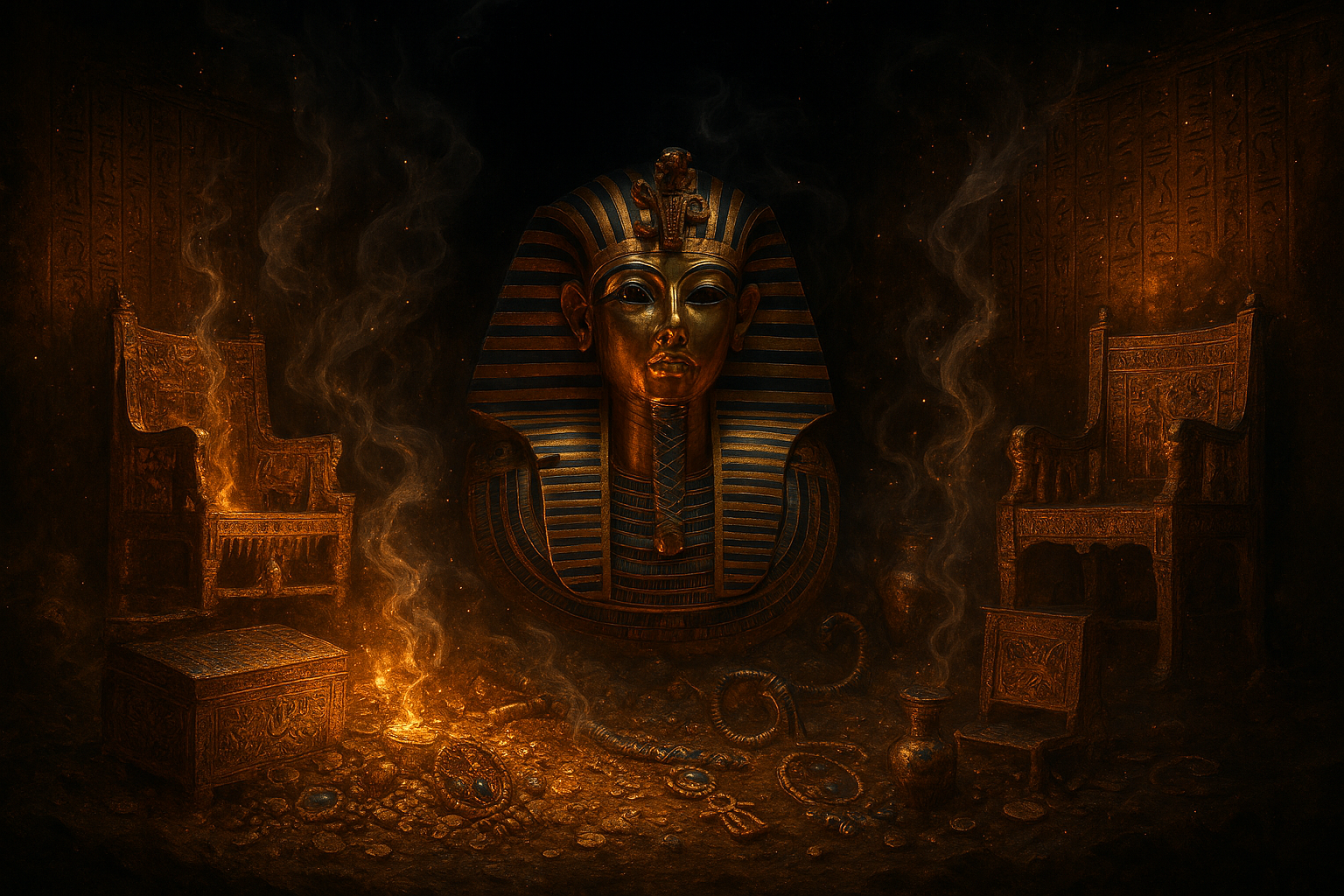
In 1922, under the blazing sun of Egypt’s deserts, a discovery would change history: Howard Carter and his team uncovered the tomb of the young pharaoh Tutankhamun in the Valley of the Kings. But this was not just a tomb—it was a time capsule filled with mystery, curses, and the secrets of ancient Egypt. 🚀
Imagine this: golden masks shining ✨, hieroglyphs telling stories 📜, and at the same time, a chilling feeling in the underground air… Because for thousands of years, Egyptians believed: those who disturb the peace of the pharaoh will be cursed. 🧿
Tutankhamun: A Young Pharaoh, A Big Impact 👑
Tutankhamun ascended to the throne at just 9 years old and died at the young age of 18. At that time, Egypt was nearing the end of the New Kingdom period and was politically unstable:
The young pharaoh’s rule was shaped by palace intrigues and the influence of powerful advisors ⚔️.
Society was unified around the pharaoh, with order maintained through religious and social rituals 🏛️⛪.
Economically, Egypt relied on agriculture thanks to the fertile lands of the Nile River and was connected to the Mediterranean through trade routes 🌊💰.
Despite his short life, Tutankhamun’s tomb reveals the culture, beliefs, and economic conditions of ancient Egypt.
The Tomb and the Mystery of the Curse 🏺💀
When Howard Carter opened the tomb, he encountered a world untouched for 3,000 years:
Golden masks, thrones, statues, and jewels 💎
Everyday objects: food containers, furniture, and weapons 🗡️🍯
Hieroglyphic warnings: “Those who disturb the pharaoh’s peace will be cursed” 🧿
Then, strange events began to unfold:
Lord Carnarvon died of a mysterious infection just weeks after the discovery ⚰️
Some members of the team suffered sudden illnesses 🤒
Newspapers quickly published headlines about the “Curse of the Pharaoh” 📰🔥
Although modern science suggests microbiological explanations, the story has evolved into a fascinating and mysterious legend 😏
Geographical and Strategic Importance 🗺️🏜️
Tutankhamun’s tomb is located near Thebes (Luxor) in the Valley of the Kings, a strategically important area:
The Nile River and desert routes allowed control over internal Egyptian and Mediterranean trade 🌊🚤
The valley served as a powerful symbol of both religious and political authority 🏛️
Its geographical isolation helped preserve the tomb for centuries ⛰️
In other words, the tomb was not just a burial site—it was a symbol of Egypt’s geographical and economic strategy.
Social and Economic Impacts 💼📈
Tutankhamun’s tomb and its discovery influenced both ancient understanding and the modern world:
Social impact: Helped us understand the relationship between pharaohs and gods in ancient Egypt ✨
Economic impact: Boosted tourism and archaeological interest, bringing major revenue to Egypt 🌍💰
Cultural heritage: Showcased artistic, architectural, and jewelry design excellence of the era 🎨🏺
The Humorous and Unusual Side of the Curse 😅🧿
Yes, we talk about a curse—but let’s not forget the humor:
Some team members remained completely healthy, and the tomb’s treasures dazzled everyone ✨😎
Modern tourists flock to see the golden mask, laughing off the curse 😂
The “curse” became a tool that fueled historical curiosity and popular culture 🎬📚
Historical Context and Causes 🏛️⚡
Egypt was dealing with internal conflicts and religious reforms during Tutankhamun’s death ⚔️
The tomb was hidden and carefully protected to prevent damage to the pharaoh’s body 🏺🔒
The belief in curses reinforced both the sacredness of the pharaoh and respect for the afterlife 🧿✨
Conclusion: Curse or History? 🏺🔥
Tutankhamun’s tomb teaches us this:
History is not just about stone and gold—it also includes mystery, culture, and social structure 📜✨
Sometimes, a young pharaoh can captivate the world even after thousands of years 😍
The curse may be real or a myth, but one thing is certain: this tomb is a perfect blend of history and human imagination 🧠🔥