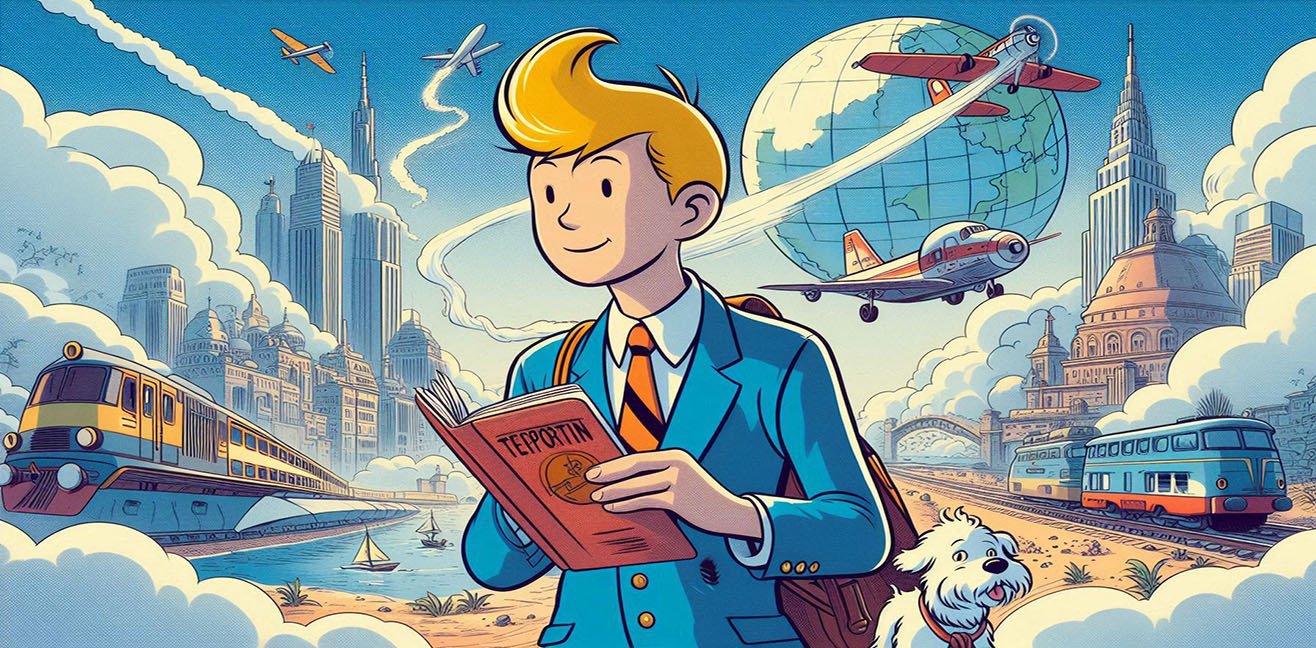
How does a comic book turn into a world-wide cultural heritage?
Think about it for a moment:
A quiff-haired boy, a dog who never speaks but thinks everything, an irritable captain, and a professor who keeps saying “I didn’t hear that”…
And this crew has been traveling the world for nearly 100 years.
This is no coincidence.
This is a masterfully constructed comic universe.
🧑🎨 Hergé: Not Just a Drawer, but a Thinker
Seeing Hergé merely as “the man who created Tintin” would be a great injustice.
He is one of the artists who elevated comics from children’s entertainment to the level of narrative art.
🔍 Hergé’s Artistic Identity – Practical Reading Tips
- His drawings are never random
- Every panel is designed to guide the reader’s eye
- Locations are not imaginary; they are based on photographs and documented research
👉 Tip:
While reading a Tintin page, cover the text and look only at the drawings.
You’ll notice the story is still perfectly understandable.
That is mastery of visual storytelling.
✍️ Ligne Claire (Clean Line): The Philosophy of “Draw Less, Tell More”
The ligne claire style created by Hergé was a revolution in comic art.
What Does This Style Mean?
- Bold, clear outlines
- No shadow confusion
- Backgrounds that are simple yet information-rich
- Characters that are readable rather than exaggerated
🎓 Educational Note:
The “user-friendly visual storytelling” approach used today in animation, infographics, and UI/UX design is actually very close to Hergé’s drawing philosophy.
So Tintin is not just a comic book;
it’s also a design lesson.
🧑🚀 Tintin: A Hero Whose Superpower Is Curiosity
What makes Tintin special is not his fists, but his questions.
Character Analysis:
- He never says “I know it all”
- He constantly observes
- He unwillingly ends up at the center of events
- He uses violence only as a last resort
🎯 Tip from a Cartoonist’s Perspective:
Tintin is a “blank page” character.
His personal traits are deliberately limited so readers can project themselves onto him.
That’s why anyone can be Tintin.
🐶 Snowy (Milou): The Hidden Engine of Humor
Snowy is one of the most cleverly written supporting characters in comic history.
Why?
- He doesn’t speak, but he thinks
- He thinks—and is usually right
- He carries humor without disrupting the narrative
😂 Humor Technique Tip:
Snowy represents the visual form of dramatic irony.
The reader knows something Tintin doesn’t.
That’s where the laughter comes from.
🧑✈️ Captain Haddock: Character Depth Written in Curses
Haddock brings humanity into the Tintin universe.
- He is flawed
- He is hot-tempered
- He is brave but uncontrolled
- Even his curses are creative
📚 Literary Detail:
Haddock’s insults are not mere swearing;
they are metaphors of emotional outbursts.
(“Blistering barnacles!”)
🧠 Professor Calculus: The Thin Line Between Genius and Absurdity
Professor Calculus is the caricature of science itself.
- Brilliantly intelligent
- Hopelessly forgetful
- Constantly misunderstood
- Yet capable of changing the world
🎓 Educational Perspective:
Here, Hergé tells us:
“A scientist may be detached from society, but they are the key to progress.”
🌍 History, Politics, and Transformation: As Tintin Grows, Hergé Grows Too
Early Tintin adventures are criticized today.
And those criticisms are valid.
But what truly matters is this:
When Hergé is criticized, he doesn’t deny it—
he researches, learns, and corrects himself.
In Later Albums:
- Cultural details increase
- Political narratives become more sophisticated
- Comics move away from propaganda
🎯 Reader’s Tip:
If you read Tintin albums chronologically,
you can witness the intellectual evolution of an artist.
🧩 Golden Lessons for Cartoonists and Illustrators
What Tintin teaches us:
✔️ Story comes before drawing
✔️ Characters must be clear
✔️ Humor should be intelligent
✔️ Research strengthens illustration
✔️ Simplicity is not laziness
🎬 Why Is Tintin Still Effective Today?
Because Tintin is:
- Timeless
- Universal
- Entertaining while teaching
- Thought-provoking while amusing
And most importantly:
he never talks down to his reader.
🏁 Final Words: How Does a Comic Become Immortal?
Tintin’s secret is not in his quiff.
It lies in his sincerity.
For those who want to explore the world, he is a compass;
for those who draw, a guide;
for those who read, an endless adventure.