More than two millennia ago, the execution of Socrates shook classical Athens. For his most devoted disciple, Plato (c. 428–348 BCE), this tragedy was not merely personal—it was systemic proof that an unreflective society guided by flawed perceptions is prone to catastrophic injustice.
In response, Plato founded the Academy (the Western world’s first institution of higher learning) and authored over thirty dialogues that laid the architectural foundation of Western metaphysics, epistemology, and political theory.
1. The Core Metaphysics: Theory of Forms
At the heart of Platonic thought lies the distinction between appearance and essence. Plato argued that our physical reality is not the true reality, dividing existence into two realms:
The Sensible Realm (World of Becoming): The material world experienced through our senses. It is temporal, mutable, imperfect, and subject to decay.
The Intelligible Realm (World of Being / The Forms): The transcendent plane populated by abstract, immutable, and eternal archetypes (Forms or Ideai).
Every physical tree, triangle, or just action on Earth is merely an imperfect, fleeting copy of the singular, perfect Form of “Treeness,” “Triangularity,” or “Justice.” For Plato, highest among all Forms is the Form of the Good, which illuminates the intellectual realm just as the sun illuminates the physical world.
2. Epistemology & Anamnesis: Learning as Remembering
If pure truth exists only in the realm of Forms, how do mortal humans access it?
Plato proposed Anamnesis (Recollection). In dialogues like Meno and Phaedo, he argued that the immortal soul once dwelled in the realm of Forms before incarnation, possessing complete knowledge.
The Epistemological Shift: Earthly learning is not the acquisition of brand-new information, but the structured recovery of what the soul already knows. Socratic questioning (elenchus) acts as an intellectual midwife, stripping away sensory distortions to help the mind remember eternal truths.
3. The Allegory of the Cave: The Journey from Illusion to Truth
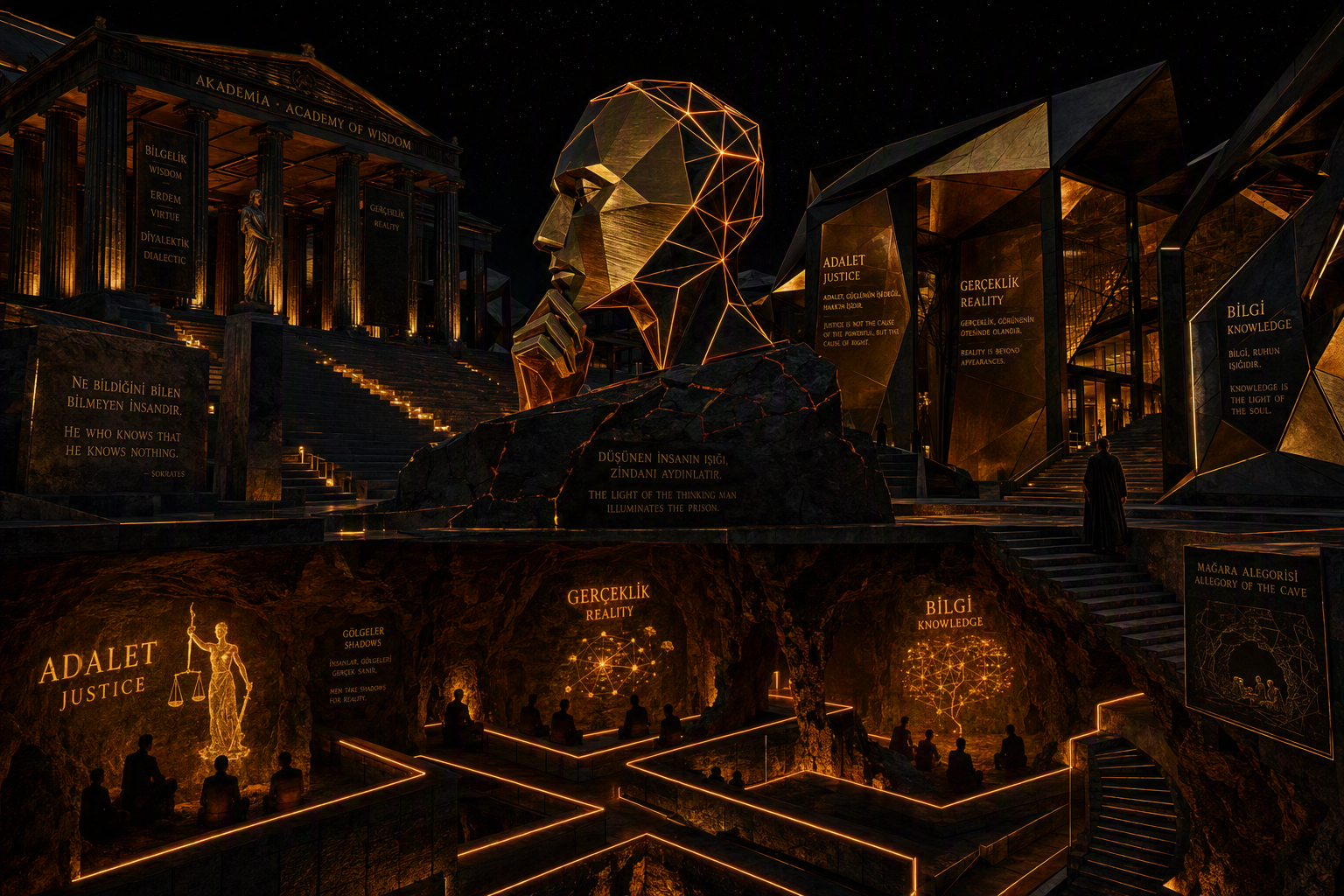
Featured in Book VII of The Republic, the Allegory of the Cave stands as one of the most enduring thought experiments in history.
[ THE SUN & UPPER REALM (True Forms / Objective Reality) ]
                         ▲
            (Painful Ascent: Philosophy & Critical Reason)
                         │
[ THE FIRE & PUPPETEERS (Social Conditioning / Manufactured Narratives) ]
                         │
[ SHADOWS ON THE WALL (Sensory Illusions) ]  <---  [ CHAINED PRISONERS (Unexamined Life) ]
The Enslavement: Prisoners chained inside a dark cave mistake shadows cast by a fire onto a stone wall for objective reality.
The Ascent: A released prisoner undergoes a disorienting, painful climb into the sunlight. Blinded at first, their vision gradually adjusts to see the world as it genuinely is.
The Return: Duty-bound to liberate the remaining prisoners, the philosopher descends back into the cave. Struggling in the dark, the philosopher is mocked, deemed insane, and met with hostile resistance—a direct parallel to the trial and death of Socrates.
4. The Republic: Blueprint for Justice or Proto-Authoritarian State?
In The Republic, Plato maps the tripartite structure of the human soul directly onto the social architecture of the polis:
| Social Class | Soul Component | Dominant Virtue | Function in the Ideal State (Kallipolis) |
| Rulers (Philosopher-Kings) | Reason (Logos) | Wisdom (Sophia) | Dispassionate governance based on truth |
| Guardians (Auxiliaries) | Spirit / Will (Thymos) | Courage (Andreia) | Defense, law enforcement, and order |
| Producers (Artisans/Laborers) | Appetite (Epithymia) | Temperance (Sophrosyne) | Material production and commerce |
To prevent corruption, rulers and guardians are stripped of private property, wealth, and traditional nuclear families. Leadership is not an entitlement of ambition, but a heavy burden undertaken strictly by those who grasp the Form of the Good.
5. Critical Reflection: The Paradox of the Platonic Vision
Plato’s philosophy continues to provoke critical modern inquiries:
The Modern Cave: Algorithms, hyper-personalized feeds, and synthetic media project increasingly sophisticated shadows. Are modern information echo chambers the digital manifestation of Plato’s cave?
The Danger of Technocracy: While Plato’s critique of demagoguery and mob rule is sharp, does placing absolute governance in the hands of an unelected intellectual elite open the door to authoritarian technocracy?
The Critique of Art: In banishing poets and dramatists from the ideal city for producing “copies of copies” (mimesis) that stir irrational passions, did Plato underestimate art’s power to reveal moral and psychological truth?