Imagine walking through the streets of 14th-century London or 18th-century Paris. The smell? Absolutely horrifying! 🤢💨 For centuries, if you caught a fever, developed a mysterious cough, or fell ill after a stroll near a swamp, physicians had a quick and confident explanation: “It’s in the air!” 🌬️🦨
Welcome to the era of the Miasma Theory—a time when people truly believed that bad smells, or “night air,” were the ultimate source of human disease. Fast forward to today, and we know that a microscopic world of bacteria, viruses, and fungi is actually calling the shots! 🦠🧫
So, how did we get from waving scented handkerchiefs in front of our noses to washing our hands with antibacterial soap and taking targeted antibiotics? 🧼💊 Grab a cup of tea (or coffee!) ☕ and let’s take a trip back in time to explore how the shift from bad air to tiny microbes completely revolutionized modern healthcare! 🏛️✨
1. The Era of Bad Smells: What Was Miasma Theory? 🌫️💀
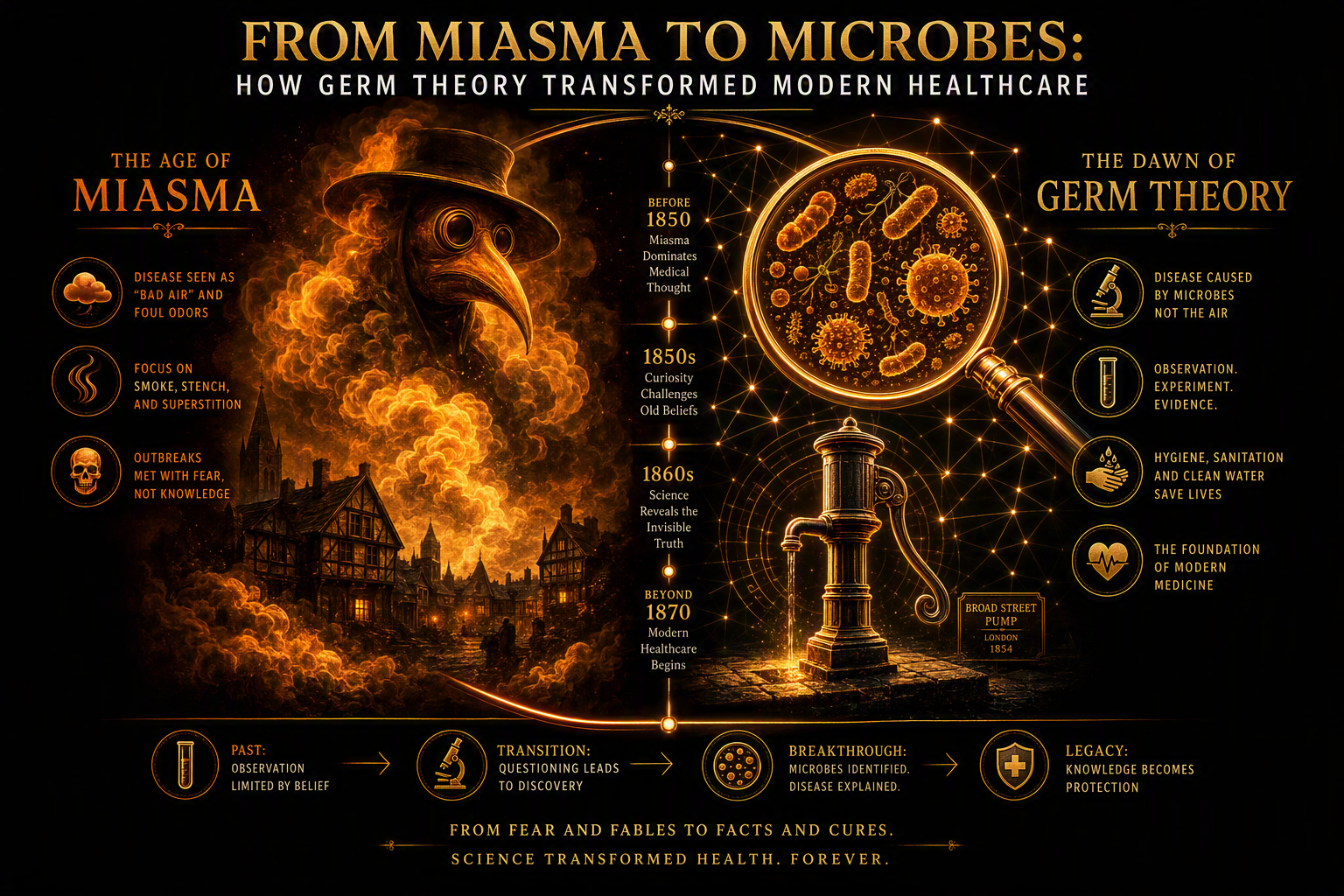
For over two millennia, the prevailing wisdom in medical science was simple: dirty, decaying organic matter produces a toxic vapor called miasma (Greek for “pollution” or “stain”). ☣️ If you breathed in this putrid air, your body’s internal balance—the infamous Four Humors (blood, phlegm, yellow bile, and black bile)—would throw a major tantrum, making you sick! 🩸🧪
People went to incredible lengths to avoid miasma:
The Plague Doctors: 👺 Those famous bird-like masks with long beaks? They weren’t just a fashion statement. The beaks were stuffed with dried flowers, camphor, and spices to filter out bad smells. 🌿🪻
Flower Bouquets (Nosegays): 💐 Wealthy citizens walked around clutching small bouquets of sweet-smelling flowers to shield themselves from sewer gases.
Closing the Windows: 🪟🔒 Fresh air at night was considered toxic, leading people to sleep in tightly sealed, stifling rooms.
While this theory sounds absurd now, it actually led to a few accidental wins! 🏆 Cities began cleaning up overflowing trash and building better sewer systems—not because they knew about bacteria, but because they wanted to get rid of the stink! 🧹🚰
2. The Medical Detectives: Cracking the Code 🕵️♂️🔍
The downfall of Miasma Theory didn’t happen overnight. It took a few stubborn, curious, and incredibly observant minds to prove that invisible living organisms, not bad odors, were the real culprits. 🧬👀
John Snow and the Broad Street Pump (1854) 🚰🗺️
During a severe cholera outbreak in Soho, London, a physician named Dr. John Snow decided to test the miasma theory. Instead of smelling the air, he mapped out every single cholera case on a street map. 📍🇬🇧
His findings were striking: the cases clustered tightly around a public water pump on Broad Street. Snow convinced local officials to remove the pump handle, stopping the outbreak in its tracks! 🛑💧 Cholera wasn’t airborne—it was waterborne! Yet, despite his hard evidence, many doctors remained skeptical. Old habits (and bad theories) die hard. 😅
Louis Pasteur: The Wine Savior 🍷🧪
Across the English Channel, French chemist Louis Pasteur was busy studying why wine and beer went sour. 🍾 In the 1860s, Pasteur proved that fermentation—and spoilage—was caused by tiny living microorganisms. 🔬
He realized that if microbes could make milk or wine “sick,” they could probably do the same to human beings! 🥛✨ Through his famous swan-neck flask experiments, Pasteur proved that these germs didn’t just spontaneously appear out of thin air; they came from the environment. This breakthrough led to pasteurization and gave the Germ Theory of Disease its solid scientific footing. 🧠💡
Robert Koch: The Proof Master 🧫🥼
If Pasteur gave Germ Theory its wings, German physician Robert Koch gave it its backbone. Koch developed a set of strict scientific rules (known as Koch’s Postulates) to prove beyond a shadow of a doubt that a specific microbe causes a specific disease. 📜🔍 He successfully identified the bacteria responsible for anthrax, tuberculosis, and cholera! 🎯
3. The Great Healthcare Transformation 🏥⚡
Once medicine accepted that tiny living invaders cause infections, everything changed! Healthcare underwent a massive, life-saving upgrade: 🚀
Antiseptic Surgery: 🔪🩺 Before Germ Theory, surgeons routinely performed operations in dirty street clothes, using unwashed instruments. A Scottish surgeon named Joseph Lister changed all that by introducing carbolic acid (phenol) to sterilize surgical tools and clean wounds. Infection rates plummeted! 📉🧼
The Handwashing Revolution: 🧼🙌 Ignaz Semmelweis, an Hungarian obstetrician, had argued years earlier that doctors washing their hands with chlorine solutions saved mothers’ lives in maternity wards. Germ Theory finally explained why he was right all along! ❤️👶
Vaccines and Antibiotics: 💉💊 Understanding microbes paved the way for targeted vaccines and, eventually, Alexander Fleming’s accidental discovery of penicillin in 1928. 🧫✨ Diseases that used to wipe out entire communities became manageable—or entirely preventable! 🛡️
4. Why This History Matters Today 🌟💡
It’s easy to look back and chuckle at plague doctors stuffing their bird masks with lavender 🪻🎭, but the transition from miasma to microbes teaches us something profound: science is a constantly evolving story. 📖✨
Every time you use hand sanitizer 🧴, drink pasteurized milk 🥛, or receive a sterile injection at the doctor’s office 🩺, you’re benefiting from a centuries-long journey of human curiosity. We stepped out of the fog of superstition and bad odors into a world of scientific clarity—and modern medicine has never been the same since! 🌈🔬
What’s your favorite bizarre historical medical theory? Let’s chat in the comments below! 👇💬💬