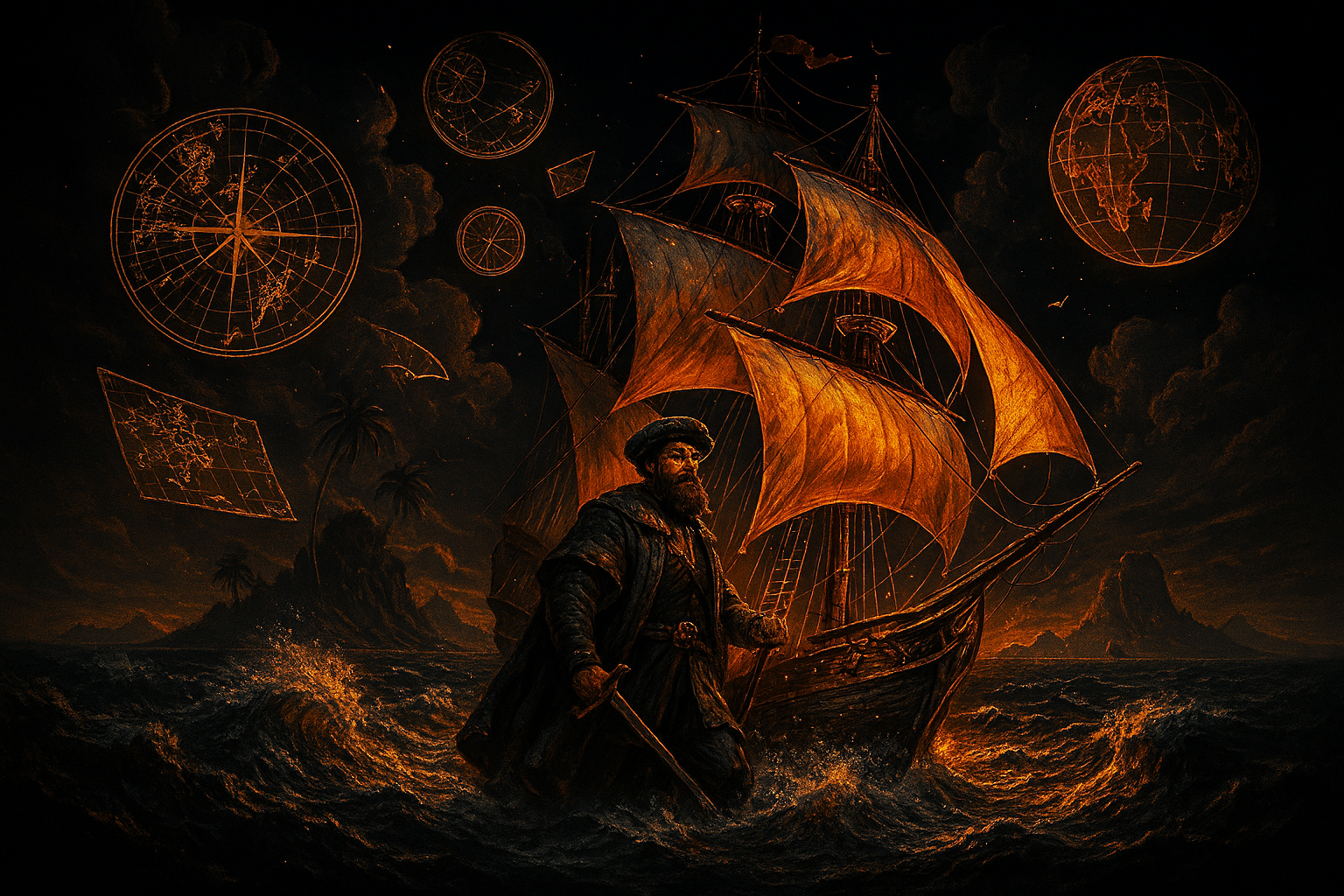
At the beginning of the 16th century, people in Europe were still asking, “Is the Earth really round?” It was at this moment that the Portuguese captain Ferdinand Magellan emerged. Born around 1480 in Portugal, Magellan came from a noble but adventurous family. At a young age, he gained experience on expeditions across the Atlantic and Indian Oceans. Intelligent, disciplined, and somewhat stubborn, he commanded both fear and respect from sailors.
But Magellan was more than just a captain: he was a visionary who sought to circumnavigate the globe, map strategic trade routes, and prove the Earth was round.
The Plan to Circumnavigate the World: Why and How? 🌏🗺️
In 1519, with the support of the Spanish Crown, Magellan’s plan became reality. But why was such a voyage necessary?
Economic Reasons: Europe’s hunger for spices and exotic goods was enormous. Portugal and Spain were racing to discover new trade routes.
Strategic Reasons: Circumnavigating South America and reaching the West via the Pacific Ocean promised both prestige and economic advantage.
Scientific Reasons: Magellan aimed to measure the circumference of the Earth and make a major contribution to the scientific world.
In short, Magellan’s route was a commercial, political, and scientific strategy all in one.
The Voyage Begins: Ships, Sailors, and Chaos 🚢🌊
Magellan set sail with five ships and about 270 sailors:
Ships: Trinidad (flagship), San Antonio, Concepción, Victoria, Santiago.
Early Stages: Crossing the Atlantic Ocean, they faced storms, hunger, and disease.
Mutinies: Some sailors rebelled against Magellan. He acted as both captain and psychologist to suppress the uprisings.
Geographical Challenges: Upon reaching the southern tip of South America, they discovered the strait that opens into the Pacific (today called the Magellan Strait), one of the most dangerous waterways in history.
Magellan’s journey was practically a “survival at sea, courage test, and geography lesson all in one” 😅.
A Historic First: Proving the Earth is Round 🌍✅
In 1521, Magellan tragically died in the Philippines. But the voyage continued. In 1522, the Victoria ship returned to Seville. This proved:
The Earth’s circumference could be measured and its roundness confirmed.
Europeans now saw the Earth not just as a line on a map, but as a real globe to be traveled and traded upon.
This voyage reshaped the foundations of geography in Europe.
Strategic and Geographical Impact 🗺️📌
Magellan Strait: Connecting South America’s southern tip to the Pacific, it became a critical route linking Europe and Asia.
Spice Islands: The Maluku Islands in Indonesia were an economic treasure for Europe. Magellan’s route made them accessible.
Pacific Ocean: Previously unknown to Europeans, the vast Pacific entered maps and opened new doors for international navigation.
Historical Significance of Magellan’s Voyage 🏛️🌟
Age of Discovery: New trade routes opened for Europeans.
Science and Geography: The roundness of the Earth was now empirically proven.
Cultural Impact: Contact with new continents and peoples changed European perspectives.
Economic Impact: Spice and exotic trade accelerated.
A Humorous Perspective: Sailors’ Life and the Art of Survival 😅⚓
Sailors kept morale by joking during storms and hunger.
Some joked, “Let’s swallow a little more salty water—it’s like a meal anyway.”
Mutinous sailors went down in history as “brave but desperate rebels.”
Magellan, firm yet visionary, sometimes entered “madness is necessary to survive” mode.
Outcomes and Legacy 🔮🌏
Magellan’s voyage was not just a maritime expedition, but also:
Expanded Europe’s global trade routes 💰.
Accelerated the maritime rivalry between Spain and Portugal ⚔️.
Established first official contacts with diverse geographies and peoples 🌍.
Showed that courage, discipline, and a bit of madness can change the course of history 🌟.
In short, Magellan’s voyage was an epic adventure filled with chaos, courage, strategy, humor, and historical lessons. 🌊⛵🎨