Some inventions change the world.
Some change economies.
Some change wars.
Gummy candy, however, has taken on a much harder mission:
Making people happy for absolutely no reason.
And it does this so quietly that by the time you notice, all you’re left with is an empty bag.
🍭 What Is Gummy Candy? (Not Just Candy, but an Experience)
Gummy candy is a chewable capsule of happiness born from the controlled chaos of gelatin, sugar, flavorings, and colorings.
But this is where the philosophy begins:
Not hard → Creates a sense of safety
Soft → Relaxing
Colorful → Tricks the brain
Small → Triggers the “just one more” feeling
In psychology, this is called the micro-reward effect.
Each gummy creates a tiny sense of achievement.
So technically speaking, when you eat gummy candy, your brain says, “Well done.”
🧪 How Was Gummy Candy Invented? (A Sweet Rebellion)
In the early 1900s, the candy world was painfully uniform:
Hard candies
Plain shapes
Zero imagination
What this era was to the art world, it was also to candy:
Rule-bound, boring, monochrome.
And right at that moment, someone asked a dangerous question:
“Why can’t candy be a sculpture?”
👤 Hans Riegel: The Picasso of Candy
Hans Riegel was not an ordinary candy maker.
He was a man who designed candy.
When he founded Haribo in Germany in 1920, he had:
No large capital
But one very big idea
That idea was simple:
“People don’t just want flavor — they want fun.”
This mindset turned him into:
Not a candy seller,
But a sweet artist.
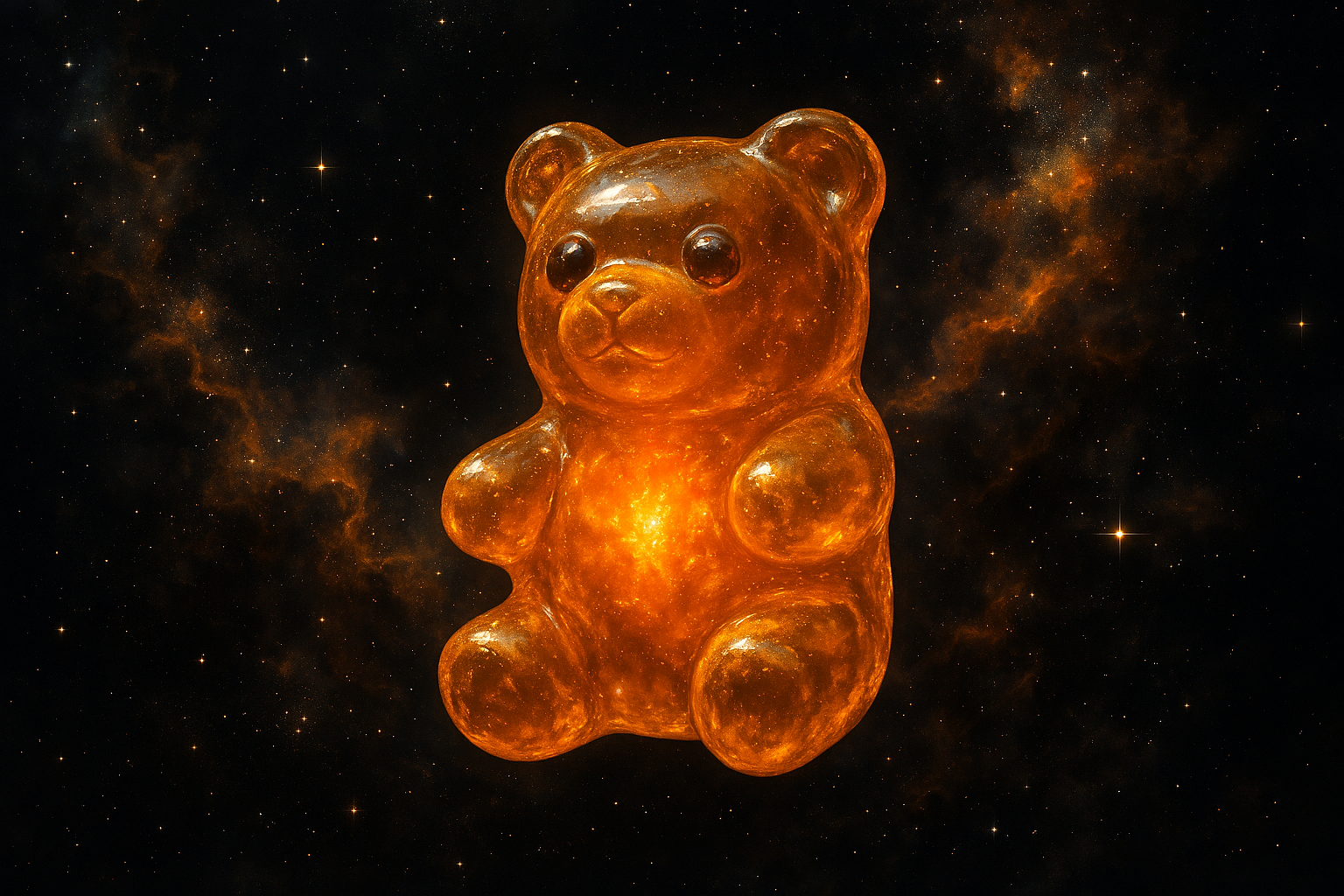
🐻 Gummy Bears: The Mascot of Candy
The choice of a bear was not random.
Bears are:
Cute to children
Nostalgic to adults
Universally recognizable
In today’s branding world, this is called an iconic form.
Nike’s swoosh is what Haribo’s bear is.
👉 Practical tip:
If a product’s shape is memorable, it needs less advertising.
Hans Riegel figured this out 100 years ago.
🌈 The Science of Color (Why Are Gummies So Colorful?)
Colors are never random:
Red → energy, appetite
Yellow → happiness
Green → freshness
Orange → movement
Just as artists use color on canvas, gummy makers paint the brain.
👉 Small but surprising fact:
Two gummies with the same flavor will be perceived as tasting different if their colors are different.
🎶 Gummy Candy, Music, and Pop Culture
Candy — especially gummies — appears as:
A “sweet escape” metaphor in pop music
A staple of advertising jingles
A hidden star of children’s songs
Most songs with themes like “Sugar,” “Candy,” or “Sweet”:
Start innocent
But tell adults a very different story 😄
Gummy candy is the same:
Fun for kids
An escape for adults
🍬 The Real Benefits of Gummy Candy (No Exaggeration)
Yes, it’s candy — but still:
🧠 Provides quick mental recovery
😌 Relaxes through the chewing reflex during stress
🎉 Encourages sharing in social settings
🧩 Supports color and shape learning in children
👉 Practical tip:
During long meetings or study sessions, 1–2 gummies can offer a gentler motivation boost than caffeine.
🍿 Gummy Candy in the Modern World
Today, gummy candy is:
A movie theater essential
A regular on gamers’ desks
The secret weapon in office drawers
The silent accomplice of those who say, “I don’t eat candy”
Even in the minimalist age, gummy candy offers:
Maximum color, minimum seriousness.
🎨 If Gummy Candy Were a Work of Art…
As a sculpture → Pop art
As music → A cheerful pop song
As a movie → Short, fun, and with a happy ending
And maybe that’s why it’s so loved:
Because gummy candy doesn’t take life too seriously.
🎈 The Final Gummy
The invention of gummy candy teaches us this:
Big inventions don’t always save the world —
sometimes they just make the day better.
But sometimes,
making a day better is enough to save the world.
🍬🐻