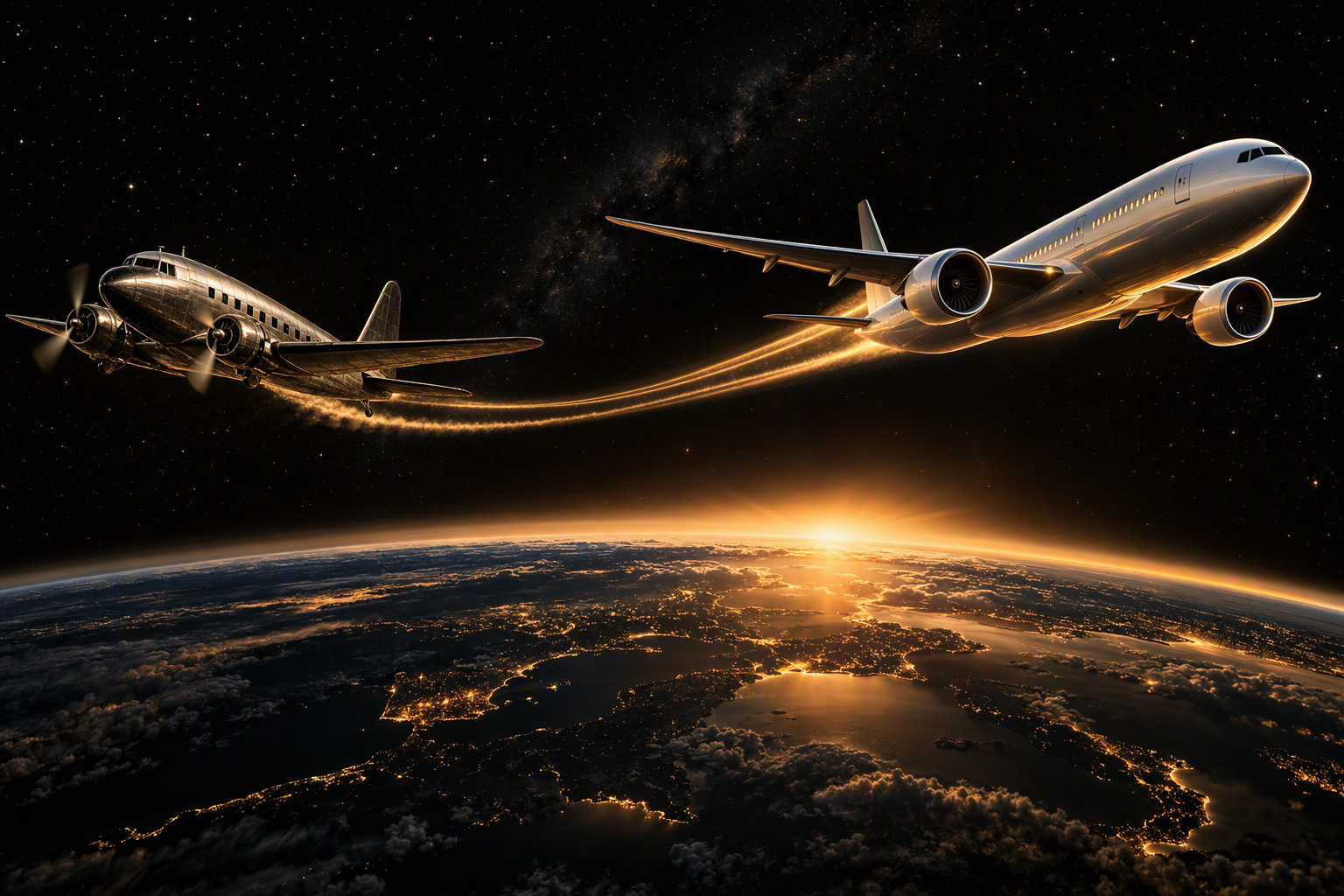
The inventions, business decisions and changing travel habits that opened the skies to millions.
At an airport departure gate, an extraordinary part of human history looks surprisingly ordinary. A student adjusts an overloaded backpack. A family checks its boarding passes. Someone buys a coffee before flying to another country for the weekend.
A century ago, such a scene would have been almost impossible to imagine.
Flying was expensive, uncomfortable and available to very few people. Today, air travel is a practical option for a much wider public. This transformation took decades. Engineers had to build better aircraft, airlines had to change their businesses, and governments had to allow more competition.
The story of affordable flying is the story of how all those developments came together.
It began with one passenger
On 1 January 1914, the St. Petersburg–Tampa Airboat Line launched a pioneering scheduled passenger service across Tampa Bay, Florida. The flight took approximately 23 minutes, and the aircraft carried just one passenger beside the pilot in an open cockpit. It was a remarkable demonstration of what aviation could offer: a much faster way to complete a familiar journey.
Yet speed alone could not create a successful airline.
Early aircraft carried too few people to spread the cost of each flight effectively. Operating expenses were high, and many early passenger businesses failed. In the United States, government airmail contracts helped support the emerging airline industry while passenger services developed.
The challenge was clear: airlines needed aircraft that could carry enough paying customers to make regular passenger flights financially sustainable.
The 1930s: better aircraft made better business possible
A major breakthrough came with the Douglas DC-3, which first flew in 1935. Its standard daytime configuration carried 21 passengers. It combined useful capacity with reliability, comfort and relatively economical operation, helping airlines make money from carrying passengers without depending on government subsidy.
Twenty-one seats may sound modest today, but the economic improvement was significant.
An airline must pay for an aircraft, its crew, maintenance and the operation of every journey. When a reliable aircraft can carry more passengers at a manageable cost, the business becomes stronger. That creates a foundation for expanding services and, eventually, offering more affordable tickets.
Flying still remained beyond the budgets of most people. The Smithsonian notes that a coast-to-coast return ticket in the United States during this early period could cost about half the price of a new car. Passenger numbers were growing, but trains and buses remained the realistic choice for most travellers.
After the war, commercial aviation grew in scale
Following World War II, a new generation of larger passenger aircraft expanded commercial flying. Aircraft such as the Douglas DC-6 and Lockheed Constellation carried more people at greater speeds and offered improved comfort. Their capabilities helped airlines develop longer routes and lower fares.
This development mattered because a flight had to be more than technically possible. It needed to be useful enough for people to choose it regularly.
More comfortable cabins made longer journeys easier to tolerate. Greater capacity improved the economics of each departure. As airlines offered more practical services, flying began to develop into a broader transport system.
Then jet aircraft changed the scale of what was possible.
The jet age made distance feel smaller
During the 1950s and 1960s, commercial jets transformed passenger travel. Aircraft such as the Boeing 707 and Douglas DC-8 brought greater speed and capacity to major routes. Jet propulsion made it possible to build larger aircraft that could travel much faster than earlier piston-engine airliners.
For travellers, the obvious benefit was time. A faster journey made a distant destination more practical, especially when holiday time or business schedules were limited.
For airlines, speed also had commercial value. Completing journeys more quickly could allow an aircraft to perform more useful flying within a given period, depending on its schedule and route.
However, the first jets did not immediately turn flying into a cheap purchase. The transition was gradual. Technological progress improved the economics of air travel, while later changes in competition and airline strategy helped bring those benefits to more customers.
Package holidays gave people a reason to take their first flight
Aircraft development explains how airlines could carry more passengers. The growth of tourism helps explain where those passengers came from.
During the 1950s and 1960s, overseas package holidays became an increasingly important part of British travel. Flying abroad for a holiday began to enter the lives of people who had previously spent their breaks much closer to home.
The package holiday made a complicated purchase easier. Rather than arranging every part of an unfamiliar trip separately, customers could buy transport and accommodation together. Charter flights—services arranged for a particular group or holiday programme—became part of this developing market.
The appeal was both practical and emotional. Travellers were buying a manageable plan for a week in the sun. For someone unfamiliar with airports or international travel, that simplicity could be as important as the price.
The jumbo jet changed the economics of long-distance travel
When the Boeing 747 entered service in 1970, its size attracted enormous attention. Depending on its configuration, it could carry around 400 passengers, more than twice the capacity of the 189-seat Boeing 707 described by the Smithsonian. Its efficient turbofan engines and large capacity helped reduce the cost of transporting each seat over a given distance.
The principle is easy to understand: carrying more people can spread operating costs across more tickets.
But there is an important condition. Those seats need passengers.
A large aircraft with many empty seats can be an expensive problem. Airlines therefore had a stronger reason to attract a wider market and sell their available capacity effectively. The jumbo jet helped make mass long-distance travel economically possible; filling it required prices and products that more people would consider.
Competition helped turn efficiency into lower fares
Better technology does not automatically produce cheaper tickets. Market conditions matter too.
For many years, governments controlled important commercial decisions in aviation, including which airlines could serve particular routes and what fares they could charge. In the United States, the Airline Deregulation Act of 1978 reduced these economic restrictions and gave airlines more freedom to compete.
When customers can choose among competing airlines, price becomes a powerful way to win their business.
Research by the U.S. Government Accountability Office found that fares fell in inflation-adjusted terms after deregulation, although the benefits varied. Busy routes generally experienced greater improvements than some smaller markets. The report also cautioned that technological and economic developments contributed to the changes, making deregulation’s exact effect difficult to isolate.
Europe followed its own gradual process of opening national aviation markets. The development of a competitive single market gave airlines greater freedom to operate routes and set fares, helping expand choice and reduce prices.
Affordable flying became more achievable when efficient aircraft operated in markets where airlines had stronger incentives to compete.
Budget airlines redesigned the journey around cost
Low-cost airlines took that competition further by examining almost every part of their operations.
Many used a single aircraft type, which simplified maintenance, spare-parts requirements and crew training. They fitted more seats into cabins, offered simpler onboard services and worked to reduce the time between an aircraft’s arrival and its next departure. Some also chose less congested airports to reduce charges and delays. These became common features of the low-cost model, although individual airlines used different combinations.
The logic was straightforward. A plane parked at the gate still represents a major investment. Using it productively for more of the day helps spread that investment across more flights.
Passengers also gained more opportunities to buy a basic journey and pay separately for extras. The attractive starting fare might exclude checked baggage, a meal or a particular seat.
That trade-off suited many travellers. Someone taking a short trip with a small bag might prefer a lower fare to a more generous onboard service. However, the final price still matters: a cheap starting fare is not always the cheapest complete journey.
Digital booking removed another barrier
The internet changed how people bought flights. Online booking and electronic ticketing became important tools for low-cost airlines, supporting direct sales and simpler distribution.
For passengers, the practical difference was enormous. They could explore destinations, compare options and make a booking without visiting a ticket office.
This made flexibility easier to use. A traveller could consider a different departure date or another airport while planning the same trip. Booking became part of everyday life, something that could begin at a kitchen table rather than in a travel agency.
Technology was improving the aircraft and the process of getting a seat on it.
Affordable flying is still an unfinished achievement
The phrase “accessible to everyone” needs some care. Air travel has become available to far more people, but many still cannot afford it. Geography matters too: living near a busy airport with competing airlines creates different opportunities from living far from regular services.
Nor have prices followed a perfectly smooth downward path. Fuel costs, economic shocks and changes in competition can affect fares. The long-term development is clearer: technological progress, operational efficiency and more open markets have helped reduce the real cost of air transport over decades.
The transformation came through a series of connected advances. More capable aircraft made passenger services commercially stronger. Jets reduced journey times. Larger cabins spread costs across more seats. Holiday companies brought new travellers into the market. Competition encouraged lower prices, while budget airlines and digital booking made flying easier to buy.
At the departure gate, none of this history is particularly visible. There is simply a boarding announcement, a queue and a destination on a screen.
Yet that ordinary scene represents one of aviation’s greatest achievements: making an extraordinary journey feel possible for millions of ordinary people.