Imagine celebrating your 150th birthday.
You wake up, stretch, check your messages, complain that teenagers are listening to terrible music, and then remember something slightly disturbing:
You were born in 1916.
Sounds like science fiction. But today, scientists are asking questions that would once have sounded ridiculous:
Why do we age? Can aging be slowed? Can damaged cells be rejuvenated? And could humans ever become biologically immortal?
The short answer is:
We are nowhere near immortality.
The more interesting answer is that scientists are beginning to understand aging not simply as an unavoidable countdown, but as a collection of biological processes that may, at least partly, be manipulated.
Welcome to the strange and rapidly developing science of longevity.
🕰️ First Question: Why Do We Age?
Most people imagine aging as simple wear and tear.
Your body works for decades, things slowly break, and eventually the warranty expires.
That is partly true—but biology is much more complicated.
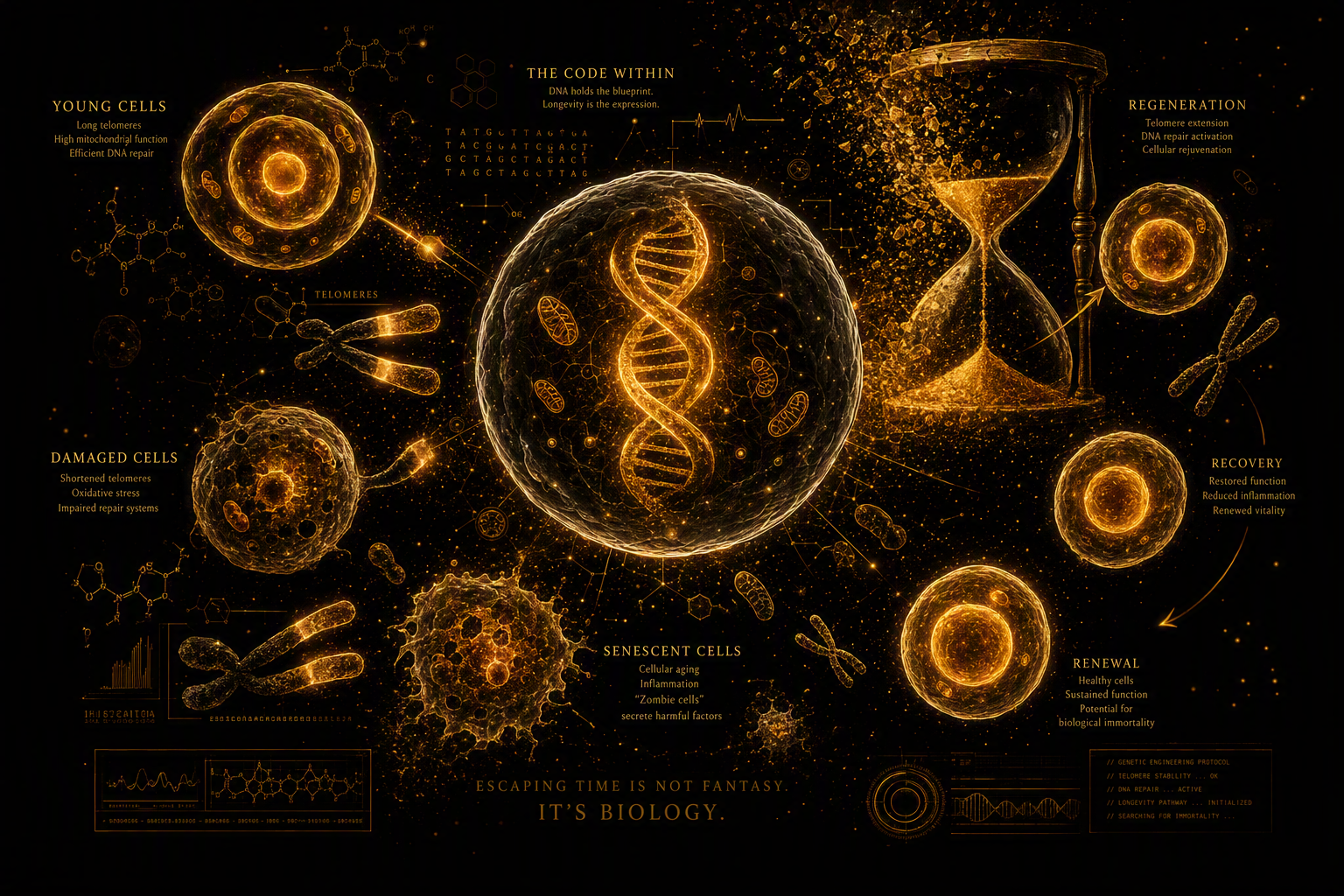
Aging involves many interconnected changes inside our cells and tissues. Scientists often describe these changes through different biological “hallmarks” of aging.
Among them are:
DNA damage
telomere shortening
mitochondrial dysfunction
cellular senescence
chronic inflammation
loss of protein quality control
changes in gene regulation
reduced stem-cell function
altered nutrient-sensing pathways
In other words, there probably isn’t one giant “aging switch” hidden inside the human body.
Aging looks more like a city gradually developing problems with its electricity, roads, communication networks, waste disposal system and repair crews—all at the same time.
And fixing one pothole does not magically repair the entire city.
🧬 Telomeres: The Tiny Caps on Your Chromosomes
One famous piece of the aging puzzle involves telomeres.
Telomeres are protective sections of DNA found at the ends of chromosomes.
Think of the little plastic caps on shoelaces.
Without those caps, shoelaces begin to fray.
Telomeres perform a somewhat similar protective role for chromosomes.
Each time many of our cells divide, telomeres tend to become shorter. Eventually, extremely short telomeres can contribute to cells entering a state where they can no longer divide normally.
That sounds simple enough:
Long telomeres = young.
Short telomeres = old.
Except biology rarely allows anything to be that convenient.
Some cells maintain their telomeres using an enzyme called telomerase. Cancer cells frequently exploit telomerase, helping them continue dividing when ordinary cells would stop.
So simply activating telomerase everywhere is not an obvious immortality cheat code.
You might help certain cells divide longer—but potentially create opportunities for dangerous cells to do the same.
Evolution apparently installed several annoying security systems.
👻 Zombie Cells Are Real… Sort Of
One of the most fascinating areas of modern aging research involves cellular senescence.
A senescent cell is a damaged or stressed cell that permanently stops dividing.
This can actually be useful.
If a cell has serious DNA damage, preventing it from multiplying can reduce the chance of dangerous mutations spreading.
But there is a problem.
Senescent cells do not always disappear.
Some remain inside tissues and release signaling molecules that can promote inflammation and affect nearby cells.
Researchers sometimes jokingly call them:
“Zombie cells.”
They are not dead.
They are not functioning normally.
And they can influence the cells around them.
Research published in recent years continues to show that cellular senescence plays complicated roles in aging and age-related diseases. Importantly, senescence is not purely “bad”: it also participates in processes such as wound repair and development. That makes eliminating every senescent cell a potentially terrible idea.
Scientists are therefore investigating drugs called senolytics, designed to selectively eliminate certain senescent cells.
Animal experiments have produced intriguing results.
But despite internet advertisements suggesting otherwise, we do not currently have a scientifically established “delete your zombie cells and become 25 again” treatment for humans.
Unfortunately.
🔋 Your Mitochondria Are Getting Tired Too
Inside most of your cells are tiny structures called mitochondria.
You probably learned about them in school as:
“The powerhouse of the cell.”
A sentence that has survived more biology classes than almost any organism on Earth.
Mitochondria convert nutrients into usable cellular energy.
As we age, mitochondrial function can decline. Damaged mitochondria may become less efficient and contribute to oxidative stress and inflammation.
Our cells have systems for detecting and recycling damaged components—including damaged mitochondria—but those maintenance systems can also become less effective with age.
Imagine having a factory where machines occasionally break.
When you’re young, the repair team arrives immediately.
At 80?
The maintenance department may be answering emails from 1974.
🧹 Aging May Partly Be a Maintenance Problem
Your body is constantly repairing itself.
DNA gets damaged.
Proteins become malformed.
Cells malfunction.
Molecules are recycled.
Damaged components are removed.
The remarkable thing isn’t that our bodies eventually deteriorate.
The remarkable thing is that they survive for decades despite trillions of cells constantly performing chemical reactions.
One important cellular recycling process is called autophagy.
The word literally relates to “self-eating.”
Sounds horrifying.
But it is actually useful.
Cells can break down and recycle damaged components rather than allowing biological junk to accumulate indefinitely.
Scientists are therefore intensely interested in pathways controlling cellular maintenance.
And this brings us to one of the biggest subjects in longevity science:
nutrient sensing.
🍽️ Can Eating Less Make You Live Longer?
This idea has fascinated researchers for almost a century.
In numerous laboratory organisms, calorie restriction—reducing calories without causing malnutrition—can affect aging and sometimes extend lifespan.
Yeast, worms, flies, rodents and other organisms have all contributed to this field.
Humans, however, are considerably more inconvenient laboratory animals.
We live for decades.
We have different lifestyles.
We frequently ignore scientific instructions.
And convincing thousands of people to carefully eat fewer calories for 60 years is apparently difficult.
Still, one major human experiment provided interesting evidence.
The CALERIE trial, supported by the U.S. National Institute on Aging, examined calorie restriction in healthy adults without obesity.
Participants were asked to reduce calorie intake by 25%, although on average they achieved roughly a 12% reduction over two years. Researchers found changes in several biomarkers, including a modest slowing in one measurement of biological aging called DunedinPACE.
One analysis estimated that the intervention slowed the measured pace of aging by roughly 2–3%.
However, other epigenetic aging clocks did not show significant reductions in biological age, and the researchers emphasized that the effects were relatively small.
That distinction matters.
This study did not prove:
“Eat 12% less and live 30 years longer.”
It showed that changing metabolism may influence certain measurable processes associated with aging.
That is scientifically fascinating—but very different from immortality.
🧬 Biological Age vs. Birthday Age
Suppose two people are both 50 years old.
One exercises regularly, sleeps well and has healthy cardiovascular function.
The other has metabolic disease, chronic inflammation and poor cardiovascular health.
Chronologically, both are 50.
Biologically, their bodies may not be aging at exactly the same rate.
This idea created enormous interest in biological aging clocks.
Some examine chemical modifications to DNA known as DNA methylation.
These patterns change predictably with age.
Researchers can analyze them and estimate aspects of biological aging.
But aging clocks are still research tools.
Different clocks measure slightly different things.
This is why one intervention can improve one clock while leaving another almost unchanged—as happened in CALERIE.
Your body does not have a tiny digital display saying:
BIOLOGICAL AGE: 43.7
Would be convenient, though.
💊 Rapamycin: One of Longevity Science’s Most Famous Drugs
Now things become especially interesting.
A compound called rapamycin has become one of the most discussed substances in aging research.
Rapamycin inhibits a cellular pathway known as mTOR.
mTOR acts somewhat like a cellular growth-and-resource manager.
When nutrients are plentiful, mTOR helps cells grow and manufacture proteins.
When resources are scarce, cells can shift toward maintenance and recycling processes.
In laboratory animals, altering this pathway can influence lifespan.
Rapamycin has produced lifespan-extending effects in several animal models, making mTOR one of the most important pathways in geroscience.
But there is a very large sentence that must follow that paragraph:
A drug extending lifespan in mice does not mean healthy people should start taking it to live longer.
Rapamycin is already used medically, including as an immunosuppressive drug, and it can have significant side effects.
The challenge is finding doses, schedules or related drugs that might produce useful effects on aging without creating unacceptable risks.
That remains an active area of research—not a finished anti-aging therapy.
🧪 Metformin: The Diabetes Drug That Entered the Longevity Conversation
Another famous candidate is metformin.
Metformin has been used for decades to treat type 2 diabetes.
Researchers became interested in whether its metabolic effects might influence age-related diseases more broadly.
This eventually helped inspire the idea of clinical studies focused specifically on whether targeting biological aging could delay several diseases simultaneously.
The important concept here is called geroscience.
Traditional medicine often thinks like this:
Heart disease → one treatment.
Cancer → another.
Dementia → another.
Diabetes → another.
Geroscience asks a different question:
What if several age-related diseases share underlying biological mechanisms?
If scientists could slow those mechanisms, perhaps they could delay multiple diseases at once.
That would arguably be more valuable than making someone technically survive to age 150 while spending 70 years seriously ill.
Which leads to an important distinction.
❤️ Lifespan Is Not the Same as Healthspan
There are two terms you should remember:
Lifespan
How long you remain alive.
Healthspan
How long you remain relatively healthy and functional.
Most longevity researchers are far more interested in increasing healthspan than simply keeping humans biologically alive.
Imagine medicine eventually allowed people to live to 130.
Sounds incredible.
Unless the final 45 years involved severe frailty and chronic disease.
The ideal goal would look more like this:
Instead of:
Healthy → gradual decline for decades → death
scientists would prefer:
Healthy → healthy → healthy → relatively short decline → death
This idea is sometimes called compression of morbidity.
The objective is not merely adding years to life.
It is adding life to those years.
🔄 Can Scientists Actually Make Cells Younger?
Perhaps the most science-fiction-like experiments involve cellular reprogramming.
In 2006, researcher Shinya Yamanaka and colleagues demonstrated that mature cells could be reprogrammed toward an embryonic-like state using specific transcription factors.
These became known as the Yamanaka factors.
The discovery was revolutionary and eventually earned Yamanaka a Nobel Prize.
Then researchers asked a wild question:
Instead of completely resetting a cell…
What if we reset it only partially?
The goal would be to restore youthful cellular patterns without causing the cell to forget what it is.
Because fully reprogramming a skin cell is not necessarily helpful if it suddenly decides:
“I have resigned from being skin.”
Partial cellular reprogramming is now one of the most exciting—and experimental—areas of aging research.
Animal studies suggest that some age-associated cellular features can potentially be reversed.
But there are major challenges.
Reprogramming cells too aggressively may cause abnormal growth or tumors.
Researchers therefore have to answer a difficult question:
How do you make an old cell younger without making it dangerous?
That problem remains unsolved.
🧠 Could We Simply Replace Everything?
Another theoretical route to extreme longevity is regenerative medicine.
Imagine future medicine could regularly replace:
damaged heart tissue
failing kidneys
worn cartilage
aged immune cells
damaged neurons
blood vessels
organs
Stem-cell technology, tissue engineering, organ transplantation and possibly lab-grown organs could all contribute.
But there is a problem.
You are not a collection of replaceable car parts.
Especially when we reach the brain.
Replacing a kidney is one thing.
Replacing your entire brain raises a rather uncomfortable question:
Are you still you?
Your memories, personality, identity and consciousness are encoded through an extraordinarily complex biological network.
So even if we eventually master organ replacement, maintaining the brain over centuries could remain one of the hardest challenges.
🦞 But Aren’t Some Animals Basically Immortal?
Nature contains several creatures that make human aging look embarrassingly inefficient.
One famous example is Hydra, a small freshwater animal.
Some Hydra populations show extremely low signs of biological aging under certain laboratory conditions.
Another celebrity of longevity discussions is the jellyfish Turritopsis dohrnii, sometimes nicknamed the:
“immortal jellyfish.”
When stressed, it can sometimes transform mature cells and return to an earlier stage of its life cycle.
Essentially:
Adult jellyfish → emergency → “Actually, I’m a child again.”
Human biology unfortunately did not receive this feature.
Some animals also show unusual longevity relative to their size.
Naked mole rats, bowhead whales and certain sharks are widely studied because they may possess unusual mechanisms related to cancer resistance, DNA repair or cellular maintenance.
Nature therefore proves an important point:
Aging is not identical across all organisms.
Evolution can dramatically alter lifespan.
That means biological lifespan is, at least in principle, modifiable.
But copying mechanisms from a Hydra into a human is a little harder than changing settings in a video game.
🧬 Why Didn’t Evolution Make Us Immortal?
This is where evolutionary biology becomes fascinating.
Natural selection does not necessarily optimize organisms for infinite survival.
It largely favors traits that successfully pass genes to future generations.
Maintaining a body perfectly forever would require enormous biological investment.
Evolution instead appears to make trade-offs.
Resources must be divided between:
growth
reproduction
immune defense
repair
metabolism
survival
A mouse can reproduce quickly but may live only a few years.
A bowhead whale can live for more than a century.
Different evolutionary strategies produce different longevity patterns.
Humans are already unusually long-lived compared with many mammals of similar size.
But evolution never promised us unlimited software support.
♾️ So… Can Humans Become Immortal?
With current science?
No.
There is no scientifically proven treatment capable of stopping human aging.
There is no pill demonstrated to make humans biologically immortal.
There is no verified therapy capable of safely reversing whole-body human aging.
And despite increasingly aggressive marketing, supplements sold online under labels like:
“AGE REVERSAL FORMULA ULTRA MAX”
have not secretly solved a problem that thousands of laboratories have somehow overlooked.
What science is beginning to suggest is subtler—and arguably more exciting.
Aging may be modifiable.
Not eliminated.
Modified.
Researchers are investigating interventions that could potentially slow certain biological processes associated with aging, improve repair mechanisms or delay age-related disease.
The National Institute on Aging itself emphasizes that even promising approaches such as calorie restriction remain uncertain in humans because human studies are relatively short compared with an entire lifespan.
That is the scientifically responsible position.
🚀 What Might the Future Look Like?
Instead of discovering one magical “immortality pill,” future medicine may combine many technologies.
Perhaps someone in the late 21st century receives:
periodic cancer screening,
personalized genomic medicine,
senescent-cell therapies,
immune-system rejuvenation,
organ regeneration,
advanced cardiovascular treatment,
epigenetic therapies,
AI-designed medicines,
and cellular repair treatments.
None individually provides immortality.
Together, however, they might dramatically reduce the diseases currently associated with aging.
The breakthrough might therefore not arrive as:
SCIENTISTS CURE AGING!
It may arrive gradually.
Cancer becomes more preventable.
Heart disease becomes rarer.
Organs become repairable.
Dementia is delayed.
Biological aging slows slightly.
Then slightly more.
And suddenly average healthy lifespan begins moving upward.
🤔 The Philosophical Problem Nobody Can Escape
Suppose science eventually succeeds.
Imagine humans routinely live for 200 years.
Would society improve?
Or become extremely strange?
Would people work until age 160?
Would marriage vows need expiration dates?
Would university students spend 30 years deciding on a major?
Would wealthy people obtain longevity therapies first?
Would population growth become unsustainable?
Would dictators remain in power for 180 years?
Would humans become more cautious because death is rarer—or more reckless because medicine is better?
And perhaps the strangest question:
Would life still feel precious if we had almost unlimited time?
Science can investigate how long cells can survive.
It cannot tell us what we should do with an extra century.
🧬 The Final Answer
Can humans live forever?
Probably not with anything resembling today’s technology.
Perhaps true biological immortality will always remain impossible.
Entropy, disease, accidents, mutations and the enormous complexity of the human body create formidable barriers.
But the more realistic scientific question is no longer:
“Can humans defeat death?”
It is:
“How much of aging can we control?”
Twenty extra healthy years would already transform civilization.
Forty would change it dramatically.
A century?
That would rewrite nearly everything we know about education, family, economics and human identity.
So the future of longevity might not belong to immortal humans.
It might belong to humans who simply stay healthy for much, much longer.
And perhaps that is the more interesting achievement anyway.
Because the real dream of longevity science isn’t merely:
“How do we avoid dying?”
It is:
“How do we stay alive while we’re still truly living?”