Imagine looking up at the night sky in 1957 and realizing that, for the first time in human history, something made by people was flying above your head.
It wasn’t a giant spaceship. 🚀
It wasn’t carrying astronauts. 👨🚀
It didn’t have cameras capable of photographing distant galaxies.
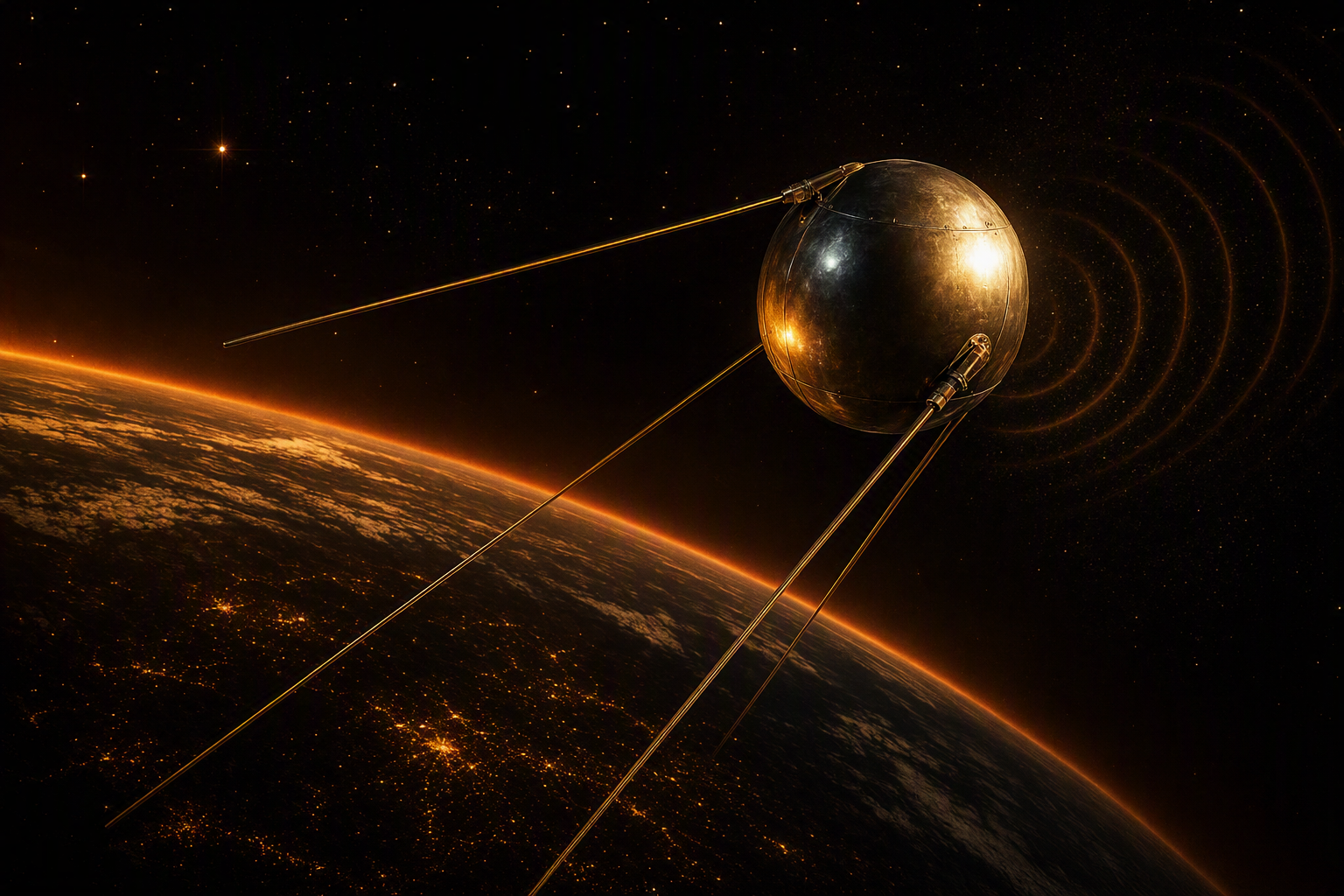
In fact, it was basically a polished metal sphere with four long antennas.
And yet, Sputnik 1 changed the world.
When the Soviet Union launched Sputnik 1 on October 4, 1957, humanity officially entered the Space Age. Its simple radio signal — a repetitive beep… beep… beep… — became one of the most important sounds of the 20th century.
But how could such a small satellite create such a huge reaction?
Let’s travel back to the beginning of the Space Age. 🌍✨
🌍 The World Before Sputnik
To understand why Sputnik caused such a sensation, we need to understand the world of the 1950s.
The Second World War had ended only a little more than a decade earlier. Two enormous powers had emerged from the conflict: the United States and the Soviet Union.
They were political rivals.
They were military rivals.
They were technological rivals.
And, most dangerously, both possessed nuclear weapons. ☢️
This period became known as the Cold War.
Instead of fighting each other directly in a massive conventional war, the United States and Soviet Union competed in military technology, intelligence, propaganda, science and political influence.
Then another battlefield appeared.
Space. 🌌
Both countries understood that rocket technology wasn’t only useful for exploring the universe.
A rocket powerful enough to launch something into orbit could potentially demonstrate the ability to deliver weapons across enormous distances.
So when Sputnik appeared above Earth, people didn’t simply see a scientific experiment.
They saw evidence of Soviet technological power.
🛰️ So… What Exactly Was Sputnik 1?
Sputnik 1 looked surprisingly simple.
It was a shiny spherical satellite approximately 58 centimeters (23 inches) in diameter.
It weighed around 83.6 kilograms (184 pounds).
Four long antennas extended from its body.
Inside were batteries, radio transmitters and instruments for monitoring conditions inside the satellite.
Compared with modern satellites packed with computers, cameras, sensors and solar panels, Sputnik was incredibly basic.
Your smartphone contains technology that would have seemed almost magical to the engineers of 1957. 📱
But Sputnik didn’t need to be complicated.
Its greatest achievement was simply this:
It reached orbit.
That had never been done before by an artificial object.
🚀 October 4, 1957: The Space Age Begins
Sputnik 1 was launched from what is now known as the Baikonur Cosmodrome, using a modified Soviet R-7 rocket.
The rocket climbed through Earth’s atmosphere and eventually placed Sputnik into orbit.
And suddenly…
Humanity had a satellite.
For thousands of years, humans had watched objects moving through the sky.
The Moon. 🌕
Planets. 🪐
Comets. ☄️
Meteors. 🌠
But this object was different.
We had built it ourselves.
Sputnik completed an orbit of Earth roughly every 96 minutes, traveling at around 29,000 kilometers per hour.
That meant this tiny metal sphere was circling the entire planet more than a dozen times every day.
For people living in 1957, the idea was astonishing.
📡 Beep… Beep… Beep…
Sputnik’s most famous feature wasn’t something people could see.
It was something they could hear.
The satellite transmitted radio signals at frequencies that could be detected by radio operators around the world.
The signal sounded something like:
Beep… beep… beep… beep…
Today that might not sound particularly exciting.
In 1957?
It was electrifying.
Amateur radio enthusiasts, scientists and monitoring stations could tune their equipment and hear proof that the Soviet satellite was passing overhead.
The sound was simple.
But its message felt enormous:
Humanity has reached space.
And there was another message hidden beneath it:
The Soviet Union got there first.
That second message caused considerably more anxiety. 😬
😨 The United States Gets a Very Uncomfortable Surprise
Sputnik shocked much of the American public.
Many Americans had assumed that the United States was technologically ahead of the Soviet Union.
Then suddenly a Soviet satellite was flying overhead.
Newspapers covered the story intensely.
Politicians demanded explanations.
Scientists were questioned.
Military officials worried about what Soviet rocket technology might mean.
If the Soviet Union could launch a satellite into orbit, people asked, could similar rockets carry nuclear weapons?
Sputnik therefore became much more than a scientific achievement.
It became a symbol of the Cold War.
The event even helped popularize the phrase “Sputnik crisis” to describe the fear that America might be falling behind technologically.
🧠 Sputnik Changed Education Too
One of Sputnik’s most important effects happened far away from rocket launchpads.
It happened inside classrooms. 📚
The United States began paying much greater attention to science and technical education.
Mathematics.
Physics.
Engineering.
Foreign languages.
Research.
The fear of falling behind the Soviet Union helped encourage major investments in education and scientific development.
In 1958, the United States passed the National Defense Education Act, providing federal support for education in areas considered important to national security.
Sputnik had essentially demonstrated that scientific education wasn’t merely academic.
Technology could influence national power.
A tiny satellite had helped turn classrooms into another front of the Space Race.
🚀 And Then Came NASA
Sputnik also accelerated changes in America’s space program.
Before NASA existed, American military branches and research organizations were working on separate rocket and satellite projects.
The Sputnik shock increased pressure for a more coordinated national space effort.
In 1958, the United States created the National Aeronautics and Space Administration — NASA.
Yes.
The NASA that would eventually send humans to the Moon…
…was created less than a year after Sputnik.
Sputnik wasn’t the only reason NASA appeared, but the satellite dramatically increased the urgency surrounding American space exploration.
The race was officially getting serious.
🐕 Sputnik 2 and Laika
The Soviet Union wasn’t finished.
Just one month after Sputnik 1, it launched Sputnik 2 on November 3, 1957.
This spacecraft carried a passenger.
A dog named Laika. 🐕
Laika became the first animal to orbit Earth.
Sadly, she did not survive the mission.
The technology required to safely return spacecraft from orbit had not yet been developed for her flight.
Her story remains one of the most famous — and controversial — chapters in early space exploration.
But Sputnik 2 demonstrated something extremely important:
Living creatures could survive launch and experience orbital flight, at least temporarily.
The next obvious question became unavoidable.
Could a human do it?
👨🚀 From Sputnik to Yuri Gagarin
The answer came only a few years later.
On April 12, 1961, Soviet cosmonaut Yuri Gagarin became the first human to travel into space and orbit Earth aboard Vostok 1.
Once again, the Soviet Union had achieved a historic first.
The Americans now faced enormous pressure.
President John F. Kennedy soon announced an extraordinarily ambitious objective:
Send humans to the Moon and return them safely to Earth before the end of the decade.
At the time, this sounded almost absurdly difficult.
But eight years later…
🌕 Apollo 11 landed on the Moon.
Neil Armstrong and Buzz Aldrin walked across its surface while Michael Collins remained in lunar orbit.
The Space Race had moved from a small beeping sphere to human footprints on another world in less than twelve years.
🔥 The Rocket Behind Sputnik Had Another Purpose
Here’s where the story becomes even more interesting.
The rocket technology behind Sputnik wasn’t originally developed purely for peaceful space exploration.
The Soviet R-7 was developed as an intercontinental ballistic missile, or ICBM.
Its enormous power made it capable of carrying heavy payloads over huge distances.
That same capability made it useful for launching satellites.
This relationship between military rockets and space exploration shaped much of the early Space Age.
The technology capable of threatening civilization also became technology capable of exploring the universe.
It’s one of the great contradictions of space history.
🚀 Rockets could carry weapons.
🚀 Rockets could carry satellites.
🚀 Eventually, rockets would carry humans toward the Moon.
Same fundamental physics.
Very different destinations.
🌎 Sputnik Helped Change How We See Earth
Sputnik also represented a philosophical change.
Before 1957, space exploration mostly existed in scientific theories, experiments and science fiction.
After Sputnik, space became somewhere humans could actually reach.
Suddenly artificial objects could orbit Earth.
Soon humans would follow.
Then spacecraft would travel to the Moon, Venus, Mars and the outer planets.
Today thousands of active satellites orbit Earth and support everyday technologies.
📍 GPS navigation
📺 Television broadcasting
🌦️ Weather forecasting
📡 Communications
🌍 Earth observation
🛰️ Scientific research
🚢 Transportation and navigation
When you check your location on your phone, watch satellite weather imagery or use certain communication systems, you’re living in a technological world that Sputnik helped begin.
🔥 What Happened to Sputnik 1?
Sputnik didn’t remain in space forever.
Its radio transmitters operated for roughly three weeks, until the onboard batteries were exhausted.
But the satellite continued orbiting Earth.
Gradually, atmospheric drag lowered its orbit.
Finally, on January 4, 1958, Sputnik 1 re-entered Earth’s atmosphere and burned up.
Its entire journey lasted about three months.
That’s surprisingly short for something that changed history.
Sputnik disappeared.
Its influence didn’t.
🤯 Fun Sputnik Facts
Here are a few things that make Sputnik even more fascinating:
🛰️ “Sputnik” roughly means “satellite” or “fellow traveler” in Russian.
📡 Its radio transmissions could be monitored by people outside the Soviet Union.
🌍 It completed roughly 1,400 orbits during its time in space.
🚀 The satellite itself was small, but the rocket required to put it into orbit was enormous.
⏱️ It circled Earth approximately once every 96 minutes.
🎓 Its launch helped push the United States toward greater investment in science and technical education.
🚀 The geopolitical shock surrounding Sputnik contributed to the environment in which NASA was created.
🌕 Only twelve years after Sputnik’s launch, humans were walking on the Moon.
Think about that timeline for a moment.
1957: Beeping metal sphere.
1961: Human in orbit.
1969: Humans on the Moon.
That’s an extraordinary technological leap in just twelve years.
🌌 Why Sputnik Still Matters
Sputnik 1 wasn’t the most sophisticated spacecraft ever built.
It didn’t discover another planet.
It didn’t photograph distant galaxies.
It didn’t carry humans.
It didn’t even survive for very long.
But history isn’t always changed by the biggest machine.
Sometimes history is changed by being first.
Sputnik proved that artificial satellites were possible.
It intensified the Cold War competition in science and technology.
It accelerated the Space Race.
It influenced education and research.
It contributed to the urgency that helped create NASA.
And perhaps most importantly, it changed humanity’s imagination.
Before Sputnik, space was something above us.
After Sputnik…
Space became somewhere we could go. 🌌🚀
🛰️ Final Thought: The Beep That Started a New Era
If you could stand outside on October 4, 1957, Sputnik would probably have seemed insignificant compared with the enormous sky around it.
A tiny sphere.
Four antennas.
A radio transmitter.
And a repetitive electronic signal.
Beep.
Beep.
Beep.
Yet those signals announced something humanity had never experienced before.
For the first time, our technology had crossed into orbit and remained there.
The universe hadn’t changed that night.
We had.
And from that moment forward, humanity would never look at the night sky quite the same way again. 🛰️🌍✨