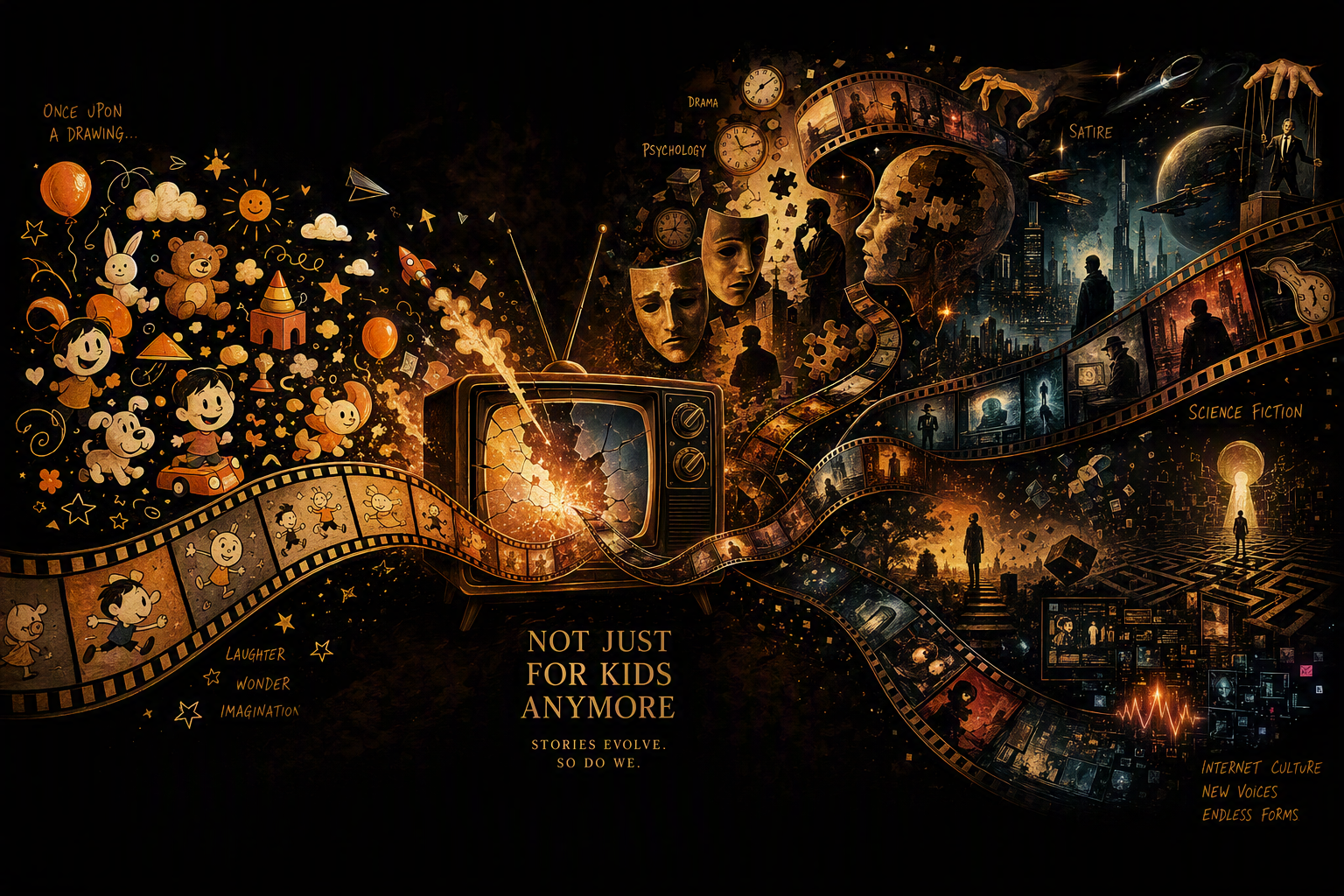
Animation grew up. Or maybe we finally noticed that it was never supposed to stay in the kids’ section.
There was a time when admitting you watched cartoons as an adult could earn you that look.
“You still watch cartoons?”
Yes, Karen. And the cartoon horse has a more complicated emotional life than half the characters in your favorite prestige drama.
For decades, Western popular culture treated animation as something with an expiration date. You watched cartoons as a child, discovered live-action television as a teenager, and eventually graduated into “serious” entertainment involving detectives, lawyers, unhappy marriages, expensive apartments, and people staring dramatically through windows.
But something changed.
Today, animation comfortably explores depression, politics, sexuality, war, identity, inequality, addiction, family trauma, mortality, and existential dread.
Sometimes all before the opening credits.
Shows such as BoJack Horseman, Arcane, Rick and Morty, Invincible, The Simpsons, and South Park have helped demonstrate something that probably should have been obvious from the beginning:
Animation isn’t a genre. It’s a medium.
And that distinction changes everything.
🎨 The Great Cartoon Misunderstanding
Nobody walks into a bookstore, points at the shelves, and says:
“Books? Aren’t those for children?”
That would be absurd.
There are children’s books, crime novels, political thrillers, horror stories, romances, biographies, philosophical works, and 700-page fantasy novels containing maps that require their own geography degree.
Books are a medium.
Animation works the same way.
Peppa Pig and BoJack Horseman are both animated.
That doesn’t mean they’re designed for the same audience.
One teaches children about family and friendship.
The other might accidentally make you reconsider every decision you’ve made since 2014.
The confusion developed partly because television animation—particularly in the West—was heavily marketed toward younger audiences for decades. Cartoons became associated with toys, breakfast cereal, Saturday mornings, and children’s television channels.
Eventually, “animated” became cultural shorthand for “made for kids.”
But the limitation was never technological or artistic.
It was mostly cultural.
🧠 Plot Twist: Adults Never Actually Stopped Watching Cartoons
Here’s where the story gets slightly embarrassing.
Adults spent decades claiming cartoons were for children…
while watching cartoons.
The Simpsons became a cultural institution.
South Park turned crude animation into social satire.
Family Guy built an enormous adult audience.
Then came shows such as Futurama, Archer, Rick and Morty and BoJack Horseman.
Apparently adults didn’t hate cartoons.
They just wanted cartoons with taxes, depression and questionable life decisions.
Part of the appeal is certainly nostalgia.
Animation can instantly transport viewers back to childhood: Saturday mornings, Cartoon Network, Nickelodeon, Disney, VHS tapes, cereal bowls and the ancient prehistoric ritual known as waiting an entire week for the next episode.
No autoplay.
No binge-watching.
We survived somehow.
But nostalgia alone cannot explain modern animation’s popularity.
People stay because the stories themselves have changed.
Characters became more psychologically complicated. Narratives became serialized. Themes became darker. Writers discovered that an animated comedy could suddenly deliver an emotionally devastating episode without abandoning humor.
The cartoon didn’t replace serious storytelling.
It became serious storytelling.
😂 The Trojan Horse Effect
Animation possesses one particularly interesting advantage over live action:
It can disguise uncomfortable ideas as entertainment.
Imagine a live-action drama opening with a forty-minute discussion about depression, mortality and whether human existence has any meaningful purpose.
Heavy evening.
Now put those ideas inside an absurd science-fiction adventure involving aliens, portals and a drunk scientist.
Suddenly millions of people are watching.
This could be called the Trojan Horse Effect of Animation.
Comedy gets the audience through the door.
Absurdity keeps things entertaining.
Then the story quietly introduces something surprisingly uncomfortable.
You laugh.
You laugh again.
Then somebody says one sentence and suddenly you’re staring at the television like:
“Why is this cartoon attacking me personally?”
This is one reason animation works exceptionally well for satire.
Reality can be exaggerated until its contradictions become obvious.
Politicians can become literal monsters.
Corporations can become machines.
Social trends can become entire dystopian worlds.
Animation doesn’t have to obey reality in order to criticize it.
Sometimes breaking reality makes the argument clearer.
🌍 Then Anime Entered the Chat
For many Western viewers, anime provided another major challenge to the “animation equals children” assumption.
International audiences encountered Japanese animated productions dealing openly with subjects such as war, death, technology, political corruption, sexuality, philosophy and psychological trauma.
Films and series such as Akira, Ghost in the Shell, Cowboy Bebop, Death Note and later Attack on Titan demonstrated the enormous range possible within animation.
Anime wasn’t simply one genre.
It could be horror.
Romance.
Comedy.
Crime.
Historical fiction.
Cyberpunk.
Sports drama.
Psychological thriller.
Or seventeen episodes of characters discussing destiny before somebody finally launches an attack powerful enough to destroy a mountain.
Different traditions developed around animation in Japan and the West, but globalization and streaming gradually exposed audiences to both.
The borders began to blur.
Western productions borrowed visual language associated with anime. Japanese studios collaborated with Western companies. Audiences stopped caring quite so much about which cultural box something belonged inside.
Animation became increasingly global.
🎭 When Reality Isn’t Emotional Enough
Here’s another advantage animation has over live action:
Reality has rules. Animation doesn’t.
Suppose a character feels lonely.
Live action can show an empty apartment, muted lighting and a quiet performance.
Animation can make the entire city disappear.
A room can stretch infinitely.
The character can shrink.
Colors can drain from the world.
Memories can physically walk into the scene.
Gravity can stop working.
None of this needs to be realistic because the objective isn’t physical realism.
It’s emotional realism.
Animation can transform internal feelings into external environments.
Anxiety becomes a maze.
Depression becomes an empty landscape.
Love becomes color.
Fear becomes a creature.
Memory becomes architecture.
This is where animation stops being simply “drawings that move” and becomes something much more interesting.
It can visualize experiences that don’t physically exist.
📱 The Internet Changed Cartoons Too
Then came the internet.
And everything got weird.
Memes transformed individual cartoon frames into global jokes.
GIFs gave old characters completely new lives.
Streaming allowed people to discover shows years after they originally aired.
YouTube introduced independent animators who didn’t need traditional television networks.
TikTok and short-form platforms turned ten-second animated moments into viral cultural references.
Suddenly a cartoon produced twenty years ago could become relevant again because someone turned one facial expression into a meme.
Animation became incredibly compatible with internet culture because cartoons are naturally exaggerated.
Big expressions.
Distinct silhouettes.
Recognizable characters.
Visual reactions.
Simple frames that remain understandable without context.
Basically, cartoons were making reaction images decades before reaction images existed.
The internet simply noticed.
🧩 The Audience Grew Up—So Animation Followed
There’s also a straightforward demographic explanation.
Children who grew up with animation became adults.
They didn’t suddenly forget how much they enjoyed it on their eighteenth birthday.
Their expectations simply changed.
At eight, you might want adventure.
At sixteen, identity.
At twenty-five, relationships and ambition.
At thirty-five, burnout, family, regret and whether buying an air fryer counts as having your life together.
The medium can accommodate all of them.
Streaming accelerated this evolution because animated productions no longer needed to fit neatly into children’s programming schedules.
Different shows could target completely different demographics.
Instead of asking:
“Are adults allowed to watch cartoons?”
The entertainment industry increasingly began asking:
“What kind of animation do adults want?”
That’s a much more interesting question.
🎬 “Realistic” Doesn’t Mean “Mature”
Perhaps the strangest assumption surrounding animation is that visual realism automatically makes storytelling more sophisticated.
Real actors?
Serious art.
Animated characters?
Kids.
But storytelling doesn’t work that way.
A terrible live-action drama doesn’t become profound because the actors have visible pores.
Likewise, an animated series doesn’t become childish because somebody drew the protagonist.
Maturity comes from writing, characterization, ideas, emotional complexity and perspective.
The camera doesn’t determine whether a story is intelligent.
Neither does the pencil.
🚀 So What Happens Next?
The boundary between animation and traditional cinema is becoming increasingly difficult to define anyway.
Modern productions already combine hand-drawn animation, CGI, motion capture, digital environments and live-action footage.
Video games borrow cinematic techniques.
Films borrow game-engine technology.
Western animation borrows from anime.
Anime borrows from Western cinema.
Independent artists publish directly online.
And AI-assisted production tools are beginning to introduce another unpredictable variable into the equation.
The future probably won’t be:
Animation vs. live action.
It will increasingly be:
What visual language tells this story best?
And that may be the healthiest way to think about animation.
Cartoons Didn’t Grow Up. We Did.
So, are cartoons for kids?
Absolutely.
Some of them.
Just like some books are for kids.
Some movies are for kids.
Some games are for kids.
The mistake was never allowing children to own cartoons.
The mistake was assuming nobody else could.
Animation can make a six-year-old laugh because a character gets hit by a frying pan.
Twenty years later, that same person might watch another animated character struggle with loneliness, ambition, identity or mortality.
And yes…
occasionally someone still gets hit by a frying pan.
That’s the beauty of the medium.
Animation can be ridiculous and intelligent, childish and sophisticated, comforting and disturbing—sometimes within the same episode.
Perhaps cartoons were never waiting to grow up.
They were waiting for us to stop underestimating them. 🎬