From the sweltering basement parties of the Bronx in 1973 to sold-out stadium tours across Tokyo, Lagos, and São Paulo, hip-hop has achieved the most improbable cultural takeover in modern history. 🌍 What started as an innovative local remedy for urban decay has evolved into the dominant global vernacular of youth culture, fashion 👟, technology 💻, and commerce 💰.
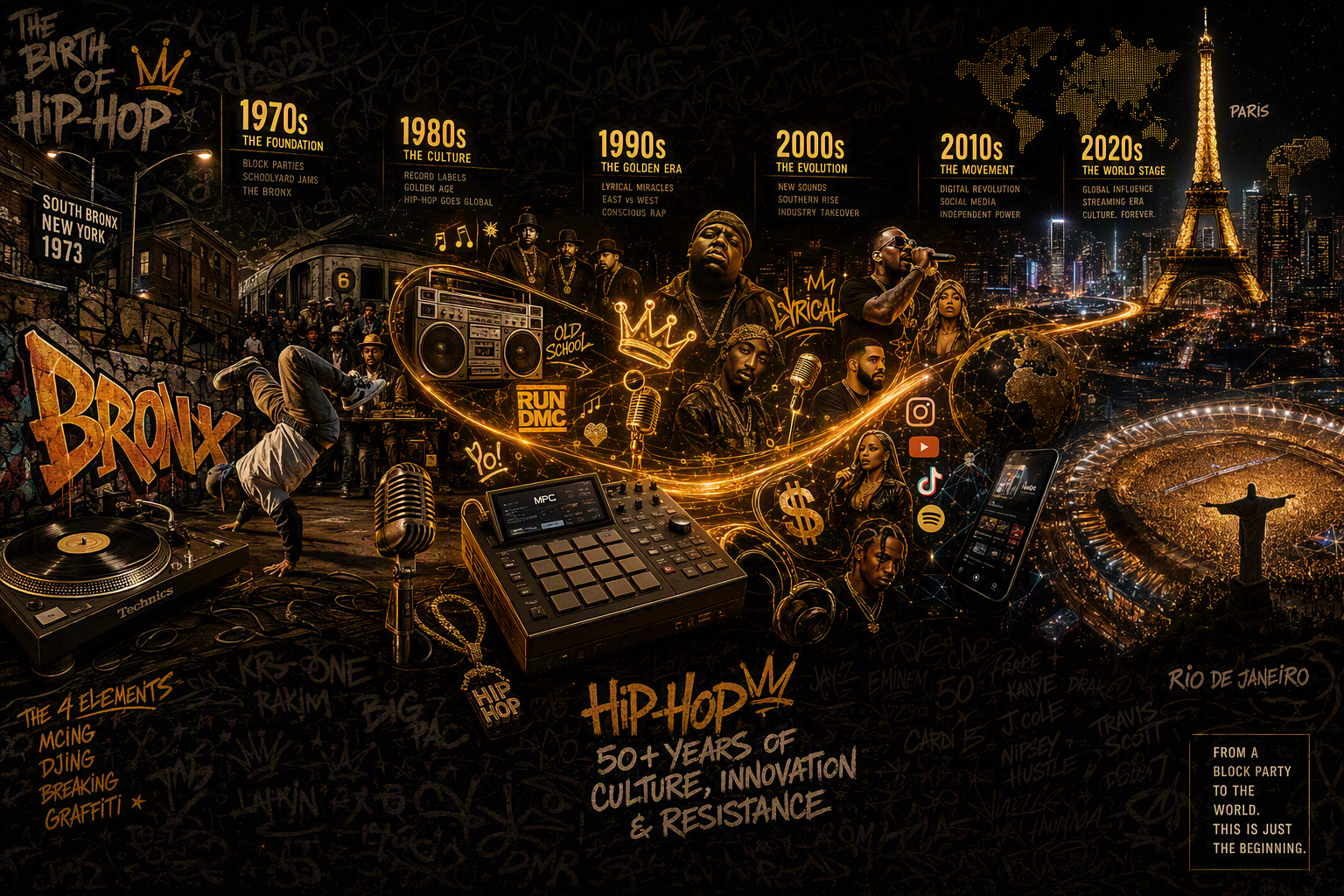
The Bronx Blueprint: The Spark and the Four Elements (1970s) ⚡ The movement traces its official genesis to August 11, 1973, at 1520 Sedgwick Avenue in the Bronx, where DJ Kool Herc hosted a back-to-school jam. By using two turntables 🎛️ to isolate and extend the rhythmic drum breaks of funk and soul records—a technique known as the “merry-go-round”—he created a continuous canvas for dancers, known as b-boys and b-girls 💃🕺. Soon, masters of ceremonies (MCs) began hyping the crowd over the rhythm, transforming party-rocking chants into structured, rhythmic poetry ✍️. Hip-hop was never just a musical genre; it was born as a four-element ecosystem:
DJing 🎧: The manipulation of vinyl and sound to create seamless, infectious rhythms.
MCing 🎤: The lyrical art of storytelling, boasting, and social commentary.
Breaking 🤸♂️: An acrobatic, high-energy street dance born from the physical expression of the beat.
Graffiti Art 🎨: The visual language of the streets, transforming neglected subway cars and brick walls into vibrant canvases.
Golden Era Innovation and the Commercial Boom (1980s–1990s) 📻👑 As drum machines like the Roland TR-808 and digital samplers entered the picture, the sonic landscape expanded rapidly. The 1980s introduced mainstream viability and political awakening through acts like Run-D.M.C. and Public Enemy, who weaponized the genre as vital social journalism 📰.
The 1990s then birthed a golden age defined by regional identity, artistic mastery, and intense geographic rivalry:
East Coast (New York) 🗽: Lyrical complexity, gritty boom-bap production, and cinematic storytelling championed by icons like Nas, The Notorious B.I.G., and the sprawling Wu-Tang Clan.
West Coast (California) 🌴: G-funk synthesizer-heavy grooves, chronicling street life, police brutality, and systemic tension, pioneered by Dr. Dre, Snoop Dogg, and Tupac Shakur.
This era proved that hip-hop could be both high art and commercial gold 🏆, setting the stage for total entertainment dominance.
The Digital Disruption and Genre-Bending Production (2000s–2010s) 💿💻 The turn of the millennium dismantled traditional music industry gatekeeping. Producers like Kanye West and Pharrell Williams shifted the sonic paradigm in the mid-2000s, blending soul vocal samples with electronic experimentation and dismantling the rigid “gangsta rap” monolith.
Concurrently, internet file-sharing and early social media platforms allowed underground artists to bypass major labels entirely. Trap music soon dominated the 2010s with its signature triplet hi-hats, rapid-fire snares, and deep 808 sub-bass 🔊. Artists like Kendrick Lamar combined razor-sharp lyricism with jazz arrangements, proving that hip-hop could capture Pulitzer Prize-level literary prestige 📚.
Global Hydration: Hip-Hop’s International Renaissance (Present Day) 🌐🚀 Today, hip-hop is no longer just an American export; it is a decentralized global hydra. The genre has hyper-localized to reflect the unique struggles and triumphs of youth worldwide:
UK Drill and Grime 🇬🇧: Shaping London’s underground nightlife with aggressive basslines and rapid-fire cadence.
Latin Trap 🌴🔥: Bridging Spanish-language reggaeton rhythms with heavy American hip-hop production, dominating global streaming charts 📊.
Afrobeats Integration 🌍🇳🇬: Borrowing hip-hop’s collaborative ethos and cross-continental networking to elevate African artists like Burna Boy and Wizkid to international superstardom ✨.
Far beyond a passing trend, hip-hop’s incredible staying power lies in its relentless adaptability. It remains the ultimate megaphone for the marginalized 📣, a multi-billion-dollar corporate titan 📈, and the gold standard for global mainstream culture. What specific era or regional movement of this rich history would you like to explore next? 🤔