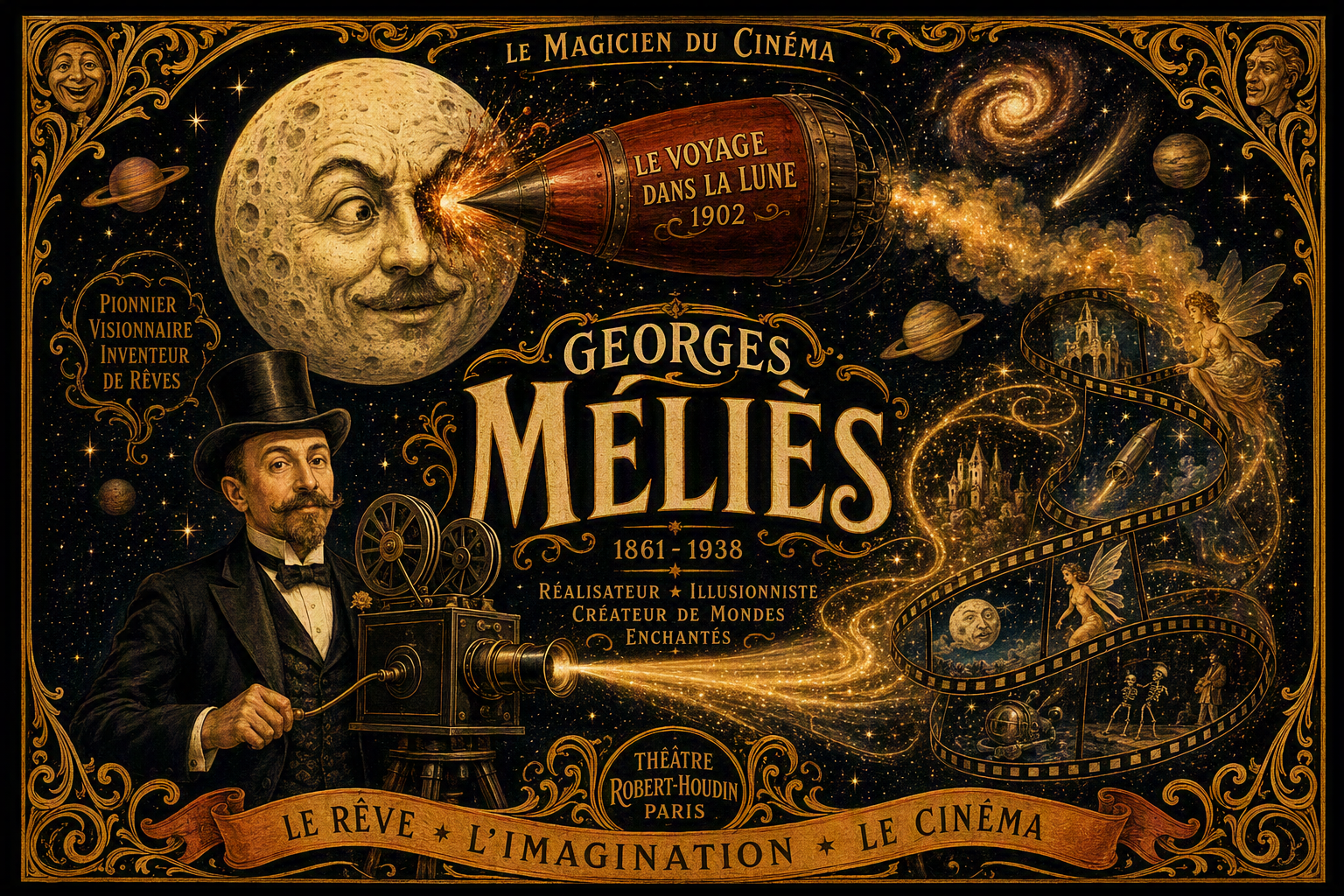
Long before Marvel dominated the global box office with multi-million-dollar green-screen spectacles 🎬 or Christopher Nolan blew up actual aircraft for IMAX ✈️, a Parisian illusionist and theater owner named Georges Méliès looked at a clunky motion picture camera 🎥 and decided it was the greatest magic wand 🪄 ever created.
Back in 1902 🕰️, when the vast majority of early filmmakers were completely content recording mundane, static slices of everyday life—such as waves crashing against a shore 🌊, factory workers leaving a shift 🏭, or a train pulling slowly into a station 🚂—Méliès had a much wilder, far more imaginative vision. He looked at the medium and thought: forget reality, let’s go to outer space 🚀. The magnificent result was A Trip to the Moon (Le Voyage dans la Lune) 🌕, a groundbreaking 14-minute silent masterclass that single-handedly invented the science fiction genre 👽 and gave birth to visual effects as we know them today ✨.
🎩 The OG Wizard of Visual Effects
Before he ever touched a roll of film, Georges Méliès was a professional stage magician 🔮 running the legendary Théâtre Robert-Houdin in Paris. When he first witnessed the Lumière brothers’ miraculous cinematograph in 1895, he immediately tried to purchase one from them. They flatly refused, famously telling him that film had “no commercial future” and was merely a passing novelty 📉. (Talk about a historically catastrophic business prediction 💀.)
Undeterred by their short-sighted skepticism, Méliès went out, reverse-engineered his own camera, built one of Europe’s very first glass-walled film studios 🏢, and immediately set out to manipulate reality itself. His background in stage magic taught him how to misdirect an audience 🃏, create optical illusions, and build elaborate theatrical worlds. But film gave him an entirely new toolkit that physical stages could never match: time and space manipulation ⏳.
His ultimate secret weapon was the stop-trick (also known as the substitution splice) ✂️. Film history lore says that Méliès’s hand-cranked camera jammed while he was shooting a routine street scene in Paris. When he finally developed the film later in his darkroom 🎞️, he noticed that the split-second glitch had magically transformed a moving omnibus into a hearse right before his eyes 👻. That moment triggered a massive lightbulb moment 💡: he realized you could physically stop the camera, alter the mise-en-scène or move objects around, and then restart the camera to create seamless, invisible magic 🪄.
🚀 Inside the Space Program (1902 Style)
Loosely inspired by the speculative adventure novels of Jules Verne (From the Earth to the Moon) 📚 and H.G. Wells (The First Men in the Moon), A Trip to the Moon follows a group of eccentric, heavily bearded astronomers 🔭 belonging to an astronomy club. They vote to build a massive, bullet-shaped space capsule, get loaded into an enormous industrial cannon 💥, and are violently shot straight into space, famously crashing right into the right eye of the anthropomorphic Man in the Moon 🌝.
The production featured brilliant, low-fi wizardry that still manages to captivate and delight audiences today:
Practical Magic 🎨: Elaborately painted cardboard backdrops, hidden trapdoors 🕳️, and cleverly timed puffs of actual smoke 💨.
The Match Cut 🎥: Instead of possessing a moving zoom lens, Méliès physically moved the physical sets closer to the stationary camera to simulate a dynamic tracking shot.
The Selenites 👽: A troop of dancers, acrobats, and contortionists from the legendary Folies Bergère rocking bizarre, handmade alien costumes that literally puff into a cloud of smoke when struck by an astronomer’s umbrella ☂️.
🏴☠️ Viral Fame and 1900s Piracy Drama
Believe it or not, A Trip to the Moon went viral in the truest sense of the early 20th century—it became a massive, unprecedented international blockbuster 🌟. Travelling projectionists carried prints across Europe and North America, captivating packed theater houses 🎟️.
However, this massive success came with a brutal dark side: rampant, unregulated international piracy 🏴☠️. Thomas Edison’s aggressive business technicians famously intercepted and stole prints of the film upon its arrival in the United States, mass-duplicating them and distributing them across American theaters without paying a single cent in royalties 💸. Because of this widespread theft, Méliès saw virtually none of the American box office profits. Over time, changing audience tastes toward grittier realism, combined with the outbreak of World War I 🪖 and the rise of massive Hollywood studio monopolies, pushed Méliès into heavy debt and eventual bankruptcy 📉. He tragically lost his studio, and at one point, was found selling toys 🧸 and candy out of a kiosk at the Montparnasse railway station in Paris 🚉. Fortunately, film historians eventually tracked him down in his later years, restoring his legacy and giving him the international flowers 💐 and profound respect he so richly deserved.
✨ Why It Still Echoes Through Modern Cinema
Georges Méliès fundamentally proved that cinema did not have to function as a digital mirror reflecting everyday reality; it could instead serve as an infinite dream machine 🌌. Every single time you sit in a theater 💺 and watch a glowing green-screen explosion 💥, a mystical portal tearing open in a blockbuster superhero movie 🦸♂️, or an indie sci-fi flick crafted on a shoestring budget, you are looking at the direct artistic descendant of a French illusionist who looked up at the night sky over Paris 🌃 and wondered what it would look like if captured on film 🎬.
What is your absolute favorite piece of early cinematic trickery or silent-era storytelling? 🍿🎭