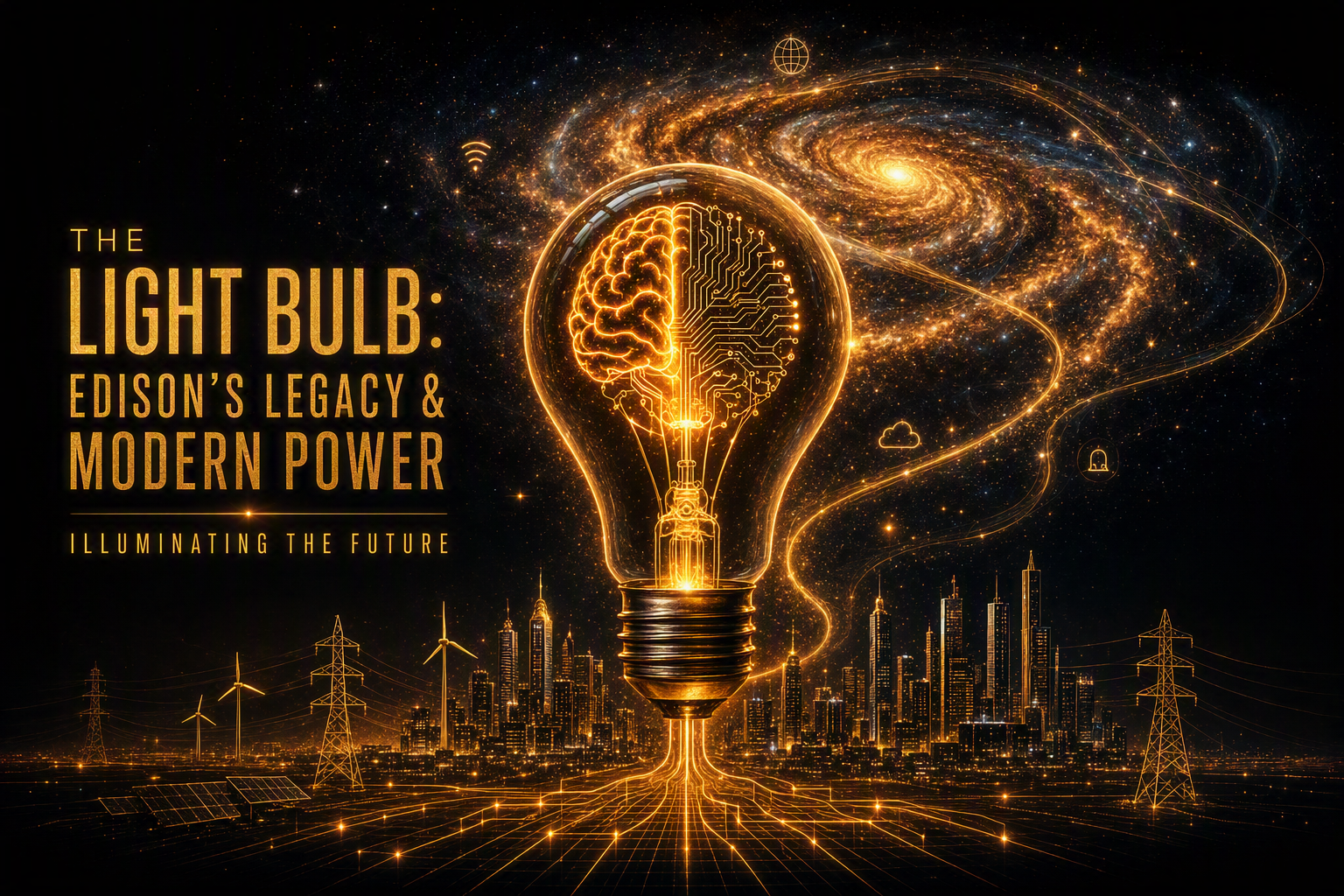
Look around your room right now. 🛋️ With a simple flick of a switch, you banish the dark, extend your workday, read deep into the night, and transform a shadowy space into a vibrant living area. 🌆 We take electricity and illumination completely for granted. ⚡ Yet, less than a century and a half ago, humanity’s nightlife relied on flickering candles, smoky oil lamps, and dangerous gaslight. 🕯️
The story of the incandescent light bulb is far more than a simple history lesson about a glowing glass orb. 🔮 It is a thrilling epic of relentless failure, brilliant engineering, fierce rivalry, and a profound shift in human civilization. 🚀
1. 🧠 The Mind of a Maverick: Who Was Thomas Edison?
When we hear the name Thomas Alva Edison, we picture the quintessential genius. 👨🔬 Born in 1847 in Milan, Ohio, Edison was famously a “dropout”—though not because he lacked intelligence. His teacher thought he was “addled” because he asked too many questions, so his mother pulled him out of school and homeschooled him. 🏡
Edison was less of a traditional academic scientist and more of an industrial pioneer. He possessed an insatiable curiosity and a tireless work ethic. He famously stated:
💡 “Genius is one percent inspiration and ninety-nine percent perspiration.”
By the time he passed away, Edison held a staggering 1,093 U.S. patents. 📜 While the light bulb is his most famous crown jewel, his fertile mind also gifted the world the phonograph 🎵 (which first recorded human voice) and the motion picture camera 🎬, single-handedly laying the groundwork for the modern entertainment and tech industries.
2. 🔍 The Quest: How Was the Light Bulb Invented?
A common historical misconception is that Thomas Edison “invented” the light bulb from scratch. In reality, inventors had been experimenting with electric arc lights and early incandescent prototypes for decades. However, these early versions were wildly impractical: they burned out in minutes, consumed too much electrical current, or were far too blindingly bright for a living room. 💥
Edison’s true genius lay in system-building and persistence. In 1878, he boldly declared that he would make electric light so cheap that only the rich would burn candles. 🕯️💸
🧪 The Secret Recipe
The primary engineering puzzle was finding the right filament—the material inside the bulb that glows when electricity passes through it. Edison and his team at Menlo Park tested thousands of materials, ranging from platinum and coconut fiber to fishing line and even human hair. 🧶
After testing over 6,000 plant growths, Edison discovered in late 1879 that a carbonized cotton thread filament could glow inside a near-total vacuum for over 13 hours. It was a monumental breakthrough. 🌱✨
3. ⚡ The Science: How Does It Actually Work?
At its core, an incandescent light bulb relies on a deceptively simple yet brilliant physical principle: electrical resistance.
The Circuit: 🔌 When you flip a switch, an electrical current flows from the power source through the metal wires of the bulb.
The Bottleneck: 🚧 The current hits the filament. Because the filament is extremely thin and has a high electrical resistance, electrons struggle to push through it.
Heat and Light: 🔥 This struggle generates intense heat. The filament heats up to roughly 2,200°C (4,000°F), causing it to glow brightly (incandesce).
The Vacuum: 🌬️ If you heated a wire that hot in normal air, it would instantly catch fire and burn to ash in a fraction of a second due to oxygen. To prevent this, Edison sealed the filament inside a glass bulb from which almost all the air (oxygen) was pumped out.
4. 🌍 Rewriting Reality: What Did the Light Bulb Unleash?
The introduction of the commercial light bulb did much more than light up dark rooms; it fundamentally restructured human existence.
Conquering Time: ⏰ Before the bulb, human productivity was dictated by the sun. When night fell, activity slowed to a crawl. Edison’s invention effectively doubled the usable hours of the day, giving birth to the 24-hour global economy, night shifts, and urban nightlife. 🌃
Urban Safety and Growth: 🏙️ Gas lamps were notorious for causing catastrophic city fires. Electric lighting made city streets dramatically safer, reducing crime and allowing bustling urban centers to thrive long after sunset.
The Blueprint for Modern Power Grids: ⚡ To make light bulbs useful, Edison didn’t just invent a product; he invented the infrastructure. He built the Pearl Street Station in New York in 1882, creating the world’s first investor-owned electric utility. This paved the way for the electrical grids that power everything from our smartphones 📱 to electric vehicles 🚗 today.
5. 🤔 Reflection: Looking Forward in the Glow of the Past
Today, incandescent bulbs are largely being phased out in favor of energy-efficient LEDs, yet the legacy of Edison’s Menlo Park laboratory remains all around us. 🌟 It reminds us that massive technological leaps rarely happen in a single, magical “Eureka!” moment. Instead, they are forged through thousands of failed experiments, stubborn resilience, and a deep desire to solve everyday human problems. 🛠️
As we look toward modern frontiers like artificial intelligence 🤖 and quantum computing, the spirit of Edison’s workshop asks us a quiet question: What standard part of our daily lives are we currently accepting as “impossible” that someone will completely reinvent tomorrow? 🔮✨