Every living organism is an engineering marvel powered by roughly 37 trillion tiny cities working in relentless synchrony. Cellular biology is not just a catalogue of microscopic parts—it is the study of computational architecture, rigorous quality control, and the genetic choreography that keeps complex life from descending into entropy.
1. The Anatomy of the Nanoscale Factory
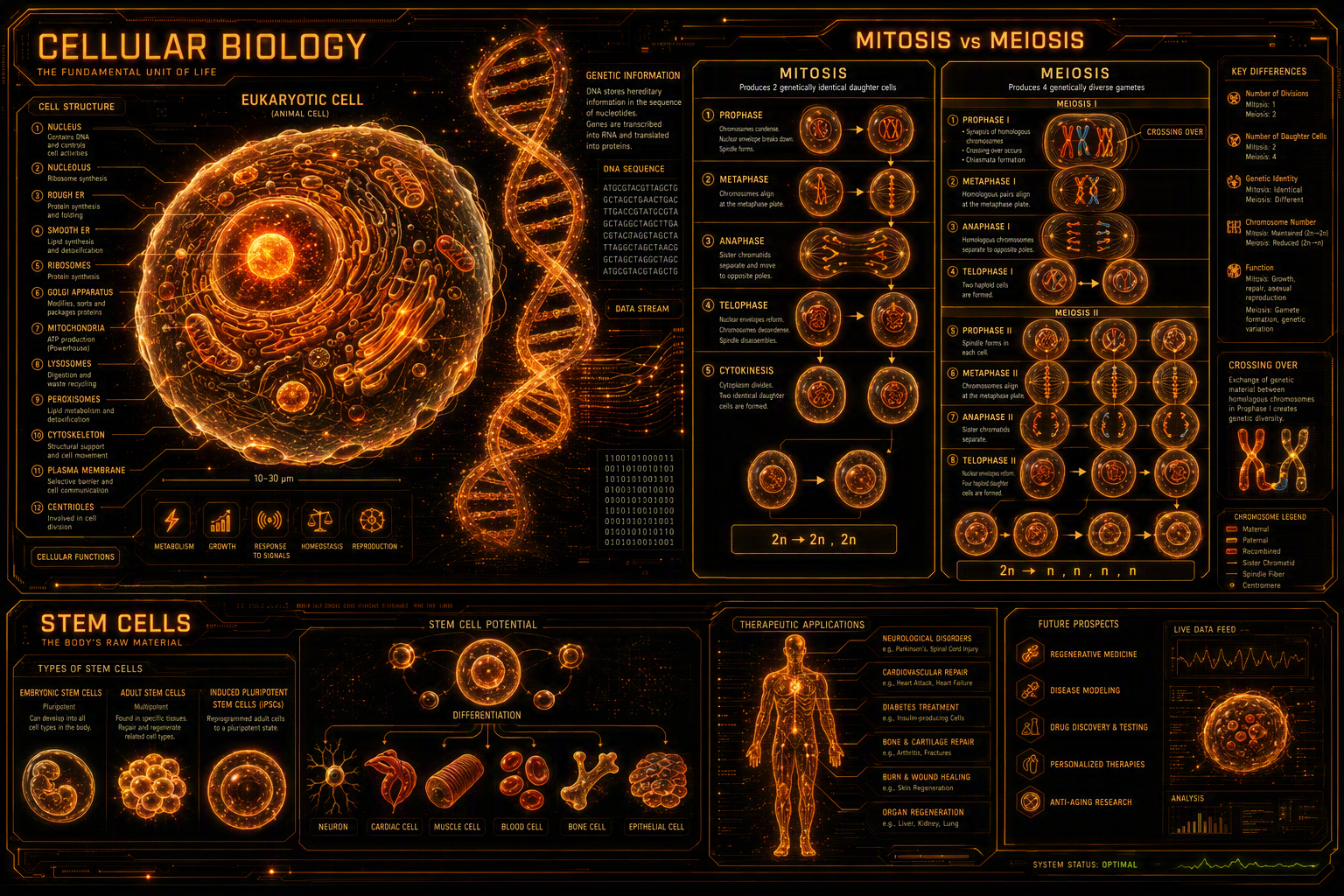
A eukaryotic cell is far from a passive bag of soup. It is a compartmentalized powerhouse where specific biochemical reactions occur without interfering with neighboring pathways.
The Nucleus (Corporate HQ): Guarded by the nuclear envelope, this command center houses the genomic master blueprint. The nucleolus inside coordinates ribosome synthesis with clockwork precision.
Mitochondria (The Independent Powerplants): Often branded as the “powerhouse of the cell,” mitochondria do far more than synthesize ATP via oxidative phosphorylation. Endosymbiotic theory reveals they were once free-living alpha-proteobacteria, which explains why they still carry their own circular mtDNA.
Endoplasmic Reticulum & Golgi Apparatus (Manufacturing & Logistics): The Rough ER synthesizes and folds polypeptide chains, while the Smooth ER handles lipid synthesis and detoxification. Cargo is then shipped via vesicle trafficking to the Golgi apparatus for post-translational modification and sorting.
Lysosomes (The Demolition Squad): Packed with acid hydrolases, lysosomes break down cellular debris through autophagy—a recycling process so fundamental that its discovery earned a Nobel Prize in 2016.
2. The Great Duplication: Mitosis vs. Meiosis
When cells divide, they face a high-stakes data integrity challenge: duplicate gigabytes of genetic code without creating catastrophic mutations.
| Feature | Mitosis (Somatic Cloning) | Meiosis (Evolutionary Roulette) |
| Primary Purpose | Growth, tissue repair, asexual reproduction | Gametogenesis (sperm & egg production) |
| Rounds of Division | 1 division (Prophase $\rightarrow$ Telophase) | 2 divisions (Meiosis I & Meiosis II) |
| Daughter Cells | 2 genetically identical diploid ($2n$) cells | 4 genetically diverse haploid ($n$) cells |
| Genetic Variation | Minimal (barring replication errors) | Massive (via crossing over & independent assortment) |
| Failure Mode | Uncontrolled proliferation (Cancer) | Aneuploidy (e.g., Trisomy 21 / Down syndrome) |
Mitosis is biological fidelity at its peak—producing carbon-copy cells to maintain tissues. Meiosis, by contrast, is an evolutionary gamble designed to generate genetic diversity. During Prophase I, homologous chromosomes physically swap segments (crossing over), ensuring no two gametes are ever identical.
3. Stem Cells: Biology’s Blank Slates
Stem cells possess two defining superpowers: self-renewal (the ability to divide indefinitely without differentiating) and potency (the capacity to mature into specialized cell types).
Totipotent (Zygote) ➔ Pluripotent (ESC / iPSC) ➔ Multipotent (Adult Stem Cells) ➔ Specialized Cell
Embryonic Stem Cells (ESCs): Pluripotent cells derived from the blastocyst’s inner cell mass, capable of generating all three germ layers (ectoderm, mesoderm, endoderm).
Adult (Somatic) Stem Cells: Multipotent repair units residing in specialized niches (e.g., hematopoietic stem cells in bone marrow replacing 2 million red blood cells every second).
Induced Pluripotent Stem Cells (iPSCs): Shinya Yamanaka’s breakthrough discovery that introducing four transcription factors (Oct4, Sox2, Klf4, c-Myc) can rewind a mature, differentiated skin cell back into a pluripotent embryonic state.
Modern Perspectives and Future Horizons
Cellular biology has shifted from descriptive observation to synthetic manipulation. With tools like CRISPR-Cas9, optogenetics, and organ-on-a-chip platforms, researchers no longer just watch cells—they reprogram them.
The central challenge of current biogerontology lies in cellular senescence and telomere exhaustion: aging may simply be an accumulation of cellular informational noise. By understanding how stem cell niches degrade and why checkpoint controls in mitosis fail over time, regenerative medicine is steadily transforming from theoretical biology into clinical therapy.