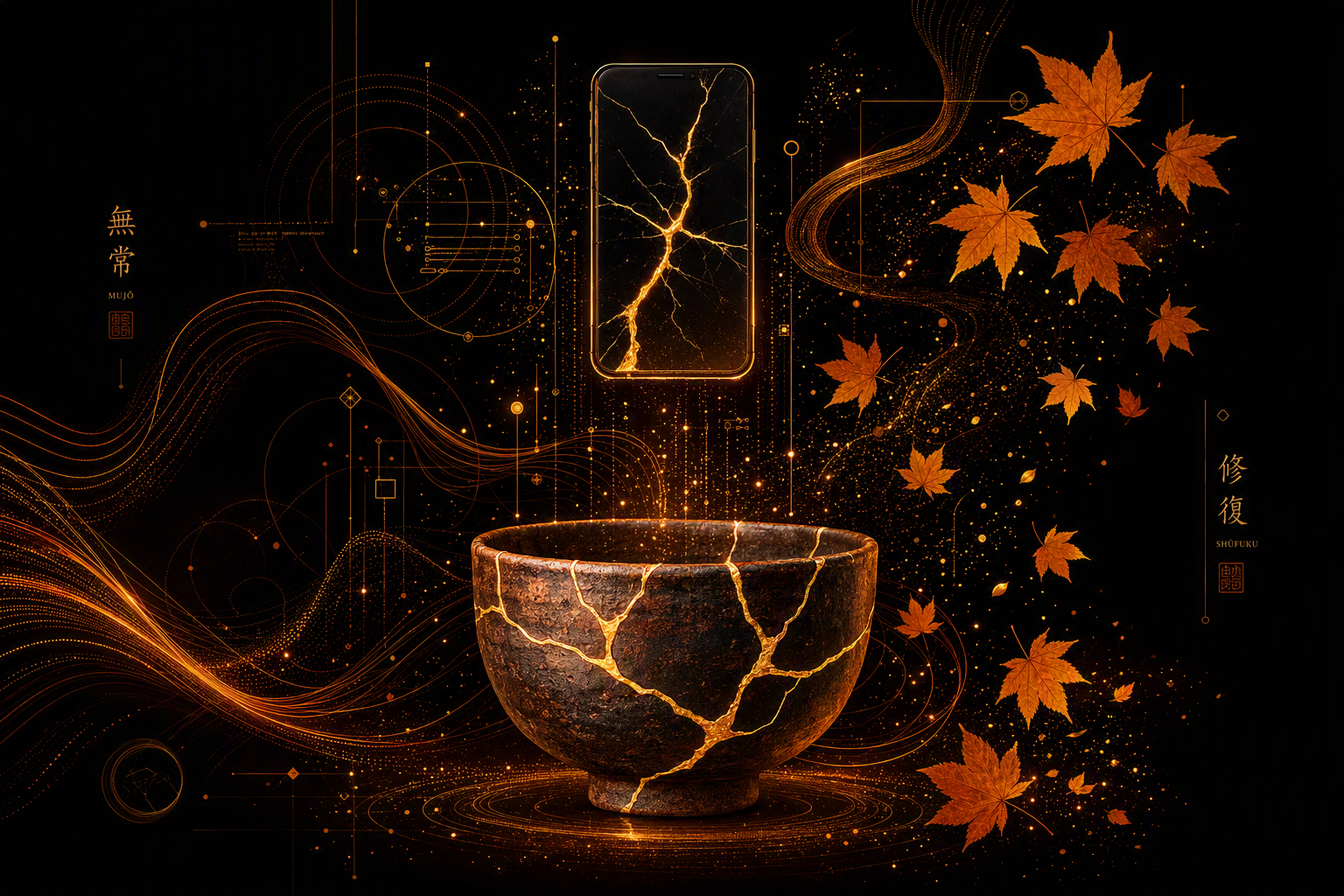
We live in a world obsessed with smooth, flawless surfaces. 📱 Look at your phone right now. Smooth glass, brushed titanium, sleek edges, pixels so fine you can’t see the joints. ✨ Open an app and you’re greeted by hyper-curated, filtered, blemish-free aesthetic perfection. 📸 Perfection is everywhere! If a device gets a tiny crack on its screen 💔 or a dent on its side, our immediate instinct isn’t to admire its journey—it’s to feel a pang of annoyance, drop $200 on a repair, 💸 or swap it for the newest model. 🆕
We have built a hyper-industrial, hyper-digital culture 🏭💻 that treats decay, aging, and imperfection not as natural phases of existence, 🍂 but as technical errors to be patched out. 🛠️
Enter Wabi-Sabi (侘寂) 🍵—the traditional Japanese aesthetic philosophy centered on finding beauty in impermanence, imperfection, and incompleteness. 🌸 At its core, wabi-sabi asks a provocative question: What if the flaw isn’t a defect, but the very place where meaning enters? 💡✨
🌾 The Anatomy of Wabi-Sabi: Asymmetry, Rust, and Time ⏳
To truly understand wabi-sabi, you have to untangle its two components 🧬:
🧘 Wabi originally referred to the solitude of living away from society in nature, 🌲 but over time it evolved to mean rustic simplicity, quiet elegance, and unpretentious grace. ✨
🍂 Sabi relates to the passage of time—the visible patina of age, 🕰️ the rust on an iron teapot, 🫖 the gentle wear on a wooden table 🪵 where hands have rested for decades. 👋
Together, they form a world view that directly opposes the Western classical ideal of beauty, 🏛️ which has historically chased symmetry, permanence, and mathematical proportion 📐 (think Greek statues 🗿 and Renaissance canvases 🎨). Wabi-sabi doesn’t care about perfect geometry. 🚫📐 It cares about history, vulnerability, and organic truth. 🌿❤️
A classic manifestation of this philosophy is Kintsugi (金継ぎ) 🏺✨—the art of repairing broken ceramics with lacquer dusted with powder gold, silver, or platinum. 🪙 Instead of hiding the fractures, Kintsugi illuminates them. 🌟 The broken bowl isn’t restored to look “like new”; its history of breaking and mending becomes its most precious feature. 💖🥣
🫖 Sen no Rikyū: The Tea Master Who Preferred Cracked Bowls to Gold 🍂
You can’t talk about wabi-sabi without talking about Sen no Rikyū (1522–1591), 👴📜 arguably the most influential tea master in Japanese history. 🇯🇵
Rikyū lived during the Sengoku period—a chaotic, bloody era of warring states in Japan. ⚔️🛡️ At the time, powerful warlords loved showing off their wealth 💰 by hosting lavish tea ceremonies using pristine, highly expensive imported Chinese porcelain. 🏺✨ Rikyū looked at this display of hyper-materialism and essentially said: “You’re missing the point entirely.” 🤦♂️🍃
Rikyū revolutionized the tea ceremony (Way of Tea 🍵) by introducing simple, locally crafted, asymmetrical Japanese ceramic cups—often rough to the touch 🤲 and unevenly glazed. 🏺
Legend has it that Rikyū was once invited to inspect a garden famous for its autumn leaves. 🍁 Before the guests arrived, the garden had been meticulously swept clean of every single fallen leaf. 🧹 Rikyū walked over to a maple tree, 🌳 shook a branch, and let a few red and gold leaves scatter randomly across the pristine moss. 🍁🍃 Only then was the scene complete. 👌🌾
His life ended tragically. 💔 His uncompromising philosophical vision and immense cultural influence eventually brought him into conflict with the powerful regent Toyotomi Hideyoshi, 👑 who ordered Rikyū to commit ritual suicide (seppuku). 🗡️ Before taking his own life at age 70, Rikyū hosted one final, exquisite tea ceremony 🍵 for his closest disciples, gifted his remaining tea utensils, 🎁 broke his own cup, 💔 and wrote a death poem. 📝 He lived—and died—by the conviction that true mastery lies in embracing the transient nature of reality. 🌌🍂
🔌 Digital Frictionlessness vs. The Tactile World 🎶 vinyl
Why does a 16th-century tea master’s philosophy matter to us in the era of algorithms 🤖 and generative AI? 📱💡
Because we are starving for friction. 🏜️⚡
Philosopher Byung-Chul Han, 📖 in his work The Agony of Eros and Non-things, points out that modern digital consumer culture aims to remove all resistance. 🛑 Everything must be smooth, instant, ⚡ and frictionless. But Han argues that when everything is smooth, nothing touches us deeply. 💔 Without resistance, negativity, or decay, experience loses its depth. 🌊
When you stream a song on Spotify, 🎧 the file is immaculate. ✨ It will sound identical whether you play it today or in thirty years. 🗓️ But when you play a vinyl record, 🦔🎵 the warm crackle, the subtle pops, 🎶 and the eventual wear of the needle on the groove remind you that both you and the record are sharing a physical moment in real time. ⏳❤️
The digital world promises immortality ♾️ and flawless replication, 👯♂️ but in doing so, it strips objects of their aura—a concept coined by cultural critic Walter Benjamin. 📜 Benjamin noted that unique, physical objects possess a distinct presence tied to their location in space and time. 📍 A deepfake or an AI-generated image 🖼️🤖 can be mathematically flawless, but it has no history, no scars, 🩹 and no mortality. It cannot age with you. ⏳
🛠️ The Obsession with Obsolescence: A Radical Act of Resistance ✊🔥
In a hyper-industrial economy driven by planned obsolescence 🔄🏭—where tech companies actively design products to become obsolete or unrepairable so you buy the next iteration 📱🛍️—embracing the decaying and broken is a radical act. 💥
To repair something—whether through Kintsugi, 🏺✨ darning a worn sweater, 🧶 or fixing an old mechanical keyboard ⌨️🔧—is to reject the idea that value is tied purely to novelty. 🏷️ It’s an acknowledgment that:
🌱 Things mature; they don’t just deteriorate.
🎨 Imperfection carries authenticity.
🌟 Flaws create individuality.
If two identical factory-made mugs roll off an assembly line, ☕☕ they are clones. 🤖 But if one falls, breaks, 💔 and is mended with a vein of gold, ✨ it becomes a singular piece of art with an unrepeatable story. 📜🏺
🪞 Living the Imperfect Life 🌱✨
Wabi-sabi isn’t just about antique pots 🏺 or chipped coffee mugs; ☕ it’s a mirror held up to human existence. 🪞👤
We spend vast amounts of emotional energy 💆♂️ trying to curate “frictionless” lives. 📲 We try to hide our personal scars, 🩹 deny our aging bodies, ⏳ and mask our psychological fractures behind polished professional personas. 🎭 But just as a perfectly smooth, unblemished bowl lacks character, 🥣 a life without cracks, mistakes, and visible repairs lacks depth. 🌊❤️
Sen no Rikyū saw that perfection is a cold, 🧊 static illusion. True vitality belongs to things that grow, 🌱 wear down, 🍂 break, 💔 and heal. ❤️🩹 In a world rushing toward an ever-smoother, hyper-digital future, 🚀🌐 perhaps the most comforting thought is that our cracks aren’t proof of failure—they are simply where the light, 💡 and the gold, 🪙 get in. ✨💛