Imagine starting your day without brushing your teeth.
No fresh breath. No minty feeling. No sparkling smile.
For billions of people around the world, brushing teeth is such a routine habit that we rarely stop to think about it. Yet this tiny tool sitting quietly in our bathroom is one of humanity’s most important everyday inventions. It has helped prevent disease, improved public health, boosted confidence, and even extended life expectancy.
But the toothbrush wasn’t always the sleek plastic tool we know today.
Its story stretches back thousands of years and includes ancient civilizations, royal inventors, accidental discoveries, and remarkable technological improvements.
Let’s explore the fascinating journey of the toothbrush—and discover how one small invention changed humanity forever.
🌿 Before Toothbrushes: How Ancient People Cleaned Their Teeth
Long before modern toothbrushes existed, people understood that keeping their mouths clean was important.
Even without scientific knowledge of bacteria, ancient civilizations noticed that clean teeth looked better, smelled better, and lasted longer.
Different cultures developed surprisingly creative methods.
Ancient Egypt (Around 3000 BC)
The ancient Egyptians were among the first people known to care seriously about dental hygiene.
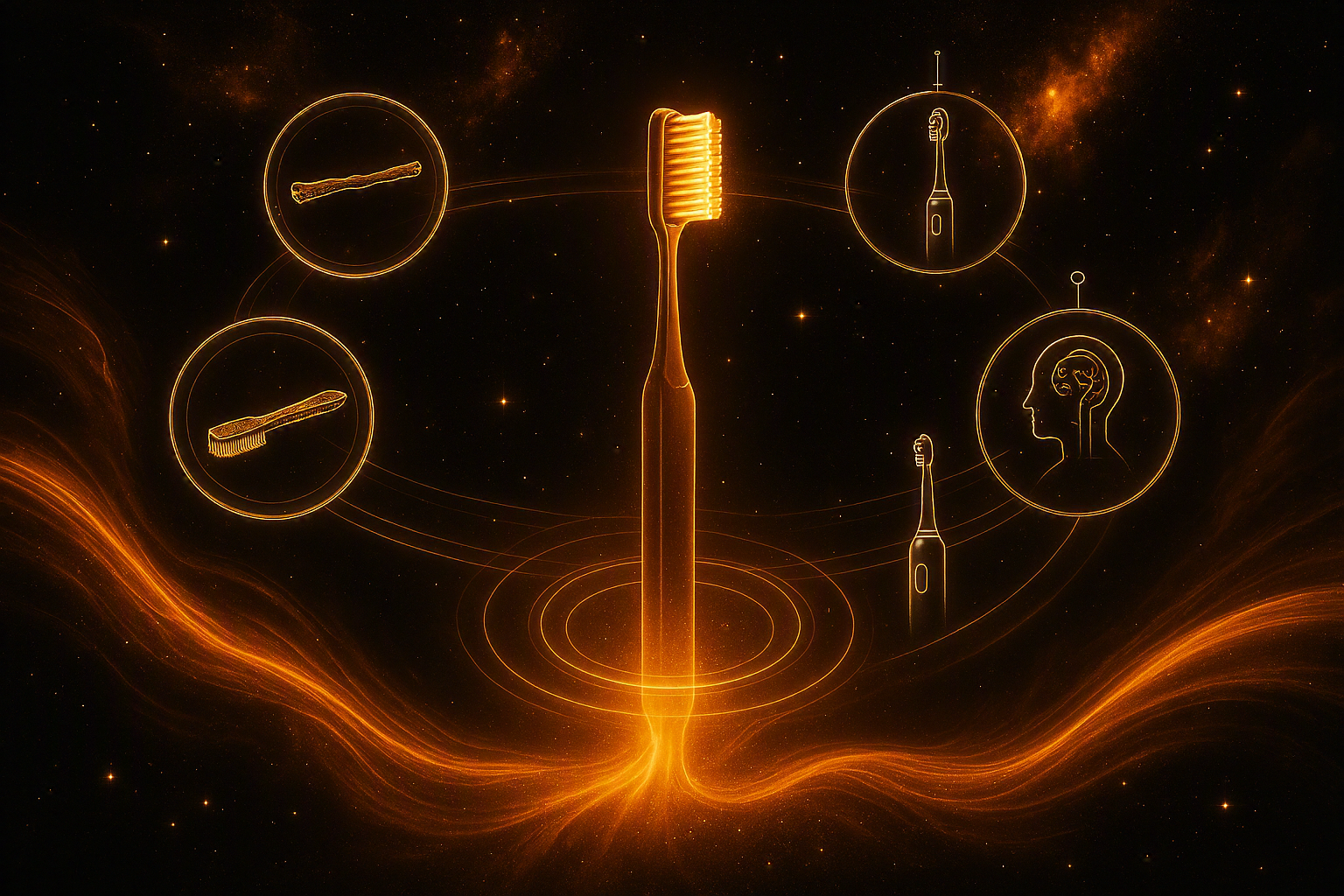
They created primitive toothbrushes using frayed twigs and chewed one end until it became soft enough to scrub the teeth.
They also invented early toothpaste made from unusual ingredients such as:
Crushed eggshells
Powdered ox hooves
Ash
Pumice stone
While these mixtures were abrasive by today’s standards, they represented an important step toward modern oral care.
Ancient Babylonians
The Babylonians also used “chew sticks.”
These small branches were chewed until the fibers spread apart like tiny brushes.
One end cleaned the teeth while the pointed end served as a toothpick.
Interestingly, similar tools are still used in parts of Africa and the Middle East today.
Ancient China
Centuries later, Chinese inventors made one of the biggest breakthroughs in dental history.
During the Tang Dynasty (618–907 AD), they created what many historians consider the world’s first true toothbrush.
Instead of plant fibers, they used:
Stiff bristles taken from Siberian wild boars
Bamboo or bone handles
Although these brushes were effective, the boar hair was extremely coarse and uncomfortable.
Still, the basic design—a handle with attached bristles—remains the foundation of every toothbrush used today.
👨🔬 Who Invented the Modern Toothbrush?
Unlike many famous inventions, the toothbrush was not created by a single inventor.
Instead, it evolved over centuries.
However, one person played a major role in bringing toothbrushes to ordinary people.
William Addis: The Prisoner Who Changed Oral Hygiene
William Addis is widely credited with creating the first mass-produced toothbrush.
His story is as unusual as the invention itself.
In 1770, Addis was imprisoned in England after participating in a riot.
While in jail, he noticed that prisoners cleaned their teeth by rubbing cloth mixed with soot and salt over them.
He believed there had to be a better solution.
Using a small animal bone saved from a meal, he drilled tiny holes into one end.
Then he collected animal hairs, tied them into small bundles, inserted them into the holes, and secured them with glue.
The result looked remarkably similar to today’s toothbrush.
After his release, Addis founded a company that manufactured toothbrushes on a large scale.
His business became incredibly successful and helped make toothbrushes available to the general public rather than only the wealthy.
🧬 The Germ Theory Revolution
For centuries, many people brushed their teeth simply to improve appearance or reduce bad breath.
Everything changed in the 19th century.
Louis Pasteur demonstrated that microscopic organisms could cause disease.
His work transformed medicine—and dentistry.
People realized that harmful bacteria lived inside the mouth.
Regular brushing became much more than a cosmetic habit.
It became an essential health practice.
Dentists soon began recommending daily brushing to reduce cavities, gum disease, infections, and tooth loss.
🏭 The Birth of the Modern Toothbrush
Early toothbrushes still had one major problem.
Animal bristles absorbed moisture.
This made them:
Difficult to clean
Slow to dry
Likely to harbor bacteria
Prone to falling out
Unpleasantly rough
Everything changed in the 20th century.
Nylon Changes Everything
In 1938, the introduction of nylon bristles revolutionized toothbrush design.
Synthetic fibers were:
✅ Cleaner
✅ Softer
✅ More durable
✅ More hygienic
✅ Less expensive
The modern toothbrush was born.
Today, nearly every manual toothbrush uses variations of this same technology.
⚡ The Invention of the Electric Toothbrush
The next major breakthrough came after World War II.
Engineers wanted to help people with limited hand movement brush more effectively.
The first electric toothbrushes appeared during the 1950s.
Modern electric brushes now include:
Pressure sensors
Built-in timers
Oscillating brush heads
Sonic vibration
Bluetooth connectivity
Smartphone apps that analyze brushing habits
Some models perform tens of thousands of brush movements every minute—far beyond what human hands can achieve.
🌍 How the Toothbrush Changed Humanity
It may seem like a simple object.
Yet the toothbrush has dramatically improved human health.
Better Oral Health
Regular brushing removes plaque before it hardens into tartar.
This reduces:
Cavities
Gum disease
Tooth loss
Bad breath
Better Overall Health
Scientists now understand that oral health affects the entire body.
Poor dental hygiene has been associated with increased risks of:
Heart disease
Diabetes complications
Respiratory infections
Pregnancy complications
Keeping your mouth healthy contributes to overall well-being.
Greater Confidence
A clean smile affects social interactions.
Fresh breath and healthy teeth often improve self-confidence during:
Job interviews
Public speaking
First dates
Business meetings
Everyday conversations
Sometimes, confidence begins with something as simple as brushing your teeth.
🤯 Fun Facts About Toothbrushes
🪥 The average person spends approximately 38 days brushing their teeth over a lifetime.
🦷 Dentists recommend replacing your toothbrush every three to four months, or sooner if the bristles become frayed.
🌎 More than 3.5 billion toothbrushes are estimated to be sold worldwide every year.
🐷 Early toothbrushes were commonly made using pig, horse, or badger hair.
🚀 Astronauts brush their teeth in space using specially adapted routines because running water isn’t available.
🧒 Children typically begin brushing as soon as their first tooth appears, with help from a caregiver.
💡 Practical Tips for Better Brushing
Even the best toothbrush works only when used correctly.
Here are some dentist-approved habits:
✔ Brush for at least two minutes, twice a day.
✔ Hold the toothbrush at about a 45-degree angle toward the gums.
✔ Use gentle circular motions instead of aggressive scrubbing.
✔ Replace your toothbrush every three to four months.
✔ Brush your tongue to help reduce bacteria and bad breath.
✔ Floss daily to clean areas your toothbrush cannot reach.
✔ Visit your dentist regularly for professional checkups and cleanings.
🔮 The Future of Toothbrushes
Toothbrush technology continues to evolve.
Researchers are developing smart toothbrushes that can:
Detect plaque automatically
Monitor gum health
Use artificial intelligence to improve brushing technique
Provide personalized dental recommendations
Connect with dentists remotely
Some experimental concepts even explore antimicrobial materials and self-cleaning brush heads.
The humble toothbrush is becoming smarter every year.
🏁 Final Thoughts
The toothbrush may not be as famous as the airplane, the telephone, or the computer, but its impact on everyday life is extraordinary.
From simple chew sticks used thousands of years ago to AI-powered smart toothbrushes, this small invention has protected billions of smiles and transformed public health around the globe.
It reminds us that the greatest inventions are not always the largest or the most complex. Sometimes, the tools that quietly improve our daily lives leave the deepest mark on human history.
So the next time you pick up your toothbrush, remember—you are holding the result of thousands of years of innovation, ingenuity, and human determination to live healthier, happier lives.
After all, some of the world’s biggest changes begin with the smallest inventions.