“Man is condemned to be free.” — Jean-Paul Sartre
🌌 Imagine This…
You’re standing in front of your favorite coffee shop.
You hesitate.
☕ Coffee or tea?
A simple choice—or so it seems.
You believe you’re making a free decision. You weigh the options, consider your mood, and finally order your drink.
But what if that decision had already been determined long before you consciously made it?
What if your genes, childhood experiences, brain chemistry, memories, emotions, social environment, and even the laws of physics quietly guided every “choice” you have ever made?
And perhaps the most unsettling question of all…
Did you actually choose to read this article?
Welcome to one of philosophy’s oldest and most fascinating mysteries.
🤔 What Is Free Will?
Free will is the idea that human beings can genuinely choose between different possible actions.
It assumes that:
You could have acted differently.
Your decisions truly belong to you.
You are responsible for your choices.
Without free will, many ideas that shape civilization become difficult to explain:
⚖️ Justice
❤️ Love
🏆 Achievement
😔 Regret
🎯 Responsibility
If our choices are merely the inevitable results of previous causes, can anyone really deserve praise—or blame?
🏛️ The Ancient Debate Begins
The question of free will is much older than modern science.
For thousands of years, philosophers have argued over one simple yet profound question:
Who is really in control?
🏺 Socrates: Know Yourself First
“The unexamined life is not worth living.”
Socrates believed that ignorance—not fate—was humanity’s greatest prison.
According to him, people often make poor decisions because they lack wisdom rather than freedom.
The more deeply you understand yourself, the freer your choices become.
Freedom begins with self-awareness.
🏛️ Plato: Are We Prisoners of Illusion?
Plato imagined humanity living inside a cave.
People watched shadows on the wall and believed they represented reality.
Only a few escaped to discover the truth outside.
Could our everyday choices also be shadows?
Perhaps what we call “free will” is simply our inability to see the invisible forces shaping us.
⚖️ Aristotle: Freedom Requires Virtue
Aristotle argued that freedom isn’t simply doing whatever you want.
Real freedom comes from developing good habits.
Every repeated action slowly shapes your character.
Eventually…
Your character begins making choices for you.
His famous insight still resonates today:
“We are what we repeatedly do. Excellence, then, is not an act but a habit.”
The more wisely you live, the more genuinely free you become.
🕰️ Determinism: Is Everything Already Decided?
Determinism is one of philosophy’s boldest ideas.
It claims that every event—including every thought and decision—is caused by previous events.
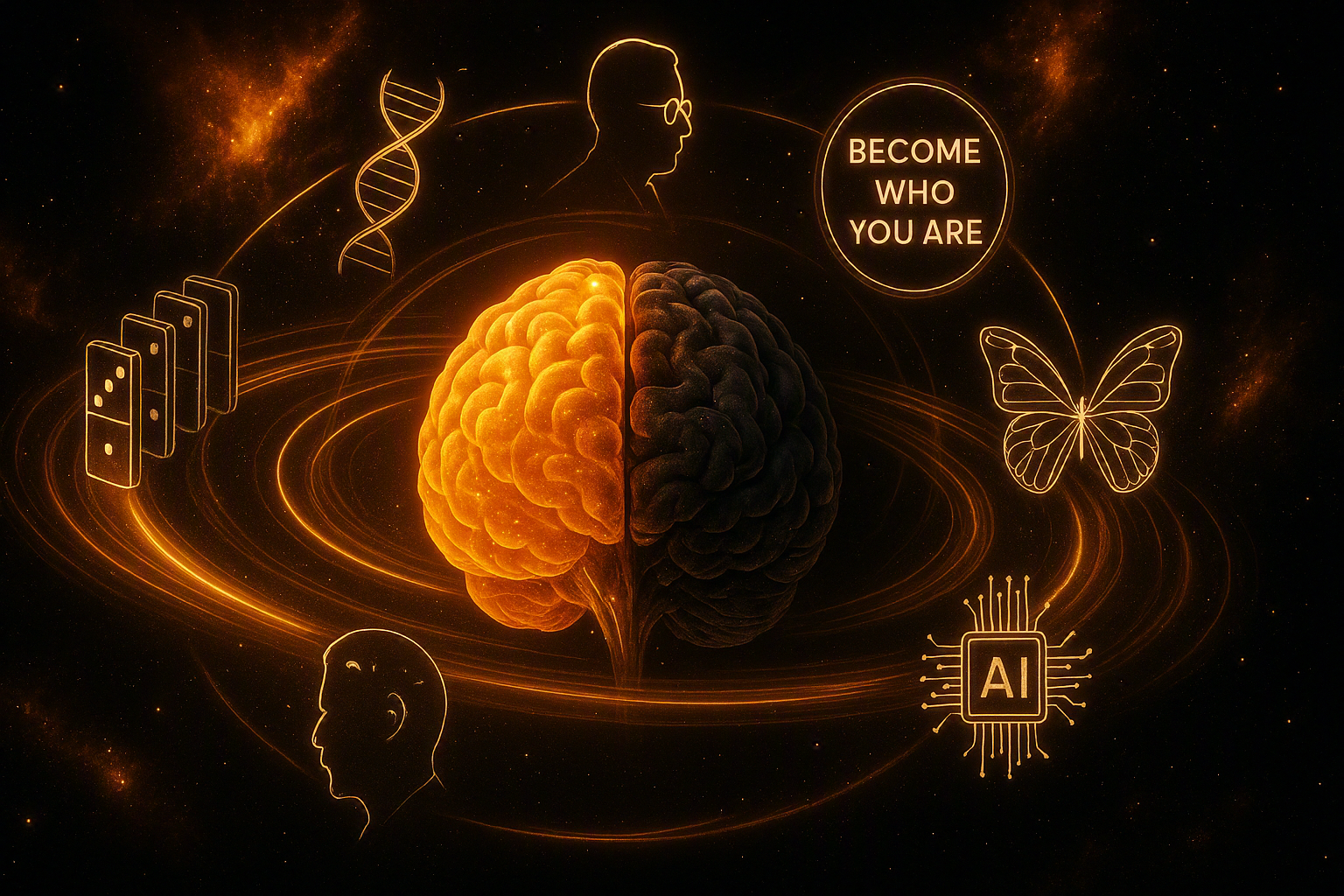
Imagine a row of dominoes.
The first one falls.
The rest follow inevitably.
Now replace the dominoes with:
🧬 Your DNA
👨👩👧 Your parents
🏫 Your education
🌍 Your culture
🧠 Your brain chemistry
Every decision may simply be another domino falling.
If this is true…
Could anyone ever have acted differently?
🌪️ Baruch Spinoza: Freedom Is Understanding Necessity
The Dutch philosopher Baruch Spinoza rejected the common idea of free will.
He famously wrote:
“Men think themselves free because they are conscious of their actions, but ignorant of the causes by which they are determined.”
According to Spinoza, people know what they choose.
They simply do not know why they choose it.
Imagine a stone thrown through the air.
If the stone were conscious, it might believe it was flying by its own choice.
Humans, Spinoza suggested, may not be so different.
⚡ Arthur Schopenhauer: You Can Do What You Will…
Schopenhauer offered one of philosophy’s most famous observations:
“Man can do what he wills, but he cannot will what he wills.”
Think about that.
You can choose chocolate ice cream.
But…
Did you choose to like chocolate?
Did you choose your personality?
Your fears?
Your desires?
Your dreams?
Many of the deepest forces inside us arrive long before conscious thought.
🔥 Friedrich Nietzsche: Become Who You Are
Nietzsche rejected passive acceptance.
Instead, he challenged humanity with another powerful idea:
“Become who you are.”
At first, this sounds contradictory.
How can you become what you already are?
Because Nietzsche believed that life is a continual act of self-creation.
Even if our instincts shape us, we still possess the remarkable ability to transform ourselves through courage, discipline, creativity, and personal responsibility.
Freedom, for Nietzsche, was not something you were born with.
It was something you earned.
🎭 Jean-Paul Sartre: We Are Condemned to Be Free
No philosopher defended freedom more passionately than Sartre.
He argued:
“Man is condemned to be free.”
Why condemned?
Because every decision carries responsibility.
Even refusing to choose…
…is still a choice.
According to Sartre, people often escape responsibility by blaming:
society
parents
luck
destiny
circumstances
Yet every excuse is itself another decision.
Freedom can be exhilarating.
It can also be terrifying.
🧠 Modern Neuroscience Enters the Conversation
Then science complicated everything.
In the 1980s, neuroscientist Benjamin Libet conducted experiments that shook both philosophy and psychology.
His findings suggested that the brain begins preparing an action before people consciously decide to perform it.
Your brain may start the process…
…hundreds of milliseconds before “you” believe you’ve made the decision.
Some researchers interpreted this as evidence against free will.
Others argued that consciousness still has the ability to approve—or stop—an action before it occurs.
The debate remains unresolved.
🤖 Artificial Intelligence Raises New Questions
Imagine an advanced AI.
It receives information.
It analyzes possibilities.
It makes decisions.
How different is that from the human brain?
If our minds also process enormous amounts of information according to physical laws…
What exactly makes human choice unique?
Could consciousness itself simply be an extraordinarily complex biological algorithm?
Or is there something fundamentally beyond computation?
No one knows.
🌍 The Butterfly Effect
Chaos theory introduces another twist.
Tiny events can produce enormous consequences.
One conversation.
One missed train.
One unexpected friendship.
One random decision.
Could your entire future depend on choices that once seemed insignificant?
If so…
Perhaps freedom exists not in controlling everything—but in recognizing the immense impact of seemingly ordinary moments.
⚖️ If Free Will Doesn’t Exist…
Suppose determinism is completely true.
Then what becomes of:
⚖️ Criminal justice?
❤️ Romantic relationships?
🏅 Personal success?
🙏 Forgiveness?
😔 Regret?
Would prisons still make sense?
Would guilt?
Would pride?
Would anyone truly deserve punishment—or reward?
Society itself would require rethinking.
🌱 Compatibilism: A Middle Path
Many contemporary philosophers reject the idea that the debate is all-or-nothing.
This position is called compatibilism.
Compatibilists argue:
Even if every event has causes…
Freedom still exists whenever we act according to our own desires, values, and reasoning—without coercion.
You may not control every influence that shaped you.
But if your actions reflect who you are rather than external force, that may be enough to call them “free.”
This view attempts to preserve both scientific understanding and moral responsibility.
🌌 Perhaps the Question Is Wrong
Maybe free will isn’t something we either possess or lack.
Perhaps it exists on a spectrum.
The more aware you become of your biases…
The more you question your assumptions…
The more intentionally you shape your habits…
The freer you become.
In that sense, freedom may not be a starting point.
It may be a lifelong practice.
💭 A Thought Experiment
Imagine someone who knows every detail about you.
Every memory.
Every fear.
Every habit.
Every neuron.
Every life experience.
Could they predict your next decision with perfect accuracy?
If yes…
Were you ever truly free?
If no…
What escaped prediction?
That tiny gap may contain one of the greatest mysteries in existence.
🌠 Final Reflection
Perhaps humanity has spent thousands of years asking the wrong question.
Instead of asking,
“Do we have free will?”
Maybe we should ask,
“What kind of beings are we becoming through the choices we experience?”
Whether our decisions arise from absolute freedom, hidden causes, or some mysterious combination of both, one fact remains:
Every day we reflect.
We learn.
We change.
We influence others.
We imagine better futures.
And perhaps that ongoing process—of questioning ourselves and reshaping our lives—is the closest thing to freedom we will ever know.
As Socrates encouraged us long ago, wisdom begins not with certainty, but with the courage to examine our own lives.
So before you close this page, pause for a moment and ask yourself:
Did you choose your beliefs… or have your beliefs quietly been choosing you all along?