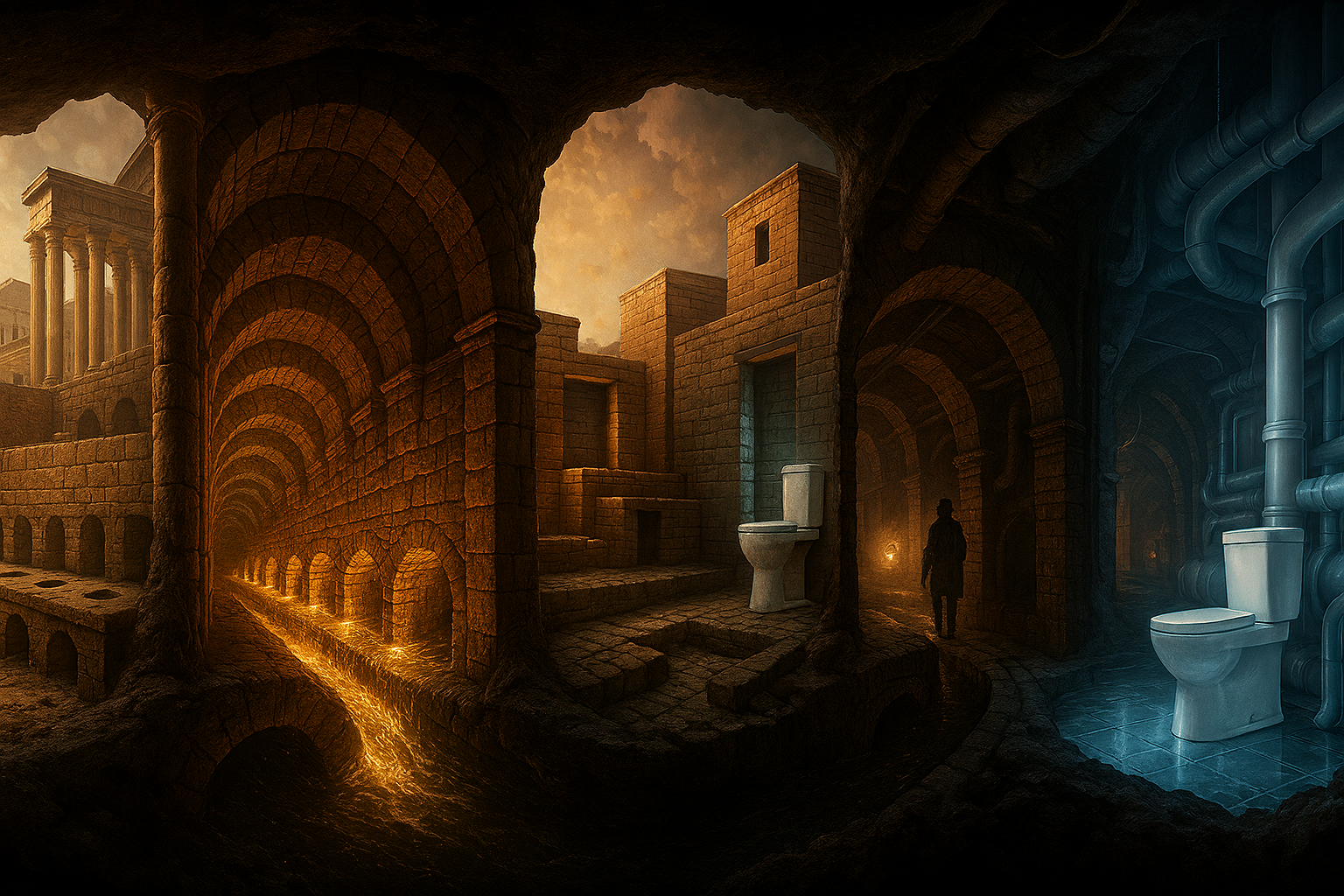
Just imagine… 🚽 Today, it feels like a simple action: you press a button and everything “disappears.” But behind this simple act lies thousands of years of engineering, urban planning, and a public health struggle. In fact, one of humanity’s greatest achievements is not skyscrapers or weapons—it is the management of waste.
That is why toilet systems are the invisible but most critical foundation of civilization 🏗️.
🚽 First Steps: An Idea Born from the Need for Cleanliness
When humans transitioned to settled life, one of the biggest problems emerged: waste accumulation. In nomadic life, nature naturally balances this process, but in cities, this balance was lost.
Early solutions were very simple:
digging pits 🕳️
open disposal areas
dumping near rivers 🌊
However, these methods quickly caused serious problems:
bad odor 😷
water contamination 💧
epidemics 🦠
Humanity realized something important:
👉 “Waste does not disappear; it must be managed through a system.”
This awareness marked the birth of the idea of sewer systems.
🏛️ The Ancient World’s Sewer Revolution
The first major engineering breakthrough came from ancient civilizations.
Ancient Rome developed one of the most advanced sanitation systems of its time. In Rome:
underground stone channels
continuous water flow
systems to transport waste outside the city
were built.
The famous Cloaca Maxima was not just a canal—it was a masterpiece of urban engineering.
Thanks to this system:
cities became more livable
diseases decreased
population density increased
💡 Rome’s power was not only in its army but also in its “invisible infrastructure.”
🏺 Ancient India and the Indus Civilization
The Indus Valley Civilization (especially the cities of Harappa and Mohenjo-daro) had one of the most surprising hygiene systems in history.
In this civilization:
toilets inside houses 🚽
covered sewer networks
organized street drainage systems
existed.
This means:
👉 Thousands of years before the modern world, humans were already solving urban hygiene systematically.
💡 Practical insight: This civilization shows how early urban planning and infrastructure began in human history.
🏰 The Middle Ages: The Forgotten Age of Hygiene
During the Middle Ages 🏛️, there was a major decline.
Cities expanded, but infrastructure did not keep up.
As a result:
waste was dumped in streets 🚨
open sewers
contaminated water sources
This led to devastating epidemics, especially the plague in Europe.
💡 At that time, people believed disease was caused by “bad smells” (miasma theory). This was incorrect, but it reflected a real perception of the problem.
⚙️ The Industrial Revolution: The Birth of Modern Sewer Systems
With the Industrial Revolution, cities grew rapidly, and a hygiene crisis emerged.
In the 19th century in particular:
London experienced the “Great Stink” 💀
rivers were filled with waste
cities became nearly unlivable
This crisis led to the creation of modern sewer systems:
closed pipe networks
pressurized water transport
wastewater treatment outside cities
Engineering began to focus not just on structures but on public health itself.
🧪 The Role of Science: The Discovery of Microbes
As the germ theory of disease developed, humanity learned a crucial truth:
👉 Diseases are caused not by bad smells, but by microorganisms.
Thanks to this discovery:
clean water systems were developed
hygiene standards were established
modern toilet infrastructure took shape
💡 This became the intersection of medicine and civil engineering.
🚰 Modern Toilets: The Invisible Miracle of Comfort
Today’s systems are actually highly complex engineering structures:
flushing systems 🚽
water pressure mechanisms
underground sewer networks
wastewater treatment plants
When you flush a toilet:
👉 gravity + water pressure + engineering design all work together.
💡 Practical insight:
regular water flow reduces pipe clogging
excessive chemical cleaners can damage pipes
sewer systems work more efficiently with water conservation
🌍 The Impact of Toilet Systems on Humanity
These systems did not only provide “cleanliness”—they transformed civilization:
🧼 1. Disease Control
Cholera, typhoid, and similar diseases were significantly reduced.
🏙️ 2. Growth of Cities
Modern cities became possible only with proper infrastructure.
🧬 3. Increased Life Expectancy
Hygiene directly extended human lifespan.
🧠 4. Psychological Comfort
Clean environments improved overall societal well-being.
💡 A Practical Perspective
We rarely notice it in daily life, but:
every flush
every sewer line
every treatment plant
represents thousands of years of accumulated engineering knowledge.
This simple system combines:
👉 urban planning
👉 medical science
👉 environmental engineering
🌌 A Final Thought
The toilet system may be one of the least discussed yet most frequently used inventions in human history.
Because the true strength of civilization lies:
✨ not in visible monuments
✨ but in invisible systems
From Ancient Rome to modern cities, this journey shows us:
👉 A society’s level of development is measured not by what stands above the ground, but by what works beneath it.
📌 In conclusion:
Sewer systems are not just waste management;
they are a silent revolution that reshaped health, urbanization, and quality of life 🧻🌍✨