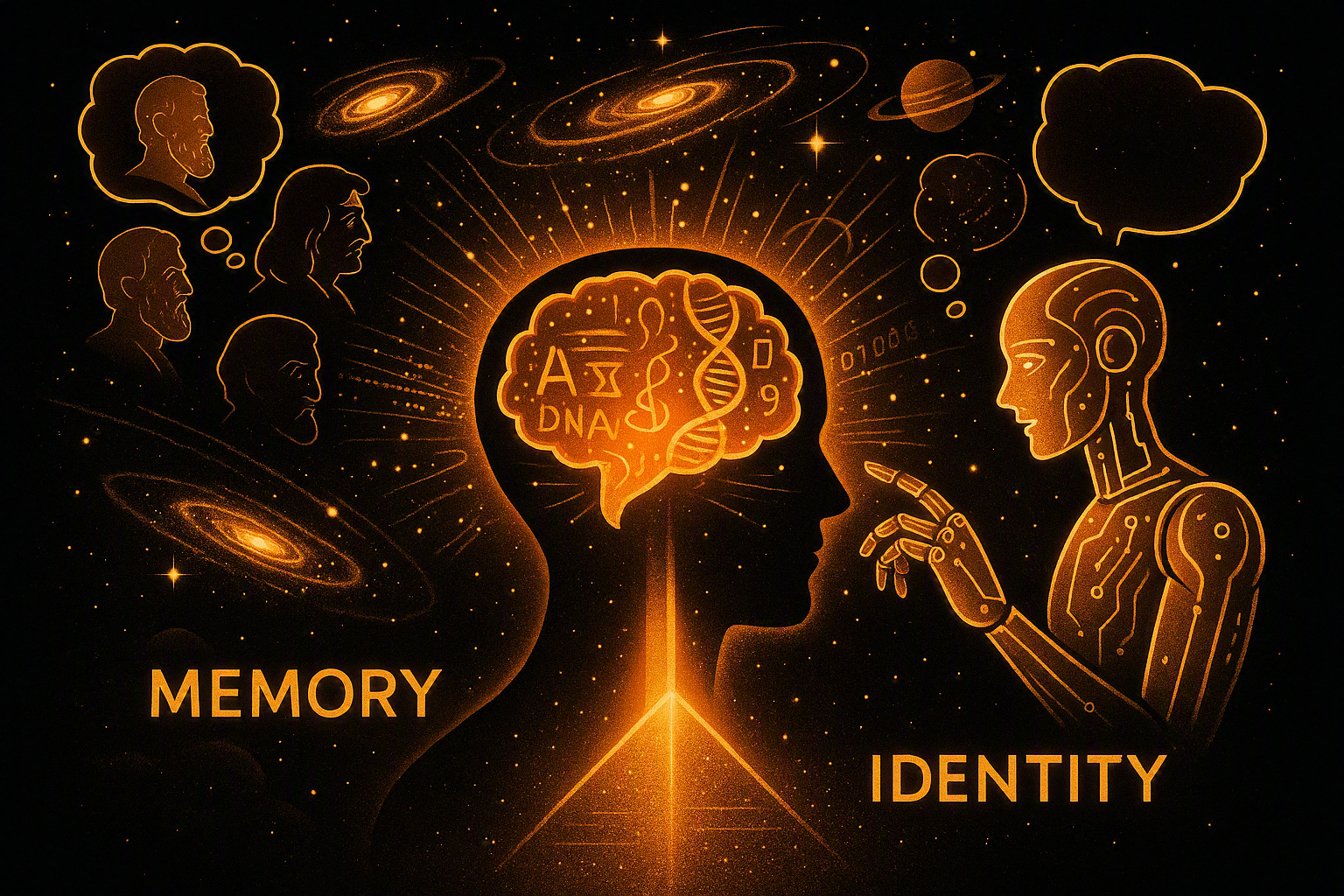
“Memory… is the diary that we all carry about with us.” — Oscar Wilde
But what if the pages of that diary had been rewritten?
What if your happiest childhood memory never happened?
What if the face you remember loving wasn’t real?
What if every experience you believe shaped your personality was carefully constructed by your own mind—or even placed there by something else?
It sounds like science fiction.
Yet philosophers, psychologists, neuroscientists, and cognitive scientists have spent centuries asking a surprisingly serious question:
Can we really trust our memories?
The answer is far more unsettling than most people expect.
Because if memory is unreliable…
Who are you?
🌌 Imagine Waking Up Tomorrow…
Imagine waking up one morning with vivid memories of growing up in a small village near the sea.
You remember the smell of salt in the air.
You remember chasing birds along the beach.
You remember your grandfather teaching you how to fish.
You can hear his voice.
You can almost feel the rough wooden dock beneath your feet.
There’s only one problem.
None of it ever happened.
No village.
No grandfather.
No ocean.
Every detail feels emotionally real…
Yet every detail is false.
Would those memories still shape who you are?
Would they still make you smile?
Would they still influence your fears, your dreams, and your personality?
If the emotional impact is real, does it matter whether the event actually occurred?
That simple question opens one of philosophy’s deepest rabbit holes.
🧩 Why Memory Is More Than a Storage Device
Most people imagine memory as a giant library.
Every experience is placed neatly onto a shelf.
Whenever needed, the brain simply retrieves it.
Modern neuroscience suggests something very different.
Memory behaves more like a storyteller than a librarian.
Every time you remember an event, your brain reconstructs it.
Small details disappear.
New details appear.
Emotions reshape the narrative.
Current beliefs quietly influence yesterday’s events.
In other words…
Your memories are not recordings.
They are living stories.
And stories change every time they are told.
🏛️ John Locke: Memory Creates the Self
The English philosopher John Locke introduced one of the most influential ideas in the philosophy of personal identity.
He argued that memory—not the body—is what makes you the same person over time.
Imagine two identical bodies.
Only one contains your memories.
Which one is truly you?
For Locke, the answer was obvious.
Identity follows consciousness.
He famously suggested that a person remains the same individual because they can remember their past experiences.
Without memory…
The continuity of the self begins to dissolve.
This raises an uncomfortable possibility.
If memories define identity…
False memories may create a false self.
🏺 Plato: Are Memories Really Recollections?
Long before neuroscience existed, Plato proposed a fascinating theory.
He believed that learning is actually remembering.
According to his Theory of Recollection, the soul already possesses knowledge before birth.
Education does not create wisdom.
It awakens forgotten truths.
He wrote:
“Knowledge which is acquired under compulsion obtains no hold on the mind.”
For Plato, memory reached beyond ordinary life.
It connected us to eternal realities.
Whether or not one accepts his theory, it raises an intriguing thought.
Perhaps some memories are not merely personal.
Perhaps they represent deeper patterns of understanding hidden within human consciousness itself.
🌀 René Descartes: Can Memory Be Trusted?
Few philosophers questioned certainty more radically than René Descartes.
He famously declared:
“Cogito, ergo sum.”
“I think, therefore I am.”
Notice what he did not say.
He did not say:
“I remember, therefore I am.”
Descartes doubted almost everything.
The senses deceive us.
Dreams imitate reality.
Memory fades.
Only one thing remained undeniable:
The act of thinking itself.
His philosophy reminds us that memory may never provide absolute certainty.
Even our most treasured recollections deserve occasional skepticism.
🎭 Friedrich Nietzsche: Memory and Forgetting
Nietzsche viewed memory from a very different angle.
He believed forgetting was not a weakness.
It was essential for living.
He observed:
“The existence of forgetting has never been proved: we only know that some things don’t come to mind when we want them.”
Elsewhere, he praised the ability to let go of the past.
Imagine remembering every embarrassing moment.
Every painful loss.
Every mistake.
Would life become unbearable?
Nietzsche argued that healthy forgetting allows growth.
Without it, people become prisoners of yesterday.
Perhaps forgetting is not the enemy of identity.
Perhaps it is one of its greatest protectors.
🧠 David Hume: Is There Even a Permanent Self?
The Scottish philosopher David Hume delivered one of philosophy’s boldest challenges.
He searched within himself for a permanent identity.
Instead…
He found only changing experiences.
Thoughts.
Sensations.
Emotions.
Memories.
Nothing remained constant.
He concluded that the self is not a solid object.
It is a bundle of constantly changing perceptions.
Imagine a river.
Every second, new water flows through it.
Yet we continue calling it the same river.
Perhaps the human mind works the same way.
Maybe your identity is not a fixed statue.
Maybe it is an ongoing process.
🌱 Henri Bergson: Memory Is Alive
French philosopher Henri Bergson believed memory could never be reduced to simple brain storage.
For him, memory flowed continuously through consciousness.
The past never completely disappears.
Instead…
It quietly accompanies every present moment.
Your childhood still influences today’s decisions.
Old fears still whisper beneath new experiences.
Past joys still shape future hopes.
Memory is not behind you.
It travels with you.
🧪 The Science of False Memories
Philosophy asked the questions.
Psychology began testing them.
One of the world’s leading memory researchers, Elizabeth Loftus, demonstrated something extraordinary.
She showed that entirely false memories can be implanted through suggestion.
Participants were convinced they had experienced events that never happened.
Some remembered getting lost in shopping malls.
Others remembered accidents that never occurred.
Many described these imaginary events with remarkable confidence.
Confidence, it turns out, is not proof of accuracy.
Sometimes…
The memories we trust most are the least reliable.
🎬 Why Movies Get This Right
Cinema has long explored the frightening possibility of fabricated memory.
Think about stories where characters slowly discover that everything they believed about themselves is false.
Their relationships.
Their childhood.
Their purpose.
Their identity.
The emotional power of these stories comes from one terrifying realization:
When memories collapse…
Identity begins to crumble.
Because we do not simply remember our lives.
We build ourselves from those memories.
🤖 Artificial Intelligence and Manufactured Memories
Imagine a future where technology becomes capable of creating perfect artificial memories.
Not photographs.
Not videos.
Actual memories.
Complete with emotions.
Textures.
Smells.
Conversations.
Would those experiences become part of your identity?
Suppose you receive memories of climbing Mount Everest.
You remember every step.
Every frozen breath.
Every breathtaking sunrise.
Although you never left home.
Would those memories still change your personality?
Could courage be learned from experiences that never happened?
The question is no longer purely philosophical.
Advances in neuroscience and AI continue to blur the boundaries between memory, imagination, and digital information.
🌍 Memory Shapes Morality
Imagine waking up tomorrow with no memory of hurting someone years ago.
Are you still morally responsible?
Suppose a criminal genuinely forgets committing a crime.
Does justice change?
Suppose a hero forgets saving hundreds of lives.
Does their courage disappear?
Memory is deeply connected to responsibility.
Without remembering our actions, concepts such as guilt, forgiveness, gratitude, and personal growth become difficult to understand.
Perhaps morality itself depends upon remembering.
🧩 The Ship of Theseus… Applied to the Mind
Ancient philosophers imagined a famous puzzle.
If every plank of a ship is gradually replaced…
Is it still the same ship?
Now replace wooden planks with memories.
Over decades…
Old memories fade.
New ones appear.
Some become distorted.
Others vanish forever.
Eventually…
Almost every memory has changed.
Are you still the same person who existed thirty years ago?
Or has a completely new individual quietly emerged?
🌌 Buddhism and the Illusion of the Self
Many Buddhist traditions challenge the very idea of a permanent identity.
The concept of Anatta, often translated as “non-self,” teaches that there is no fixed, eternal self hiding inside us.
Instead, what we call “I” is a constantly changing collection of experiences, thoughts, emotions, sensations, and memories.
If this perspective is correct, then changing memories do not destroy the self.
They simply reflect what the self has always been:
A dynamic process rather than an unchanging object.
From this viewpoint, clinging too tightly to memory may actually increase suffering.
Freedom comes not from preserving every memory, but from recognizing their impermanent nature.
💭 A Thought Experiment
Imagine a machine capable of copying every one of your memories into another person.
They remember your childhood.
They remember your first day at school.
They remember your heartbreaks.
They remember your triumphs.
They laugh at your private jokes.
They cry over your losses.
Now there are two people with identical memories.
Which one is truly you?
Or are both equally authentic?
This puzzle has fascinated philosophers for generations because it forces us to confront an unsettling possibility:
Perhaps memory alone cannot fully explain identity.
🌠 Maybe Authenticity Matters More Than Accuracy
Perhaps the real question is not whether every memory is perfectly accurate.
Perhaps the more meaningful question is:
How do our memories shape the people we become?
A memory may be imperfect.
It may exaggerate.
It may omit details.
It may even contain events that never happened.
Yet it can still inspire kindness.
Teach resilience.
Encourage forgiveness.
Or remind us to love more deeply.
In that sense, the value of memory may lie less in factual precision and more in the meaning we draw from it.
🌙 Final Reflection
Every person carries an invisible museum.
Inside are thousands of moments.
Some joyful.
Some painful.
Some crystal clear.
Some hopelessly distorted.
We visit this museum every day.
We tell ourselves stories about who we are, where we came from, and where we are going.
But perhaps those stories are never finished.
Every recollection rewrites the exhibit.
Every new experience rearranges the gallery.
As John Locke suggested, memory binds the self together.
As David Hume argued, the self may be nothing more than an ever-changing stream of perceptions.
As Nietzsche reminded us, forgetting can be just as valuable as remembering.
And as Descartes taught, certainty is far more fragile than it appears.
So before you close this page, consider one final question:
If every memory you possess were revealed to be false tomorrow…
Would you still know who you are?