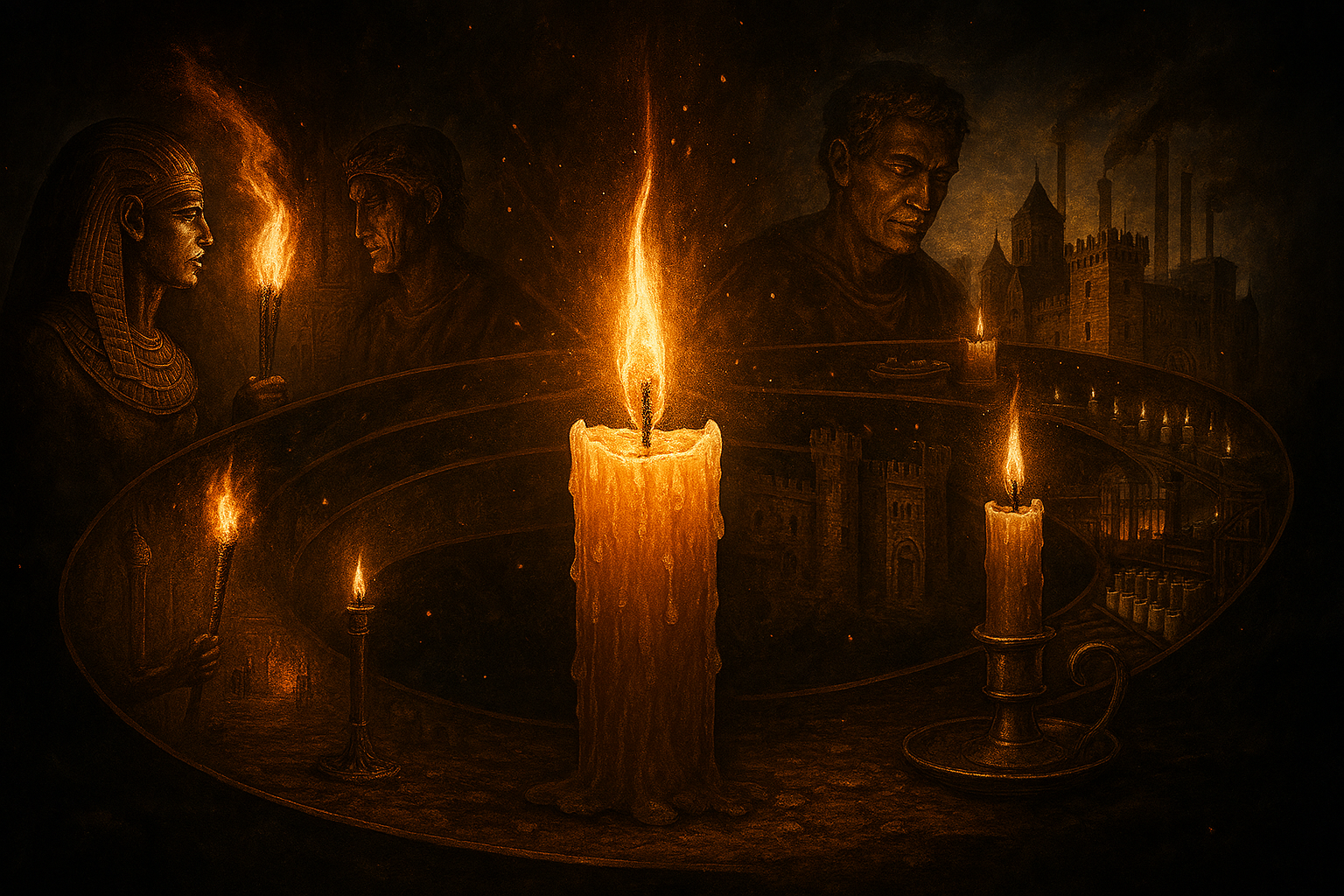
Just imagine… 🌒 The sun is setting and the world is slowly sinking into darkness. There are no street lamps and no light bulbs. For humanity, night was not only about rest but also about uncertainty, danger, and limitation. And right at this point, a small but revolutionary invention appeared: the candle 🕯️. Although it seems simple, the candle became one of the most important tools that reshaped how humans understand time, space, and productivity.
🔥 From Fire to Light: The Birth of the Candle
One of the greatest turning points in human history was the control of fire. However, discovering fire alone was not enough. It needed to be made portable, controllable, and safe. This is where the story of the candle begins.
In Ancient Egypt 🏺, people created primitive lighting tools by dipping reeds into animal fats. Technically, these were closer to torches than candles. Still, this simple method showed that fire could be stabilized in a fixed place.
A more systematic approach emerged in Ancient Rome ⚔️. The Romans developed the first “wicked candle” form by dipping fibrous plant materials into melted tallow (animal fat). This was a significant technological step because:
🔥 The flame was controlled
⏳ Burning time was extended
🚶♂️ It became portable
These early candles were far from perfect. They produced smoke, smelled bad, and burned quickly. But still, they were the first tools that made the night “usable.”
💡 Interesting fact: Most early candles were not used for daily life but for religious rituals and night watches. In other words, the candle was initially considered a luxury item.
🌏 The Contribution of the Far East: Beeswax and Nature
At the same time, regions such as China 🇨🇳 and Japan 🇯🇵 developed very different and innovative techniques.
In China, people:
📜 Used rice paper for wicks
🐋 Used whale oil, insect wax, and plant-based oils
This showed that candle production could diversify its raw materials.
In Japan, candles made from sumac tree wax 🌿 were developed. These candles:
🌫️ Produced less smoke
✨ Burned more cleanly
⏱️ Lasted longer
So the Far East did not just produce candles—it optimized them ⚙️.
A key lesson emerges here: humanity has always developed different solutions to the same problem (darkness 🌑) across different regions, and these solutions have eventually influenced each other. This highlights the importance of cultural diversity in technological evolution.
🏰 The Middle Ages: The Social Class of the Candle
By the time we reach the Middle Ages 🏛️, candles were no longer just lighting tools—they had become symbols of social status.
Candles were mainly divided into two categories:
1. Tallow Candles 🕯️
💰 Cheap and widely available
😷 Bad smell
🌫️ Produced soot and smoke
These were mostly used by peasants and lower classes.
2. Beeswax Candles 🍯
✨ Burned cleanly
🌸 Had a pleasant smell
⏳ Lasted longer
These were used in churches ⛪, palaces 🏰, and wealthy households.
This reveals a powerful sociological truth:
Even light was not distributed equally. ⚖️
Candle production became a serious craft. Candle makers known as “chandlers” 🛠️ emerged and became part of guild systems. Candle making was no longer just a necessity—it became an economic profession.
💡 Practical note: The reason beeswax candles are still preferred today is because of these historical advantages—cleaner burning and lower toxicity 🌿.
⚙️ The Touch of Science: The Industrial Revolution and the Evolution of the Candle
With the Industrial Revolution 🏭, candle production was reborn. It was no longer just craftsmanship—it became a matter of science and chemistry.
One of the most important figures of this transformation was Michel Eugène Chevreul 🧪. He studied the chemical structure of fats and successfully isolated stearic acid. Thanks to this discovery:
🕯️ Candles became harder
⏳ They burned longer
🌬️ They produced less odor
Later came the discovery of paraffin 🛢️. Paraffin:
💸 Was cheap
⚙️ Was easy to produce
🏭 Was suitable for mass production
As a result, candles transformed from luxury items into products accessible to everyone.
This period marked the industrialization of candles. Production became:
🏭 Factory-based
📏 Standardized in quality
🌍 Part of global trade
💡 Electricity Arrived… But the Candle Stayed
With electricity ⚡ and the widespread use of light bulbs, the candle’s primary function largely disappeared. But it did not vanish—it changed meaning.
Today, candles are used for:
❤️ Creating romantic atmospheres
🧘 Meditation and relaxation
⛪ Religious and cultural rituals
🚨 Emergency lighting
Even today, when the power goes out, candles are still the first thing we reach for 🕯️. This shows how deeply rooted they are in human habits.
💡 Practical tip: Choosing soy or beeswax candles instead of paraffin 🌿 provides cleaner burning and helps maintain indoor air quality.
🌟 The Impact of Candles on Humanity
The influence of candles is far greater than we might think. They are not just light sources but also civilization accelerators 🚀.
1. 🕰️ Expansion of Time
Candles allowed people to work after sunset:
📈 Increased productivity
💰 Boosted the economy
🛠️ Advanced craftsmanship
2. 📚 Spread of Knowledge
Scientists, writers, and philosophers could work at night:
📖 Increased book production
🎓 Extended education hours
🔬 Accelerated scientific progress
3. 🫂 Social Life Development
Night gatherings and conversations became possible. People started meeting not only during the day but also at night.
4. 🧠 Psychological and Cultural Impact
Candlelight:
😌 Has a calming effect
🎯 Improves focus
🕯️ Creates a ritualistic atmosphere
Even today, the calmness of candlelight reflects thousands of years of human experience 🌙.
🌌 A Final Thought
The candle is perhaps one of the most “humble” inventions in human history. It is neither complex like massive machines nor dazzling like digital technology. Yet its impact is surprisingly profound ✨.
When you light a candle:
🏺 You witness humanity’s struggle against darkness in ancient times
🏰 You see the social divisions of the Middle Ages
🏭 You feel the scientific breakthroughs of the Industrial Revolution
📱 You connect with the nostalgic needs of the modern world
📌 In conclusion: The candle is not just a light source;
it is a symbol of humanity’s struggle against darkness 🕯️.
And perhaps that is why, no matter how advanced technology becomes, that small flame still reminds us:
🌟 Sometimes the greatest changes begin with the smallest lights.