Take a moment to look around. 👀
Your smartphone 📱 is probably nearby. Maybe you’re reading this on a laptop 💻, tablet 📲, or desktop computer 🖥️. You may have a smartwatch ⌚ on your wrist, wireless earbuds 🎧 in your ears, and a smart TV 📺 waiting at home.
Despite their incredible differences, all of these devices share one fascinating characteristic:
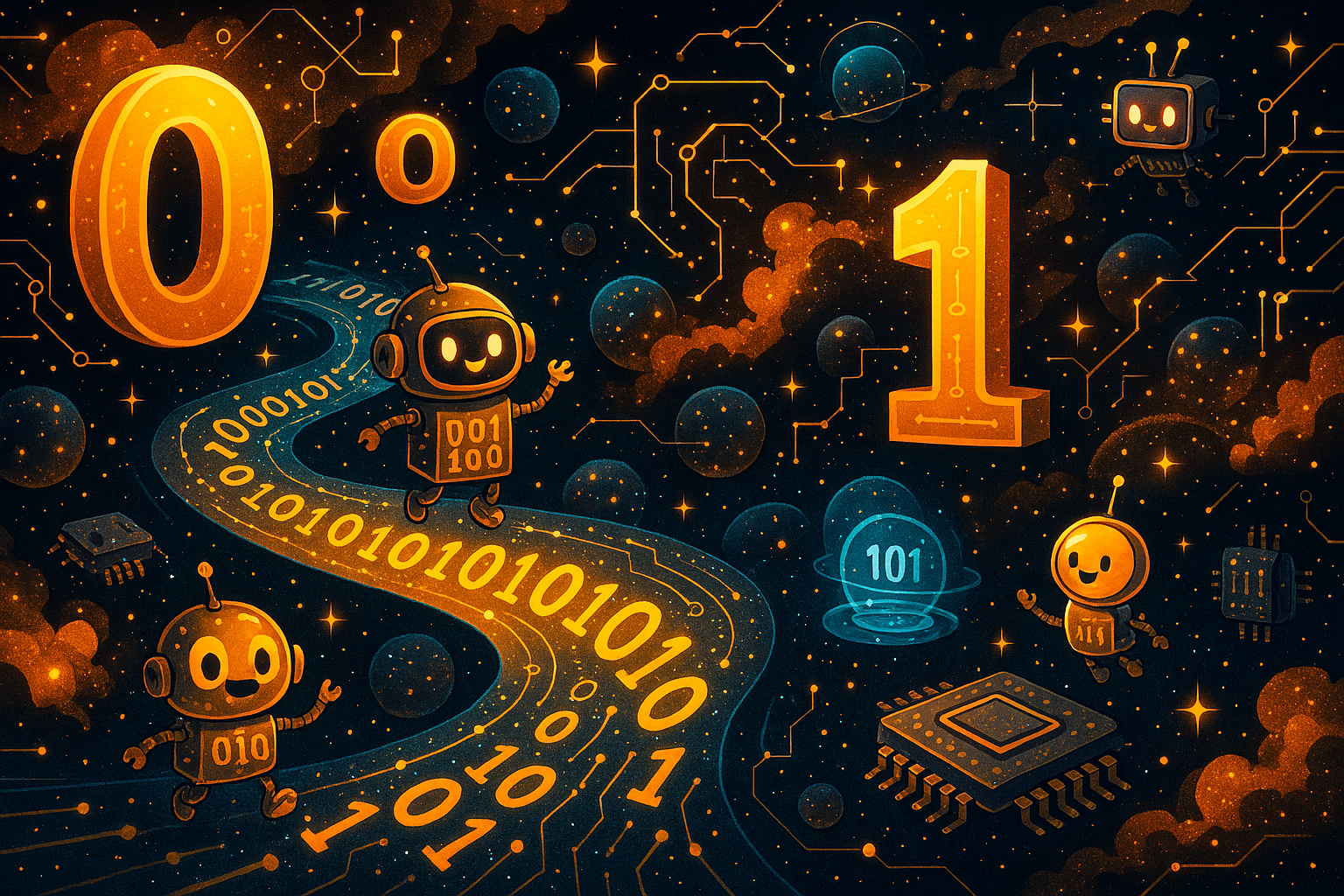
They ultimately communicate using only two symbols:
0️⃣ and 1️⃣
❌ No words.
❌ No emojis.
❌ No colors.
❌ No music.
Just zeros and ones.
But why? 🤔
In an era of Artificial Intelligence 🤖, quantum computing ⚛️, autonomous vehicles 🚗, and powerful graphics processors 🎮, why are computers still relying on a system that seems almost primitive?
The answer lies in a beautiful combination of physics ⚡, engineering 🔧, mathematics 🧮, and practicality 💡.
Let’s explore the digital world’s most important language! 🌍💻
⚡🔌 Everything Starts with Electricity
At their core, computers are electronic machines.
Unlike humans 👨💻, computers don’t see images 🖼️, hear sounds 🎵, or understand language 📖 naturally.
Instead, they process electrical signals ⚡ flowing through microscopic circuits.
The fundamental building block of modern computing is the transistor 🔬.
A transistor is essentially an incredibly tiny electronic switch.
It can be in one of two states:
🟢 ON → Electricity flows
🔴 OFF → Electricity stops
That’s it.
Modern processors contain billions of these microscopic switches 🏭, constantly changing state billions of times every second ⏱️.
Because transistors naturally operate in two reliable conditions, engineers created a language based on two values:
🟢 1 = ON
🔴 0 = OFF
This became known as binary code 💻.
💡 Think About It
Imagine trying to communicate with a friend using only a flashlight 🔦.
🟢 Light ON = 1
🔴 Light OFF = 0
Surprisingly, this simple idea is remarkably similar to how computer hardware communicates internally.
🔬🧮 Why Computers Don’t Use the Numbers 0–9
Many people assume computers would be more efficient if they used the same decimal system humans use.
After all, why work with only two symbols when ten are available? 🤷
The answer is reliability ✅.
Electronic circuits aren’t perfect.
🌡️ Heat
⚡ Electrical noise
🏭 Manufacturing imperfections
🌎 Environmental interference
All can affect signals.
Imagine a computer trying to distinguish among ten voltage levels.
That would create many opportunities for mistakes ❌.
Now compare that with only:
🔽 Low Voltage
🔼 High Voltage
Suddenly everything becomes much simpler and more reliable.
Benefits of binary:
✅ Faster Processing
✅ Greater Reliability
✅ Easier Hardware Design
✅ Better Error Resistance
✅ Massive Scalability
Binary wasn’t chosen because it was complicated.
Binary won because it was simple. 🎯
🧠🔢 What Exactly Is Binary?
Binary is a number system based on powers of two.
Humans use:
0️⃣ 1️⃣ 2️⃣ 3️⃣ 4️⃣ 5️⃣ 6️⃣ 7️⃣ 8️⃣ 9️⃣
Computers use:
0️⃣ and 1️⃣
At first glance, binary looks strange 👽.
But it’s simply another way of counting.
Instead of powers of ten, binary uses powers of two:
🔹 2⁰ = 1
🔹 2¹ = 2
🔹 2² = 4
🔹 2³ = 8
🔹 2⁴ = 16
Every binary number is simply a combination of these values.
🤯 Fun Fact
The number 255 appears as:
11111111
in binary.
🔢📦 Bits, Bytes, and Digital Building Blocks
A single binary digit is called a bit.
A bit stores:
0️⃣ or 1️⃣
Not very exciting.
But when billions of bits work together, magic happens ✨.
📦 8 bits = 1 Byte
📦 1,024 Bytes = 1 KB
📦 1,024 KB = 1 MB
📦 1,024 MB = 1 GB
📦 1,024 GB = 1 TB
Every digital file consists of these building blocks.
📷 Photos
🎬 Videos
🎮 Games
📱 Apps
📄 Documents
🌐 Websites
Everything eventually becomes collections of bits.
🖼️🎨 How Can a Photograph Become 0s and 1s?
A digital image may contain millions of colors 🌈.
Yet computers store all of it using binary.
How? 🤔
Every image consists of pixels.
Most images use RGB color:
🔴 Red
🟢 Green
🔵 Blue
Each color receives a numerical value.
Example:
🔴 Red = 255
🟢 Green = 0
🔵 Blue = 0
Result?
A bright red pixel ❤️.
Millions of pixels combine to create the photograph you see.
📷 Amazing Reality
A modern smartphone photo may contain tens of millions of pixels.
🎵🎧 How Music Becomes Binary
Music feels emotional ❤️.
Binary feels mathematical 🧮.
Yet computers connect the two.
Using a process called sampling 🎚️, computers measure sound waves thousands of times every second.
Each measurement becomes a number.
Each number becomes binary.
When you press play ▶️:
1️⃣ The file is read.
2️⃣ Binary becomes electrical signals.
3️⃣ Speakers create sound waves.
🎧 Mind-Blowing Fact
Streaming a single song may involve millions of calculations every second.
📝🌍 How Computers Understand Letters and Languages
Computers don’t naturally understand:
🇺🇸 English
🇹🇷 Turkish
🇯🇵 Japanese
🇸🇦 Arabic
Or any language.
Instead, every character gets a numerical code.
For example:
🔤 A = 65
🔤 B = 66
🔤 C = 67
Modern computers use Unicode 🌐.
Unicode allows devices to represent nearly every language on Earth.
Even emojis have codes:
😀 😎 🚀 ❤️ 🎉
Everything eventually becomes binary.
🎮🕹️ What Happens When You Play a Video Game?
Video games showcase binary at its most impressive.
Every second, your system processes:
🎮 Player input
🏃 Character movement
⚙️ Physics calculations
🤖 Artificial intelligence
💡 Lighting effects
🎵 Sound generation
🌐 Network communication
When you press a key:
1️⃣ Keyboard sends a signal.
2️⃣ Signal becomes binary.
3️⃣ CPU processes instructions.
4️⃣ GPU renders graphics.
5️⃣ Screen updates the image.
All within milliseconds ⚡.
Modern gaming PCs perform trillions of calculations every second.
🤖🧠 How Artificial Intelligence Uses Binary
AI feels revolutionary 🚀.
But underneath, it still relies on binary.
AI systems process:
📊 Numbers
⚖️ Weights
📈 Probabilities
🧮 Matrices
🔄 Mathematical operations
Even advanced AI models depend on billions of transistors switching between:
0️⃣ OFF
1️⃣ ON
The future may look intelligent.
But binary still runs the show 👑.
🚀🔮 Could Computers Ever Move Beyond Binary?
Researchers are exploring exciting alternatives.
⚛️ Quantum Computing
Uses qubits instead of traditional bits.
💡 Optical Computing
Uses light instead of electricity.
🧠 Neuromorphic Computing
Inspired by the human brain.
🔺 Ternary Computing
Uses three states instead of two.
While fascinating, these technologies are still developing.
For now, binary remains king 👑.
💡🛠️ Practical Tech Tip
Understanding binary helps explain:
📦 Why storage fills up
🗜️ Why file compression works
🌐 Why internet speed matters
🚀 Why more RAM improves performance
Binary is the foundation beneath every digital experience.
🎯🌟 Final Thoughts
Computers understand only 0️⃣ and 1️⃣ because electronics naturally provide two stable states:
🟢 ON
🔴 OFF
What began as a simple engineering solution became the foundation of modern civilization 🌍.
Every:
📱 Smartphone app
🌐 Website
🎮 Video game
💳 Digital payment
🤖 AI conversation
📺 Streaming video
Depends on billions of microscopic transistors speaking the same language.
A language with only two symbols.
0️⃣ and 1️⃣.
And from those two tiny digits, humanity built the digital world. 🚀💻🌎✨